Trump’s Directive to Military Brass
By experts and staff
- Published
- CFR Editors
Welcome to the Daily News Brief, CFR’s flagship morning newsletter summarizing the top global news and analysis of the day.
Subscribe to the Daily News Brief to receive it every weekday morning.
Top of the Agenda
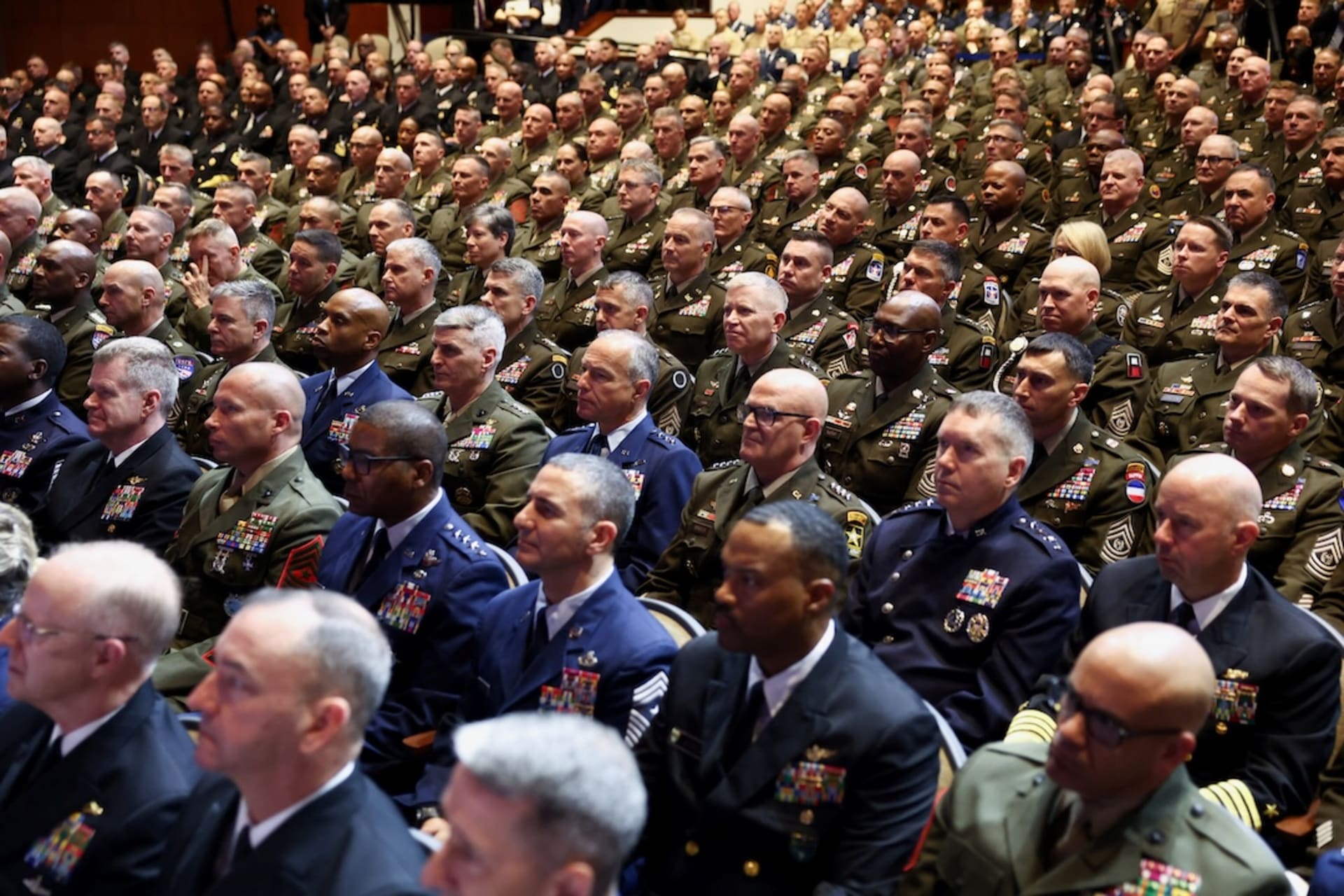
Trump and Hegseth gathered hundreds of officers yesterday and delivered a vision for U.S. military power increasingly focused on domestic missions, warning that those who disagreed should be prepared to exit the force. The assembly in Virginia brought in generals and admirals stationed around the world. Trump said that the armed forces should be used to fight an “invasion from within” and that U.S. cities should be used as military “training grounds.” Hegseth, for his part, said the U.S. military should “unleash overwhelming and punishing violence on the enemy” and eschew “stupid rules of engagement.” The address came as the administration has deployed federal forces to multiple U.S. cities, often against the wishes of local political leaders.
Further directives. Hegseth spoke first, calling for an end to “woke” culture and affirmative action policies in the U.S. military, saying that dissenters should leave the service. He argued that the military had strayed from its primary focus of winning wars, citing the Gulf War as a model conflict because it had a “limited mission with overwhelming force and a clear end state.” Trump claimed that several cities run by Democrats were unsafe and needed the military to “straighten them out” in an effort he likened to “war.” He also said the military’s role would include continued strikes on suspected drug traffickers abroad.
The context. Trump and Hegseth’s focus on domestic politics and criticism of political opponents were highly unusual for an address to military leaders. The U.S. military has a mandate to remain non-political and nonpartisan; officers mostly adhered to orders from top brass not to react during Trump’s address. The speech comes after Trump released a new national security memo last week on “countering domestic terrorism” that was criticized by civil rights groups as a gateway for cracking down on political dissent.
“There are a lot of concerning aspects of President Trump’s deployments of National Guard in areas where governors and mayors have not asked for them to be...you have to ask whether this is going to degrade our readiness for warfighting missions overseas.” —CFR expert Max Boot
Across the Globe
U.S. workers furloughed. Hundreds of thousands of State Department employees and Defense Department civilian workers are among those pausing work today due to the first government shutdown since late 2018. Other staffers of those and additional departments are required to work without pay, including active troops and border control officers. The Senate is expected to meet today regarding potential government funding measures.
UN vote on Haiti. The UN Security Council voted yesterday to expand an international security mission in Haiti from roughly one thousand personnel to more than five thousand. The multinational mission, in operation since June 2024, is authorized by a UN resolution but not run by the organization. Haiti’s transitional government requested the expansion, which the United States and Panama spearheaded at the Security Council.
Chinese policies on workers, investors. A new visa meant to attract foreign tech talent to China launched today. It does not require employer sponsorship. Separately, China yesterday began allowing foreign institutional investors to trade in its stock option market, part of Beijing’s bid for greater international use of the yuan.
Ruling on deportations. The Trump administration’s efforts to detain and deport international students for pro-Palestinian speech were unlawful, a federal judge ruled yesterday. He described the measures as a “truly scandalous and unconstitutional suppression of free speech” and said a required course of action would be decided at a future hearing. A White House spokesperson said the ruling “hampers the safety and security of our nation.”
Ukraine drone cooperation. Ukraine’s military is sending a mission to Denmark to share expertise on drone combat, Ukrainian President Volodymyr Zelenskyy announced yesterday. Romania’s government also hopes to establish joint drone production with Ukraine. The developments follow an agreement by European militaries last week to build a “drone wall” along their borders with Russia and Ukraine to better intercept airspace violations.
Japan-South Korea ties. Leaders of the two countries held their second summit in two months on Tuesday and pledged Seoul and Tokyo would remain close through Japan’s upcoming leadership transition. The rapprochement between two neighbors with historically strained ties crosses party lines in South Korea, having also been supported by the country’s previous president who hailed from another party.
U.S. deportations to Iran. The United States deported a planeload of Iranians to Tehran this week as part of an agreement between the two countries, an Iranian foreign ministry official said yesterday. Poor bilateral diplomatic relations in recent years have hindered cooperation on deportations. The wife and lawyer of one deportee said he was a political dissident who was forced onto the flight. A White House spokesperson said the move was in line with the Trump administration’s commitment to carry out the largest mass deportation operation in history.
Taiwan’s chip posture. Taiwan rejects a U.S. proposal to produce half of its chips in the United States, Vice Premier Cheng Li-chiun said today. Washington had discussed the proposal with Taipei as part of efforts to reshore U.S. manufacturing, U.S. Commerce Secretary Howard Lutnick said in a NewsNation interview that aired over the weekend. Trump has pledged to implement tariffs on chip imports, with exemptions for companies that manufacture in the United States.
What’s Next
- Today, the Global Cybersecurity Forum’s Annual Meeting begins in Saudi Arabia.
Tomorrow, the European Political Community meets in Denmark.
- Tomorrow, the U.S.-Japan Business Council’s flapship conference begins in Tokyo.