TWE Remembers: FDR’s “Four Freedoms” State of the Union Address
By experts and staff
- Published
 James M. LindsayCFR ExpertMary and David Boies Distinguished Senior Fellow in U.S. Foreign Policy
Barack Obama is set to give his State of the Union address this month. If it is like most such speeches, it will be hotly debated for a moment and then forgotten. (Quick, name the major theme of last year’s State of the Union address. I didn’t think so.) But a few State of the Union addresses do make a lasting impression. One such speech was President Franklin D. Roosevelt’s State of the Union address on January 6, 1941, better known today as the Four Freedoms speech.
[Video: https://youtu.be/QnrZUHcpoNA]

FDR had been elected two months earlier to an unprecedented third term. One reason he decided to run again—and Americans were happy he did—was the dire situation in Europe. World War II had been raging for sixteen months, and Nazi Germany held the upper hand. France had fallen in June 1940. Britain had narrowly escaped defeat with the evacuation of Dunkirk and suffered through the horrors of the Battle of Britain. The United States was officially neutral in the war, but FDR had been looking for ways to increase U.S. support for the Allies, which effectively meant Britain. In September 1940, he had struck the destroyers-for-bases deal with London, and in December he had proposed what would become the Lend-Lease Act. But he faced stiff resistance from non-interventionists like Col. Charles Lindbergh who argued that what happened in Europe had no bearing on America’s security and that FDR was risking war for no good reason.
So when Roosevelt stood before the joint session of Congress on January 6, 1941, a lot was at stake. His goal was simple: to persuade his fellow Americans that “the safety of our country and of our democracy are overwhelmingly involved in events far beyond our borders.” After a learned summary of the geopolitical conditions that had kept the United States safe for a century-and-a-half—how many other State of the Union Addresses refer to “the Maximilian interlude in Mexico”—Roosevelt argued that times had changed. With advances in technology it would be foolhardy to assume that the United States could ignore the dangers gathering beyond it shores:
In times like these it is immature—and incidentally, untrue—for anybody to brag that an unprepared America, single-handed, and with one hand tied behind its back, can hold off the whole world.
No realistic American can expect from a dictator’s peace international generosity, or return of true independence, or world disarmament, or freedom of expression, or freedom of religion, or even good business.
FDR went on to make the case for his Lend-Lease proposal. The United States would “manufacture additional munitions and war supplies of many kinds, to be turned over to those nations which are now in actual war with aggressor nations.” In that way, America would “act as an arsenal for them as well as for ourselves.
Roosevelt closed his speech by laying out his vision of the world the United States sought to create:
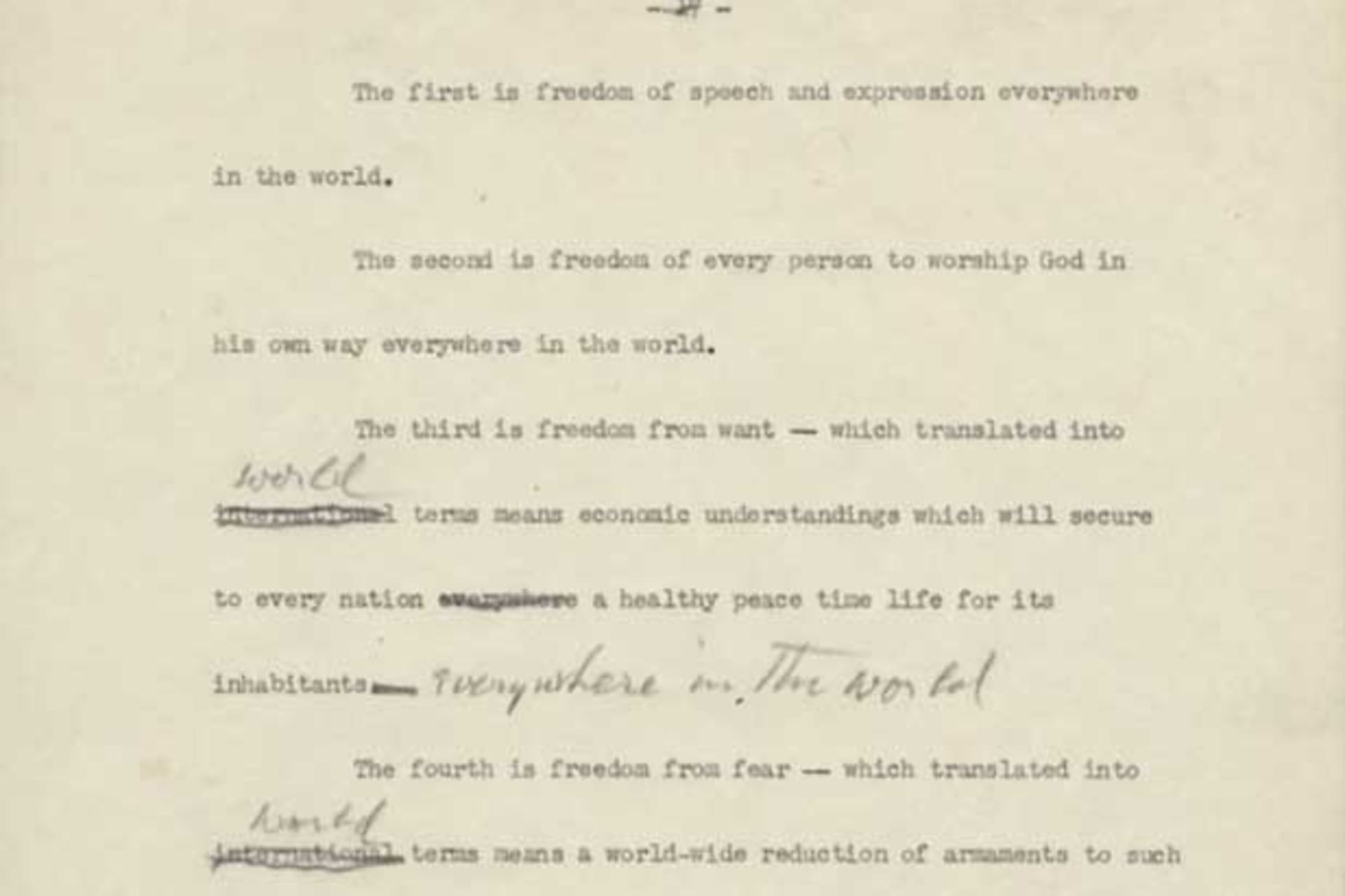
In the future days, which we seek to make secure, we look forward to a world founded upon four essential human freedoms.
The first is freedom of speech and expression—everywhere in the world.
The second is freedom of every person to worship God in his own way—everywhere in the world.
The third is freedom from want—which, translated into world terms, means economic understandings which will secure to every nation a healthy peacetime life for its inhabitants—everywhere in the world.
The fourth is freedom from fear—which, translated into world terms, means a world-wide reduction of armaments to such a point and in such a thorough fashion that no nation will be in a position to commit an act of physical aggression against any neighbor—anywhere in the world.
That is no vision of a distant millennium. It is a definite basis for a kind of world attainable in our own time and generation. That kind of world is the very antithesis of the so-called new order of tyranny which the dictators seek to create with the crash of a bomb.
To that new order we oppose the greater conception—the moral order. A good society is able to face schemes of world domination and foreign revolutions alike without fear.
While FDR’s speech hardly ended public debate in the United States over the relevance of the war in Europe for Americans, his four freedoms would eventually be embedded in the Atlantic Charter, the UN Charter, and the Universal Declaration of Human Rights. Norman Rockwell made painted four iconic paintings based on the four freedoms. More recently, Four Freedoms Park in New York City opened in 2010, and the Roosevelt Institute gives out annual awards “celebrating those whose life’s work embodies FDR’s Four Freedoms.”
Besides laying out a vision of the world that still guides U.S. foreign policy seven decades after his death, FDR also made a prediction in his State of the Union address that regrettably proved all too accurate:
When the dictators, if the dictators, are ready to make war upon us, they will not wait for an act of war on our part.
Eleven months and one day after FDR gave his Four Freedoms speech, the Japanese attacked Pearl Harbor.