Pakistan-Saudi Arabia Defense Pact
By experts and staff
- Published
- CFR Editors
Welcome to the Daily News Brief, CFR’s flagship morning newsletter summarizing the top global news and analysis of the day.
Subscribe to the Daily News Brief to receive it every weekday morning.
Top of the Agenda
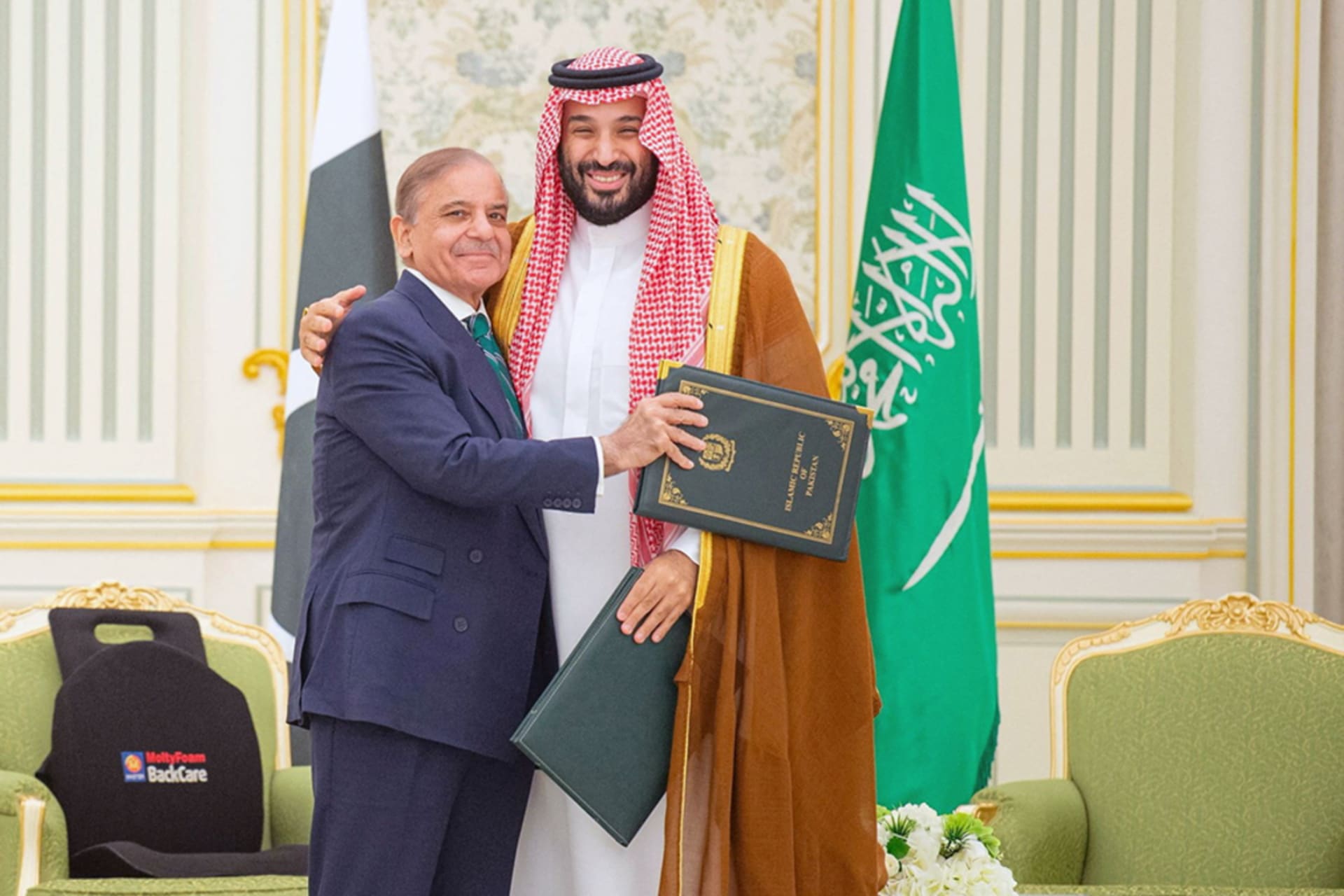
Saudi Arabia signed a mutual defense pact with nuclear-armed Pakistan yesterday that treats an attack on one as an attack on both. The announcement comes in the wake of Israel’s attack in Qatar last week. It stands to shake up the security architecture in the Gulf, where for years countries have relied on military partnerships with the United States as security guarantees. During the Biden administration, Saudi Arabia considered entering into a mutual defense deal with the United States in return for normalizing relations with Israel, but Riyadh says it has shelved those normalization plans due to the war in Gaza and lack of progress on a Palestinian state.
The details.
- The agreement commits Pakistan and Saudi Arabia to using “all defensive and military means deemed necessary depending on the specific threat,” an unnamed senior Saudi official told the Financial Times. It has been under development for “well over a year,” they added.
- Saudi Arabia has long cultivated a close defense relationship with Pakistan, which has an estimated 170 nuclear warheads as well as ballistic missiles with the range capable of hitting Israel, according to the Stockholm International Peace Research Institute. The institute also estimates Israel has around 80 nuclear weapons, though Israel does not publicly acknowledge having a nuclear program.
The context.
- The Israeli attack in Qatar last week was not the first time the Saudis questioned U.S. security guarantees: Washington did not retaliate militarily in 2019 when Iran attacked two of the most important oil facilities in Saudi Arabia.
- Saudi Arabia has diversified its security relationships in recent years, including growing closer to China, which brokered Saudi-Iranian normalization in 2023. The Biden administration’s draft security deal with Saudi Arabia was designed in part to counter Chinese influence in the Gulf.
- India, which clashed militarily with Pakistan earlier this year, said it “will study the implications of this development.”
- Israel and the U.S. State Department did not immediately respond to an Associated Press request for comment.
“The prospect of an all-out war in the Middle East—and Israeli dominance in the region—has put Saudi Arabia on the offensive. Riyadh has proactively recommitted to the cause of Palestinian statehood and sought to keep its strategic options open, engaging with the United States on the one hand and Iran and China on the other.” —Istituto Affari Internazionali’s Maria Fantappie and Kuwait University’s Bader Al-Saif, Foreign Affairs
Across the Globe
U.S. rate cut. The U.S. Federal Reserve cut its main interest rates for the first time this year, reducing them .25 percent such that the target range is between 4 and 4.25 percent. Fed chair Jerome Powell cited U.S. labor market weakness and little evidence of a “persistent inflation outbreak,” saying the “balance of risks” had moved in favor of a cut. President Trump’s newly instated appointee, Stephen Miran, voted to cut rates by double that amount.
EU-Indonesia trade talks. The European Union (EU) and Indonesia have concluded trade talks after almost ten years, spokespeople for both sides said yesterday. Officials are due to make an announcement in Indonesia next week. Although Indonesian objections to strict EU rules against deforestation slowed progress in the negotiations, Brussels has sought to accelerate trade deal approvals in light of Trump’s tariffs.
Plan for Russian funds. Brussels is considering using frozen Russian funds to back some $200 billion in loans for Ukraine, unnamed sources told the Financial Times. One version of the plan would reportedly use Russian central bank assets to buy zero-interest EU bonds, which would then be transferred to Kyiv. A Kremlin spokesperson said any such use of Russian assets “will not go unanswered.”
Argentina props up peso. The country’s central bank intervened to prop up the value of the local currency for the first time since lifting some currency controls in April—a move that was part of libertarian President Javier Milei’s pro-market reform program. The April measures allowed the peso to float freely between upper and lower limits. Milei faces midterm elections next month in what could prove to be a key litmus test for the reforms.
U.S. investments in UK. U.S. companies have pledged $200 billion in direct investments in the United Kingdom (UK) over the next ten years, London announced during Trump’s state visit today. The commitments include a roughly $136 billion pledge by asset manager Blackstone, $2 billion pledged by data tech firm Palantir, and plans to upgrade biomedical and rail facilities. Trump is meeting with UK Prime Minister Keir Starmer today.
DRC war continues. The Democratic Republic of Congo (DRC) and the M23 rebel group both say they are sending hundreds of fighters to the frontlines as their conflict escalates in spite of mediation efforts by Qatar and the United States. In June, Washington and Doha brokered a deal between the DRC and Rwanda, which the UN says backs the rebels. In July, Qatar brokered a deal between the DRC and the rebels, pledging to reach a peace agreement by August 18, but that deadline has come and gone.
India’s greener grid. Carbon emissions from the country’s power sector declined in the first half of 2025 compared to the same period last year—only the second such decline in around fifty years, according to the Centre for Research on Energy and Clean Air. The shift was driven by the growth of renewable energy sources and a drop in electricity demand. Carbon emissions from India, the world’s most populous country, have been rising steadily in recent years, with most emissions coming from its power sector.
Asylum seekers in Canada. Asylum claims at the Canadian border jumped 30 percent in the first half of 2025, government data showed. Haitians were the most numerous among those applicants, followed by U.S. citizens—often the children of undocumented immigrants, according to experts—and Venezuelans. The surge could be a product of increased immigration raids in the United States, the president of the Canadian Association of Refugee Lawyers said.