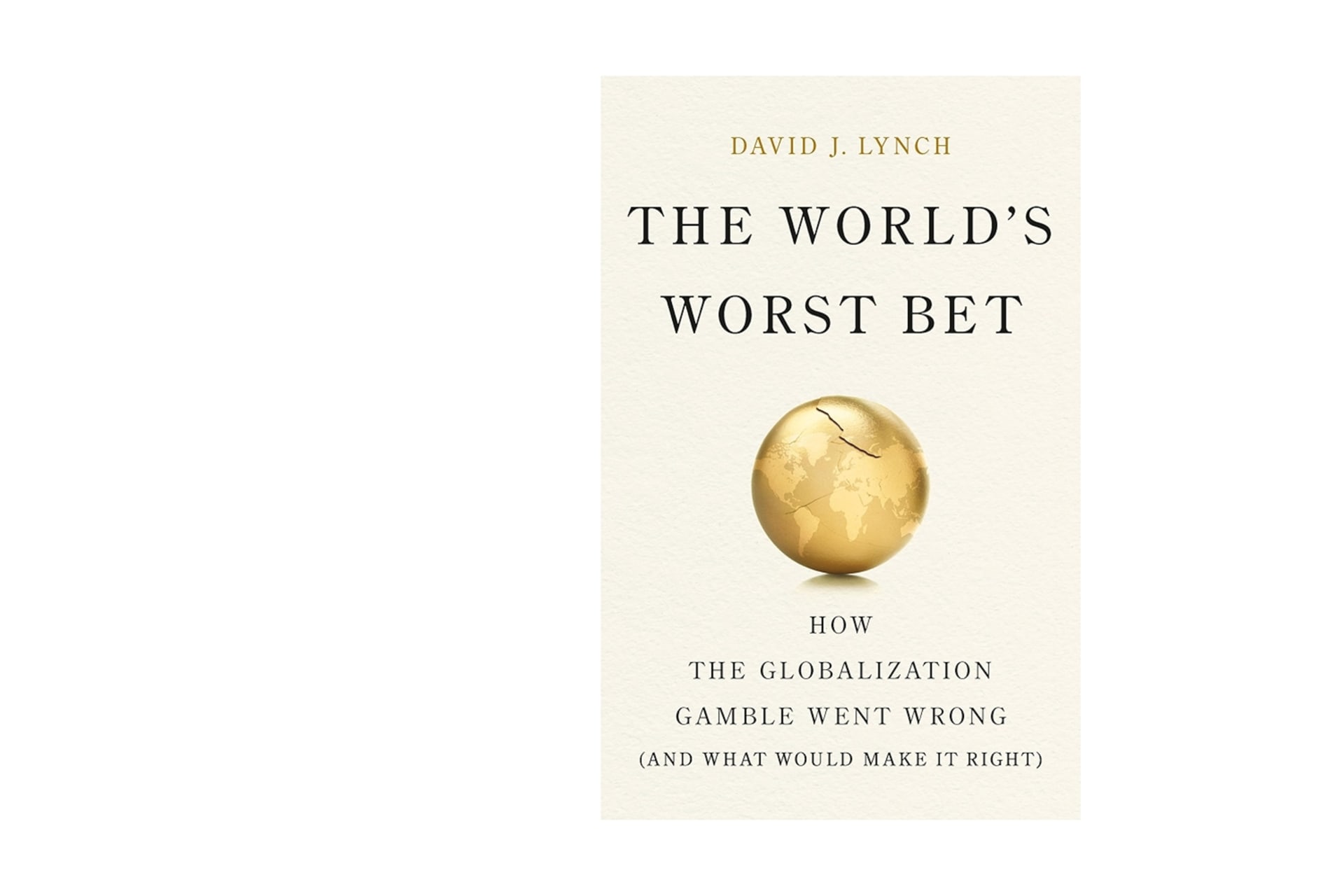
A Review of The World’s Worst Bet: How the Globalization Gamble Went Wrong by David J. Lynch
The book argues that the United States erred in embracing globalization. But many other policy decisions contributed to America’s current economic predicament—and raising trade barriers may prove as misguided as the mistakes it claims to correct.
By experts and staff
- Published
 James M. LindsayCFR ExpertMary and David Boies Distinguished Senior Fellow in U.S. Foreign Policy
The late 1990s were a heady time for the United States. The consensus earlier in the decade that the United States and the Soviet Union fought the Cold War but Germany and Japan won had faded. The U.S. economy was booming, the federal budget was running a surplus, and U.S. free-market capitalism was the envy of the world. The unipolar moment had arrived, history had ended, and the world was becoming flat. Other countries either had to follow the U.S. lead or be left behind.
A quarter of a century later, the world is no longer America’s oyster. The expected golden age of U.S.-led prosperity and democratic dominance has given way to economic uncertainty and authoritarian backsliding. Three of four Americans rate the state of the U.S. economy as either fair or poor, while the monitoring organization Freedom House has recorded nineteen straight years of decline in global freedom.
David J. Lynch, an award-winning global economics and finance correspondent for the Washington Post, seeks to explain what went wrong in his well-reported, but ultimately incomplete, new book, The World’s Worst Bet: How the Globalization Gamble Went Wrong (And What Would Make It Right).
The subtitle telegraphs Lynch’s argument: Washington failed to think through its embrace of globalization. “American leaders launched their unprecedented project of global integration for all the best reasons,” he writes. “But they did so without investing in the guardrails that were needed to make it safe for all segments of society.” The result is that “globalization went awry . . . because of policy choices, inaction, and error.”
Lynch’s argument is hardly novel. Both Democrats and Republicans have turned against globalization in recent years. The political winds now blow stiffly in the direction of protectionism, with the two political parties disagreeing only over how fast and how far to raise trade barriers.
Still, Lynch captures the triumphalist thinking that guided U.S. thinking three decades ago. President Bill Clinton argued in 1997 that globalization was “irreversible” and would trigger a virtuous circle of greater prosperity and freedom. The primary target of the latter was to be China. Free markets, aided by the liberating effects of new digital technologies, would empower the Chinese people while cementing U.S. economic and political leadership. Convinced by those claims, the United States supported China’s entry into the World Trade Organization (WTO) and granted China Permanent Normal Trade Relations status in 2000.
That confidence—or naivete—was bipartisan. The Republican Party is the tariff party in 2025, but at the century’s start it championed free trade. President George W. Bush opposed most of Clinton’s policies, but he agreed that trade with China would remake the communist regime. “My belief,” said the man from Midland, “is by trading with an entrepreneurial class in China it will enhance the spread of freedoms in China.” Few asked how globalization would reshape the United States.
The World’s Worst Bet focuses on this latter question. The failed political liberalization of China merits only passing mention, even though an extensive literature now exists on China’s political regression.
Washington learned quickly that economic integration would not be cost-free. By 2003, the Bush administration knew that China was ignoring many of its trade commitments, keeping the renminbi below its fair market value, and subsidizing domestic industries. Chinese exports to the United States surged, ushering in the “China shock.” The Bush administration responded with lectures that Chinese officials ignored. Stronger retaliatory actions all came with costs that Bush and his advisers were reluctant to bear. The result, as Lynch writes, was that “the United States was slow to press for real change.”
That too-little, too-late dynamic continued under President Barack Obama. By 2010, China was clearly hacking digital networks to steal intellectual property on an unprecedented scale. Yet it took the Obama administration three years to move from sending private diplomatic notes that Beijing ignored to publicly challenging the widespread theft. Obama secured a pledge from Chinese President Xi Jinping during a September 2013 White House visit to stop commercial spying. The halt was temporary.
The Bush and Obama administrations were equally slow in helping Americans hurt by globalization. That failure partly reflected Bush’s hostility to government intervention in the market and Obama’s inability to pass significant domestic policy initiatives once the Tea Party arrived in Washington. But as Lynch shows, the neglect of workers hurt by trade started long before globalization became official policy. The Trade Adjustment Assistance program has been underfunded and of limited reach since its creation in 1962. That failure owes in part to the ambivalence that labor unions have toward helping people transition to new industries. As Lynch quotes one former union head: “My job is not to care about future jobs for American workers. My job is to keep the jobs that my workers have now.”
No one knows whether more forceful responses from Washington would have changed how globalization unfolded. Counterfactual history can produce whatever outcome one desires. By the same token, the challenges that globalization unleashed do not by themselves establish that resisting economic integration would have been the wiser choice. As Lynch notes, globalization created winners as well as losers in the United States. An earlier embrace of economic nationalism might have meant significantly less prosperity and a different set of political challenges.
We are left only with the history we have. And the story Lynch tells only partly explains the United States’ current predicament. Although he stresses how trade undid the U.S. economy and politics, he occasionally acknowledges that technology likely eliminated far more jobs. Indeed, manufacturing was declining as a share of overall jobs long before the United States welcomed China into the WTO.
But the forces driving the current moment do not end with technology. It was not globalization that drove the United States to squander its blood, treasure, and reputation on the invasion of Iraq. It was not globalization that drove the United States to ignore the subprime mortgage lending risks that triggered the global financial crisis in 2007 and upended so many American lives. It was not globalization that drove the United States to pursue lax border policies despite growing public opposition. It was not globalization that drove the United States to run persistent budget deficits, tilt the tax code to encourage corporations to book their profits overseas, underinvest in infrastructure and people, or sustain a health-care system that is both expensive and underperforming. Had the United States chosen differently on even a few of those issues, the U.S. economy and American politics might look far better today.
However historians apportion the blame for why the promise of the late 1990s gave way to the turmoil of the 2020s, the question for policymakers is what to do next. Here Lynch has relatively little to say—contrary to what his subtitle promises—and what he does say will likely surprise readers who reach his concluding chapter. In his view, globalization—or what he suddenly renames “hyper-globalization”—remains a bad bet that has reached its end. However, “globalization itself is not ending, only changing.” (Perhaps Clinton was right after all about globalization’s inevitability.) In Lynch’s view, reversing the U.S. integration into the global economy is too difficult and expensive to achieve, and “industrial policy will not deliver a meaningful renaissance in factory employment.” Indeed, the risk today may be “overcompensating” for yesterday’s errors.
Rather than fighting the last war, Lynch calls for preparing for the next one—the economic upheaval that artificial intelligence is unleashing. Preparing for that tsunami, which will “make globalization look like peanuts” in the words of one of Lynch’s interviewees, requires enacting policies the United States has long avoided: shoring up and expanding the social safety net, rewriting the tax code to curb tax avoidance and make corporations pay more, creating better and broader workforce development programs, and encouraging regional economic development.
Lynch no doubt is right that artificial intelligence is presenting challenges that policymakers should anticipate and address. But if his history of the past three decades shows anything, it is that Washington sticks to its policies long past their sell-by date. With Donald Trump channeling his inner Tariff Man, Washington’s war on globalization will continue for some time. If so, Lynch’s next book might be on how the anti-globalization gamble went wrong.