Council of Councils
 Think Global Health
Blogs
The Internationalist
Latest Post
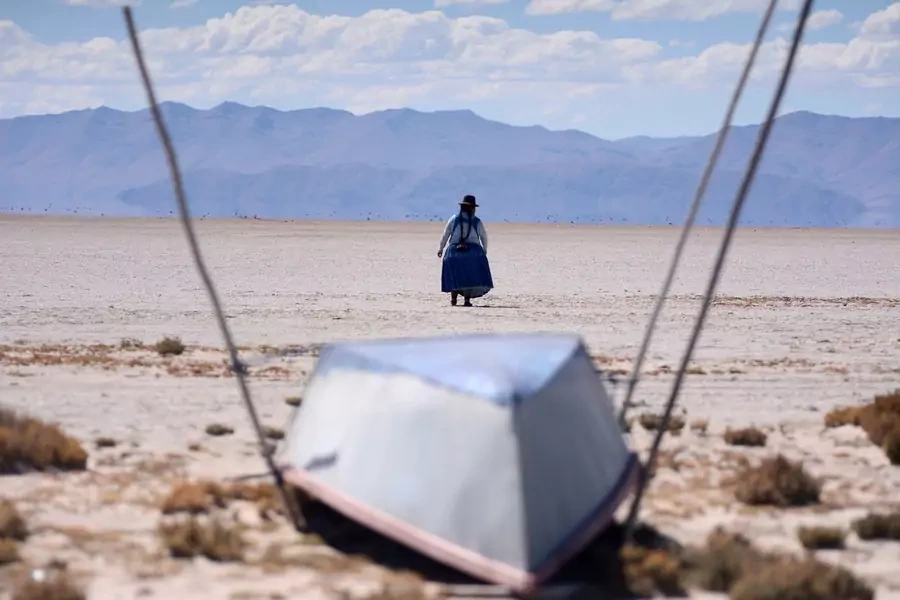
The Crisis of the Century: How the United States Can Protect Climate Migrants
The disastrous effects of climate change could displace more than a billion people in the next thirty years. International and domestic legal systems cannot continue to let climate migrants slip through the cracks.
How U.S. Allies Are Adapting to "America First"
In a new postscript published in Foreign Affairs, I analyze the evidence of countries hedging against the United States after one year of President Trump’s “America First” agenda.
At the dawn of the administration of U.S. President Donald Trump, I predicted in Foreign Affairs that Trump’s “America first” agenda would set in motion tectonic forces beyond his control. As the ground shifted beneath their feet, longtime U.S. allies would lose confidence in U.S. leadership and credibility. They would adapt by hedging their bets, moving away from alignment with a United States no longer willing to promote and defend the liberal world order that it had sustained since 1945. The evidence for this hedging would be in adjustments by U.S. allies to their approaches toward geopolitics, economics, and climate change. One year after Trump’s inauguration, the liberal order has not collapsed. But it is in distress as the president turns his back on the world the United States made to embrace a nationalist and isolationist foreign policy.
Read the full article here.
To Strengthen Trump’s National Security Approach, Promote Human Rights
The following is a guest post by John B. Bellinger III, adjunct senior fellow for international and national security law at the Council on Foreign Relations, and Richard Fontaine, president of the Center for a New American Security.
In a series of tweets on New Year’s Eve, President Donald J. Trump expressed strong support for Iranians protesting against their autocratic regime. He added that the United States would be “watching very closely for human rights violations!” The president’s pronouncements have been valuable in emphasizing the importance of human rights in Iran. They also mark something of a departure for an administration that has only episodically expressed concern for the protection of fundamental freedoms abroad.
Given the president’s recent focus on human rights, it’s disappointing that the administration’s National Security Strategy, which was released on December 18, gives human rights such short shrift. The NSS emphasizes many familiar Republican foreign policy themes, like the need to deal with China and Russia, confront North Korea and Iran, protect against terrorism and increase military strength—and for those supportive of U.S. global leadership, there is much to like. But the omission of any mention of promoting human rights as a national security priority is striking, and unfortunate. The human rights effort has long been a priority in Republican as well as Democratic administrations. Done right, supporting human rights strengthens, rather than weakens, American national security.
The National Security Strategy is not wholly silent on issues like freedom and democracy. Indeed, a small portion of the document commits the administration to support individual dignity, freedom, and the rule of law. Such good things, however, are cast as “American values,” rather than rights to which all people are entitled. The strategy does make several references to “individual rights” but the term “human rights” appears just once to warn that the United States will deny admission to “human rights abusers.”
Yet acknowledging the existence of universal human rights, and America’s critical role in protecting and promoting them, is more important today than in many years. In its latest 2017 report, Freedom House observed the eleventh consecutive year of decline in global freedom. Sixty-seven countries suffered net declines in civil liberties and political rights, against just thirty-six that posted gains. And the human rights situation has deteriorated not only in the usual dictatorships but also among friends and allies like Turkey, Ethiopia, Hungary, Bahrain and Azerbaijan.
Where the NSS does reference a U.S. role in expanding democracy and freedom, it is largely one of inspiration rather than active promotion. This is America as city on a hill, a shining beacon but little more. “We are not going to impose our values on others,” the document assures readers. “The American way of life cannot be imposed upon others, nor is it the inevitable culmination of progress.”
It precisely because such freedoms are not inevitable that America must play an active role in protecting and advancing them. This requires their vigorous promotion—the United States as actor as well as exemplar. Embracing the cause of basic rights and freedoms gives purpose and direction to America’s role in the world, beyond its narrowly-construed national interests. And it is consonant with precisely those American values that the National Security Strategy is at pains to highlight.
Standing up for fundamental rights abroad does something more: It makes the world safer for Americans and makes us stronger. The NSS acknowledges this implicitly, noting, “Governments that respect the rights of their citizens remain the best vehicle for prosperity, human happiness, and peace.” Given Trump’s repeated emphasis on the importance of national strength and restoring international respect for the United States, his administration should recognize that America is respected around the world not merely for its military might and strong economy but equally for its commitment to human rights and the rule of law.
As the Trump administration begins to implement its new strategy, there are three reasons why it should embrace, rather than reject, a human rights agenda.
First is to resist growing restrictions on freedom in the world. U.S. leadership is necessary to reverse this trend. Human rights will never represent the America’s only foreign policy objective and often will not be the top agenda item in key foreign relationships. But efforts to promote human rights should be interwoven with all else we seek to achieve. The decline in freedom will very likely accelerate the longer America is out of the game.
Second is the general disillusionment with human rights and democracy promotion at home and abroad. Disasters in Iraq and Libya, the Arab Spring’s failures, China’s combination of power and repression, and backsliding in places like Myanmar have all increased doubts about both liberalism’s staying power and America’s ability to aid it. There have been deep disappointments but great successes as well, and Washington should examine the drivers of that distinction and act on the lessons.
The third reason is about us. The NSS argues that “America First” means more than safeguarding our security and prosperity at the expense of any others. But the world—and many Americans—genuinely wonder about the Trump administration’s lack of international altruism. A fulsome embrace of human rights would demonstrate to all the country’s nobility of purpose at a time when confidence in the United States is shaky.
All this would require a shift of presidential emphasis and philosophy. We must hope that the president’s support for freedom in Iran reflects a new recognition of the role that the United States—and the president himself—play in championing human rights around the world. If the president declines to play this role, Congress and civil society will need to increase their own efforts to ensure that the United States continues to promote international human rights. It’s critical that they do so. Few efforts could be better tailored to making America great again.
This post originally appeared on Lawfare, published in cooperation with the Brookings Institution.
Trump and Wilson's Ghost: The Fourteen Points Turn 100 year
In an op-ed recently published in the Hill, I contrast President Donald J. Trump’s transactional and cynical diplomacy with President Woodrow Wilson's Fourteen Points, which turn one hundred today.
One year into his presidency, Donald Trump’s worldview is clear. He has abdicated global leadership and renounced the international order that America made. His purely transactional, nakedly cynical diplomacy rejects longstanding U.S. support for collective security, multilateral trade, and democracy. How different from the idealistic Woodrow Wilson, the prophet of internationalism who issued his famous blueprint for a liberal world order, the Fourteen Points, exactly a century ago. Wilson had reluctantly taken the nation to war in April 1917. But once the United States was engaged, he renounced traditional war aims, insisting that the nation pursue a new world order informed by American principles.
Read the full op-ed here.
Year One of America First: Global Governance in 2017
Coauthored with Anne Shannon, former intern in the International Institutions and Global Governance program at the Council on Foreign Relations.
After President Donald J. Trump’s election last fall, many experts predicted that 2017 would be a tumultuous year for international cooperation. During his campaign, Trump promised to “make America great again” by renegotiating or renouncing “bad” and “unfair” international agreements, and questioned the value of international institutions. Since January, Trump’s “America First” policies have seen the United States abdicate its global leadership role. Yet contrary to expectations, multilateral cooperation on pressing issues like climate change and migration has continued, as other states have stepped up to lead. Despite all the tumult, the world has recorded several important achievements for multilateralism alongside the setbacks.
Climate Change
Trump’s largest blow to international cooperation came in June when he announced his intention to withdraw the United States from the Paris Climate Accord. Early reactions suggested that other countries might respond in kind, reneging on their commitments and stalling overall progress on environmental governance. Nevertheless, this November’s climate conference in Bonn, aimed at finalizing aspects of the Paris Agreement, was a success. Participating states secured additional funding for climate initiatives and agreed to several objectives in the fields of agriculture, indigenous rights, and gender equality in climate governance.
French President Emmanuel Macron, who has made combatting climate change a signature policy, hosted a separate global climate conference this December, raising additional funds to meet Paris commitments. And while the Trump administration signaled its intent to abandon the agreement, many U.S. states, cities, and companies have stepped into the void, pledging commitments of their own. The successes in Bonn and Paris, combined with near-unanimous international support for the Paris Accords, indicate that multilateral cooperation on climate change will continue without U.S. leadership, even if the politics look challenging.
Global Trade
Trump’s protectionist campaign positions suggested that global trade would take a beating in 2017. Experts warned of trade wars, predicting that a downward spiral of tit-for-tat measures could strangle economic growth. In fact, according to the International Monetary Fund (IMF), global trade in goods and services increased, growing 4.2 percent in 2017, almost twice the growth registered in 2016. Despite Trump’s decision to pull the United States out of the Trans-Pacific Partnership (TPP) and threats to pull out of the North American Free Trade Agreement (NAFTA), neither deal is dead yet. The remaining TPP members revived the idea of trans-pacific trade at the Asia-Pacific Economic Partnership (APEC) summit in November, making significant progress without the United States toward what is now known as the Comprehensive and Progressive Trans-Pacific Partnership (CPTPP).
Even as extreme U.S. demands stall NAFTA renegotiations, U.S. public support for NAFTA increased in 2017, pressuring the Trump administration not to withdraw from the agreement. While the United States has abdicated global trade leadership, the European Union (EU) has made progress on several important agreements of its own, notably one with Japan, encompassing countries that account for over 30 percent of the world’s GDP. The EU-Japan agreement will reduce the ability of the United States to set world product standards and other regulations—disadvantaging U.S. exports in the process. In exercising his America First strategy, President Trump could actually hurt U.S. businesses. Reinforcing this possibility was the disappointing December WTO ministerial meeting in Argentina, in which parties failed to reach any significant multilateral deals.
Migration
Trump has continually and publicly expressed negative opinions about immigrants, particularly (although not exclusively) illegal ones. He demands a wall between the United States and Mexico and has signed several executive orders attempting to halt refugee admissions, as well as ban immigrants from various Muslim-majority countries. Nevertheless, international efforts to cooperate on migration issues have continued, notwithstanding certain setbacks.
In December, Mexico held multilateral negotiations toward a Global Compact on Migration, despite the United States withdrawal from the negotiating process. In November, the African Union-European Union summit saw both blocs condemn the situation of migrants in Libya and pledge to work toward a joint migration task force. All is not rosy, of course. According to Amnesty International and other groups, EU governments remain complicit in the Libyan migrant crisis. Elsewhere, Australia closed a refugee camp on Manus Island in Papua New Guinea, while Bangladesh and Brazil struggled to accommodate influxes of refugees across their borders.
Nuclear Proliferation
Despite Trump’s decision not to recertify the “terrible” Iran deal, the Joint Comprehensive Plan of Action (JCPOA) remains alive. Europe strongly condemned Trump’s decision, and along with China and Russia, pledged to remain committed to the JCPOA as long as Iran complies, even if the United States backs out. Were such a breakdown between the United States and other permanent UN Security Council members (as well as Germany) to occur, the U.S.-led sanctions regime against Iran could well disappear as European, Chinese, and Russian firms deepen business ties with Iran. The continued success of the JCPOA is also vital for the prospects of a peaceful resolution of tensions with North Korea. Indeed, some argue that the JCPOA could be a blueprint for a similar agreement with North Korea. By contrast, the United States would lose any negotiating credibility with North Korea if the Trump administration pulls out of the Iran agreement.
International Institutions
Global governance has held ground in 2017 in other, less publicized, ways. The IMF and the World Bank, unlike other multilateral institutions, have largely escaped Trump’s criticism. Although several senior administration officials have long histories of disliking the IMF and World Bank, savvy diplomacy by Jim Yong Kim and Christine Lagarde seems to have placated the Trump administration so far.
President Trump has also backpedaled on some of his criticisms of international alliances and organizations. After repeatedly calling the North Atlantic Treaty Organization (NATO) obsolete on the campaign trail, Trump deemed NATO “no longer obsolete” in April after meeting Secretary-General Jens Stoltenberg. Trump also toned down his rhetoric on the United Nations. In April he called the organization “unfair” and an “underperformer;” in September the president tweeted that the “United Nations has tremendous potential.” (Whether this rapprochement will withstand the UN General Assembly’s condemnation of the unilateral U.S. recognition of Jerusalem as Israel’s capital remains to be seen.)
America First’s Future
Looking forward to 2018, it is difficult to predict how Trump’s America First agenda will affect global governance, particularly with a notoriously unpredictable president. It is possible that Trump will continue to renege on some campaign promises. Moreover, midterm elections in November could severely cripple his ability to pass nationalist-minded legislation. Still, he retains significant leeway, should he choose to use it, to undermine NAFTA, the JCPOA, and other international agreements through executive action.
Regardless of the president’s choices, his actions cannot overturn a fundamental contemporary reality—namely, that transnational challenges require global solutions. The lesson of 2017 is that other states are willing to step forward to fill some of the leadership roles vacated by the United States. In pulling back from international cooperation, Trump is forfeiting the United States’ historically important role in shaping international norms and multilateral policies. Nations that are willing to pick up the slack, whether under authoritarian regimes (like China) or democratic leadership (like France), will shape international rules and institutions to conform to their own priorities, not necessarily American ones. And they will not be eager to give up their new-found influence if and when the United States decides it wants the reins of global influence back.
Ten Global Summits to Watch in 2018
In a new CFR Expert Brief, I list the ten global summits to watch in 2018.
Is President Donald J. Trump’s America First approach to foreign policy compatible with international cooperation? That question will become even more prominent in 2018, as world leaders gather for ten pivotal meetings. Collectively, these summits will reveal whether the Trump administration’s first year was an aberration or the start of a post-American world.
Read the full Expert Brief here.