Echoes of Reykjavik: What Trump Can Learn From a Failed Summit
A dramatic Iceland meeting between Ronald Reagan and Mikhail Gorbachev showed that success lies not in understanding what the other side thinks but in changing it.
By experts and staff
- Published
 Stephen SestanovichCFR ExpertGeorge F. Kennan Senior Fellow for Russian and Eurasian Studies
Stephen Sestanovich is the George F. Kennan senior fellow for Russian and Eurasian studies at the Council on Foreign Relations.
President Donald Trump must be tired of all the stern exhortations, especially from European officials and commentators, not to let his summit with Russian leader Vladimir Putin become “another Munich.” (Ditto for “another Yalta.”) Everything about this advice is at odds with the way Trump most likely sees the meeting. It tells him not to be too friendly to Putin, when we know he thinks good personal relations are the key to solving problems. Worse, it implies the president could end up selling out Ukraine, just as British Prime Minister Neville Chamberlain let Adolf Hitler start annexing his neighbors after they met in Munich. Worst of all, these warnings may sound to Trump like a clamor for war. That, we should remember, is what Chamberlain would have gotten by standing tall against Hitler in 1938.
So, let’s try another summit analogy, one that compares Trump to strong leaders, not weak ones, that allows him to have a cordial sit-down with a visiting tyrant and open up vistas of peace and reconciliation—but only on terms favorable to the United States. A tall order, you might think, but there’s a meeting between Russian and U.S. leaders that passes all these tests: Ronald Reagan’s two days of talks with Mikhail Gorbachev at Reykjavik in October 1986. Not only was the Reykjavik summit a landmark in East-West relations, there’s even some reason to think it influenced Trump’s thinking. Having published his book, The Art of the Deal, less than a year earlier, Trump had become a kind of celebrity expert on bargaining and began to take a greater interest in international negotiations. (On this, more below.)
Historical comparisons are always imperfect—and subject to misuse—but a look back at the Reagan-Gorbachev meeting in Iceland almost forty years ago shows real parallels to this week’s session between Trump and Putin and the choices the U.S. president could make.
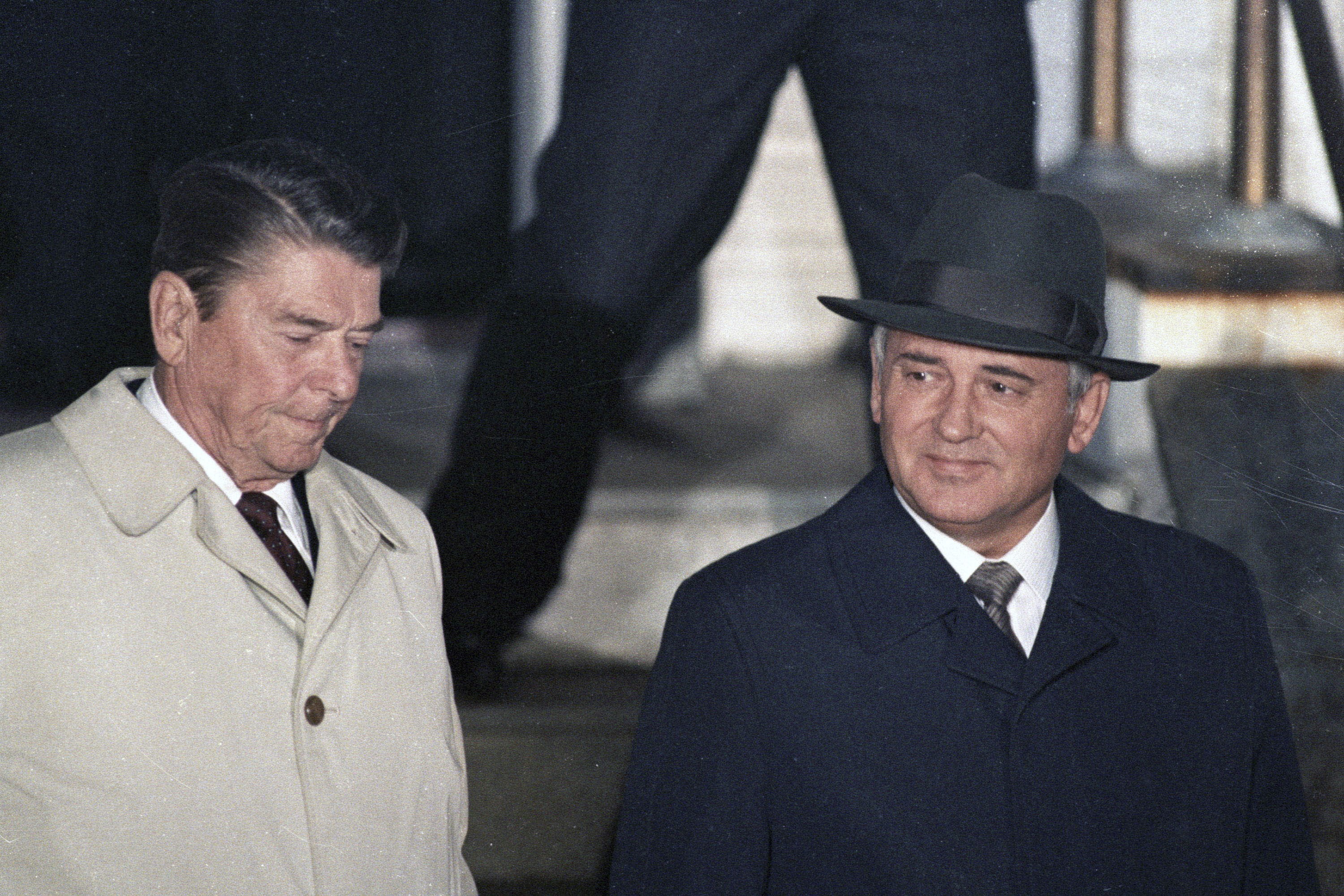
The 1980s, remember, were a time of acute international tension, reviving fears of nuclear war that had not been felt for many years. European governments and publics, while prizing transatlantic unity, were suddenly anxious about the direction of U.S. policy. Reagan and Gorbachev had agreed to hold a summit in 1986 in hopes of fashioning a major new arms agreement, but their negotiators had proved unable to make much progress. And so, on short notice, with too little preparation and next-to-no U.S. knowledge of what Moscow could be cooking up, the Reykjavik meeting was arranged. It wasn’t a “summit,” Reagan administration spokesmen insisted, just an interim opportunity for the two leaders to put futile-seeming negotiations back on track.
Sound familiar? The Reykjavik agenda was, of course, radically different from what will be on the table in Alaska: Its focus was the nuclear danger, especially Reagan’s hope to build a shield against future long-range ballistic missiles, known as “SDI,” for Strategic Defense Initiative. (Trump has a grander, developer-inflected name for his own version of the same program, the “Golden Dome.”)
By contrast, Putin and Trump will focus more on the here and now—Russia’s ongoing attempt to conquer its largest European neighbor. Yet it’s not hard to imagine many similarities between the two encounters. In Anchorage, as in Reykjavik, there will be a more or less easy familiarity between the two leaders. (Reagan’s most Trumpian moment at the summit was his suggestion to Gorbachev that they return to Iceland ten years after sealing a deal and “give a tremendous party for the whole world.”) There will be hours of closeted conversation between the presidents, while aides and advisors fret over what they might be agreeing to.
There will doubtless be some surprise proposals, too, and haggling over how to address them, so that Trump and Putin can emerge saying it was all worthwhile. At Reykjavik, Gorbachev—who badly wanted a deal—was both persistent and inventive in offering inducements for Reagan to accept his ideas; some U.S. officials, super-hardliners included, found them very intriguing. Expect more of the same in Alaska.
For all the similarities, however, there is one giant difference between the way the Iceland meeting played out and what Trump hope for from Alaska. After almost two days of talks, Reagan stood up, declaring that Gorbachev was asking too much, that he was trying to undermine hopeful possibilities for future global security, and that the summit was over. “Let’s go, George,” he said to Secretary of State Shultz, “we’re leaving.” No joint statement, no agreement on a further meeting, no attempt to pretend there had been progress. And little attempt, in parting, to jolly up the Russian leader, who returned to Moscow telling his colleagues that Reagan was a “feeble-minded caveman.”
President Trump, to say the very least, wants more than this from his meeting with Putin. Reykjavik will sound to him like a total downer. Even so, he needs to understand its astonishing aftermath. Despite (or perhaps because of) the blow-up at the end, Reykjavik was followed by the most productive period of Soviet-American relations ever. A year later, Gorbachev came to Washington to sign a nuclear arms control agreement, on intermediate-range ballistic missiles, that accepted U.S. proposals in their entirety. He also told Reagan he was cutting off military aid to Soviet clients in Nicaragua, with Afghanistan soon to follow. Reykjavik became the pivot for a fundamental reorientation in Moscow’s approach to European security and of the institutions and assumptions on which years of East-West hostility had rested. While claims about historic turning points are always controversial, this one is easy: Reagan stiffed Gorbachev, and as a result, the latter’s approach to relations with the West became steadily more cooperative.
Trump—and the rest of us—can learn a lesson from this story. The president has said he hopes to find out what Putin “has in mind,” and that once he figures that out (it might only take “two minutes”), he’ll be ready to come home. What Reykjavik shows is that a meeting like this is not simply an opportunity to find out what’s on the other guy’s mind. It’s a chance to change it.
Right now, most expert analyses of Putin’s thinking see him as convinced that Russia’s military position is getting steadily stronger, and that a settlement securing something close to his original maximalist war aims is in reach. Yet these same analyses often add that Putin knows the next year or so will bring potentially severe economic challenges. A recession may already be underway; export earnings are down; the budget deficit is up; a chain of bankruptcies looms; and so forth.
For Trump, Alaska is an opportunity to change the way Putin balances these two equally plausible realities. He should want the Russian leader to return home, having heard that his friend in Washington will do everything he can to help Ukraine weather the challenges of the moment, help turn back Russian military gains, and ensure that Putin faces economic stringency sooner rather than later.
The unconditional ceasefire, followed by negotiations, that Ukraine and European governments favor as a way to stop the fighting surely strikes Putin as a breather that Kyiv doesn’t deserve and that will keep Moscow from getting what it wants. Trump’s challenge is to shake that conviction.
Not long after the Reykjavik summit, with new arms control talks underway and The Art of the Deal a surprise bestseller, Donald Trump had a little-known opportunity to advise U.S. negotiators on how to handle their first interactions with Russian counterparts. Years later, one of them summarized the future president’s recommendations for me. Trump’s alleged advice to the head of the U.S. delegation: Once both teams have assembled for their opening session, walk into the negotiating room, locate your counterpart on the other side of the table, stand in front of him, poke a finger right in the middle of his chest, shout an expletive, and storm out.
Was Trump trying to do Reykjavik one better, or was he perhaps joking? (Or had my friend embellished the story?) We know this isn’t how the president will start, or end, this meeting with Putin. And he shouldn’t. He doesn’t really need drama to act on Reykjavik’s most important lesson. Alaska offers an opportunity to make clear that Russia cannot win its war, and that it will pay a steadily increasing price for trying to do so. Let Putin hear that message, and he’ll have a long, lonely flight home.
This work represents the views and opinions solely of the author. The Council on Foreign Relations is an independent, nonpartisan membership organization, think tank, and publisher, and takes no institutional positions on matters of policy.