The Great Aid Recession: 2025’s Humanitarian Crash in Nine Charts
The world faces unresolved conflicts, growing climate crises, attacks on aid workers, two famines, and diminishing political will—along with significant aid cuts. Altogether, 2025 has earned a grim new superlative: the worst humanitarian year on record.

Sam Vigersky is an international affairs fellow at the Council on Foreign Relations.
On a cool Geneva morning in early December 2024, Tom Fletcher, the United Nations’ newly appointed under-secretary-general for humanitarian affairs, entered the stately Palais de Nations to launch the 2025 Global Humanitarian Overview (GHO).
“The world is on fire,” Fletcher told journalists, bobbing his head for effect, “and this is how we will put it out,” a copy of the GHO raised in his right hand.
More of a technocratic roadmap than fire hose, the GHO is nonetheless the United Nations’ signature humanitarian product. Equal parts planning instrument and communications playbook, it forecasts who needs help, where and why they need it, and what interventions could alleviate their suffering—along with the costs.
At the agency Fletcher now led—the UN Office for the Coordination of Humanitarian Affairs (OCHA)—there were plenty of aid efforts that needed to get off the ground. The staff made no secret of the challenges the world faced: unresolved conflicts, growing climate crises, record attacks on aid workers, anemic funding, and diminishing political will to do much about any of it. UN ambassadors in New York were no more reassuring: the year ahead, they explained, would be as difficult as any his eleven predecessors had faced.
The 2025 GHO was titled, “Strengthening Global Solidarity and Empowering Local Communities.” It targeted 189 million people in need across 42 emergencies, with a price tag of $47.4 billion. In Geneva, Fletcher said the document filled him with shame, dread, and hope. Back in New York, UN Secretary-General Antonio Guterres called the document “an indictment of our failings as an international community.”
What neither man—nor anyone outside the dining room at Mar-a-Lago that December—could have fully foreseen was the uncontrolled burn the second Trump administration had in store for 2025. The cuts were so severe that Americans would collectively spend more on their Halloween candy in 2025 than their government did on life-saving humanitarian aid, according to data from the National Retail Federation.
The preceding four years, of course, were no cakewalk. COVID-19 and Russia’s full-scale invasion of Ukraine nearly doubled the cost of global humanitarian appeals between 2019 and 2022. Governments leveled up with record cash, peaking at $30 billion in 2022. As wars in Gaza and Sudan broke out in 2023, appeals pushed higher. This time, however, many donors did not. Three years later, most had walked back their ambition, forcing the United Nations and its partners to curtail life-saving programs.
By late 2024, a financial contraction was already underway. Germany, the second-largest humanitarian donor, slashed billions as part of Berlin’s austerity measures. Citing COVID-era economic pressures, the United Kingdom cut $1 billion in 2021 and never restored those funds. Saudi Arabia, an emerging humanitarian heavyweight and the largest Gulf donor, pulled hundreds of millions, while Japan cut $500 million from its high just two years prior.
And then there was the United States. While nominally flat between 2023 and 2024, its humanitarian spending declined as well—$3 billion from 2022’s peak because of Ukraine. Still, the United States continued to carry nearly 40 percent of all humanitarian funding, a near-record share of the burden.
With fewer dollars to work with, UN agencies began laying off staff. Acute food insecurity surged to all-time highs in 2024, affecting 295 million people.
UN officials spoke of donor fatigue and pledged to connect the dots between aid and the public. Some admitted that they hadn’t expected the wheels to come off the international system—but they remained clear-eyed that this was where matters stood as 2025 approached.
While the UN was a frequent target of Trump in his first term, humanitarian budgets actually increased substantially between 2017 and 2021. Cuts seemed likely this time around, but many at the United Nations assumed that the tallest mast on its humanitarian ship would hold.
Within a week of Trump’s inauguration, that assumption collapsed.
On January 20, 2025, an executive order paused new obligations and called for a ninety-day review of all U.S. foreign assistance. On January 24, stop work orders were issued for all existing aid programs. By February 2, USAID’s website went dark. And in the eleven months that followed, chaos and confusion gave way to downright demolition.
Even a private sector funding plan, which was to supplant some of the cuts, never truly materialized. In 2025, sixty-two donor governments contributed more than $380 million to the UN Central Emergency Response Fund. Just five private contributions were made, the largest one being two million dollars from donor “QC,” which is still listed as pledged.
The private sector has been frequently invoked by the UN, nongovernmental organizations (NGOs), and donor governments as an important solution to humanitarian needs. While individual UN agencies including UNICEF, the World Food Program (WFP), and the UN Refugee Agency have had decent success in doing so, UN OCHA has so far been unable to bring private finance off the sidelines to support their programming.
The prospect for the future does not appear much brighter. A year after Fletcher first took his role at UN OCHA, he announced the launch of the 2026 GHO. Its verdict is devastating and damning.
Total funding has dropped to 2016 levels. Thousands have lost their jobs. Most importantly, the percentage of UN-assessed needs that remain unmet spiked startlingly high.
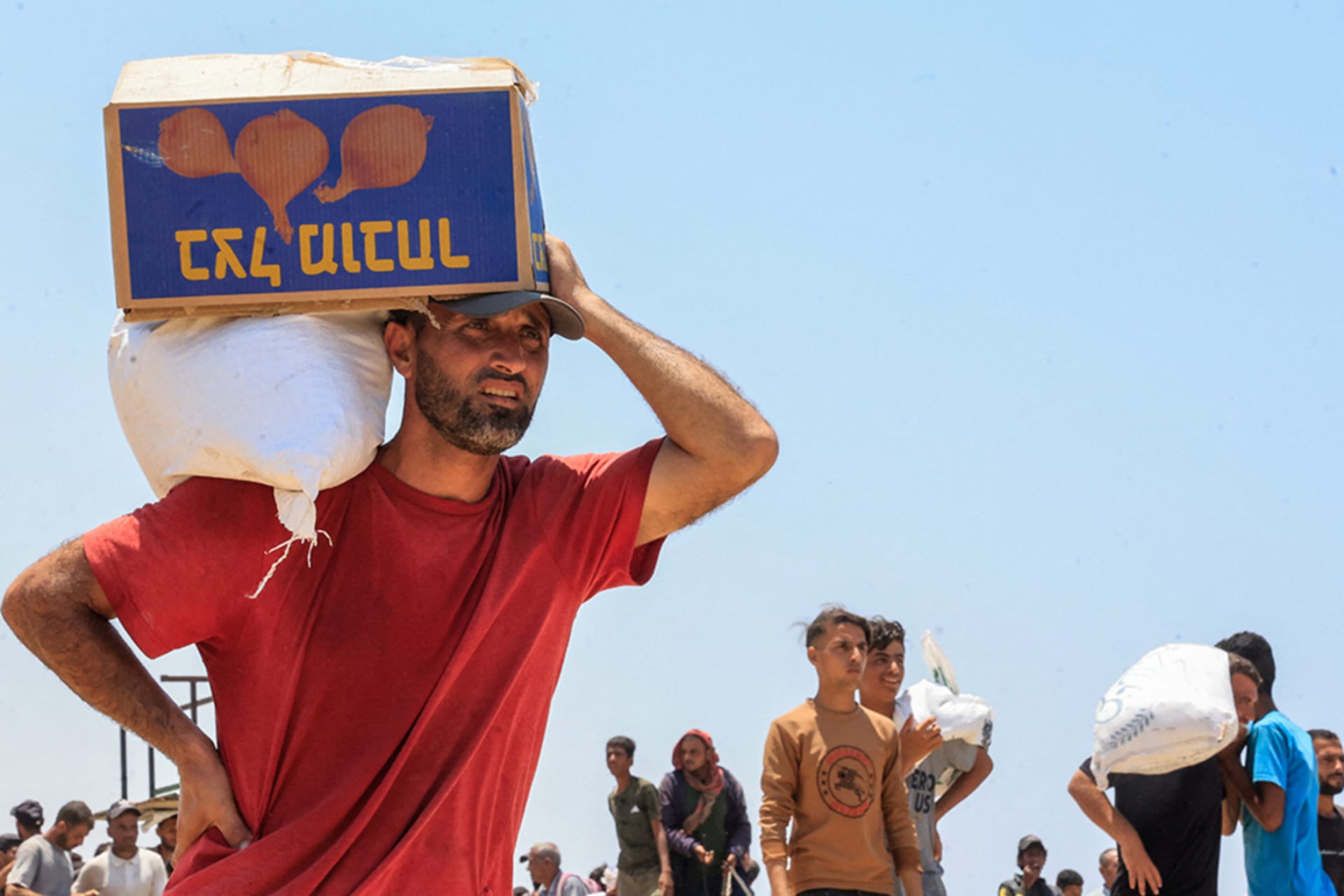
UN agencies have had to cut food from the hungry to preserve dwindling resources for the starving. Two famine declarations occurred in a single year—a first this century. The political will needed to prevent tragedy in Gaza never materialized. In a field accustomed to grim superlatives, 2025 earned a new one: the worst humanitarian year on record.
At the macro level, this meant 25 million fewer people received aid in 2025 despite their levels of need remaining nearly flat.
Meanwhile, more aid workers were killed in the first six months of 2025 than in all recorded years prior to 2023. Humanitarian Outcomes, an NGO tracking attacks on aid workers since the late 1990s, concluded that this rise in aid worker killings was unlikely to be a short-term spike but a long-term step change. That’s in no small part due to state-actors’ (as opposed to non-state actors’) increasing responsibility for aid worker deaths. Gaza, for example, remains the deadliest operational context for humanitarian relief workers, with more than five hundred killed between the Israel-Hamas war’s outbreak on October 7, 2023, and June 2025.
This development—in the Middle East, Ukraine, and around the world—holds profound implications for the permissibility of humanitarian aid. If state actors responsible for upholding international humanitarian law are now the primary threat to facilitating humanitarian aid, the entire international system risks collapse.
Even positive trends have grim undertones. In one of the year’s few encouraging stories, more than 2.5 million Syrians returned home following the fall of Bashar al-Assad’s regime in December 2024. And yet, in 2025, the United States gave just $139 million to Syria—a 63 percent decline over the prior year, and a devastating reduction for a country with a generational chance to transition from humanitarian crises to reconstruction. Syria continues to have one of the worst hunger crises in the world.
Aid cuts have been devastating to other displaced populations as well. In the world’s largest refugee camp—Bangladesh’s Cox’s Bazar—more than one million of Myanmar’s Rohingya population live as a stateless people, meaning they are completely reliant on humanitarian aid. A new wave of Rohingya refugees fled Myanmar over the last year, increasing their population in Bangladesh to 1.26 million, a 25 percent spike representing the largest surge since 2017.
In March 2025, as the United States froze its funding, the WFP halved its monthly food rations to $6 per person, down from $12.50 per person in Cox’s Bazar. The WFP and FAO 2025 Hunger Hotspots analysis reported in November 2025 that 20 percent of Myanmar’s Rohingya population was now in Integrated Food Security Phase Classification (IPC) 4, one step removed from famine. (IPC is a standardized scale, 1 to 5, for measuring the severity of food insecurity and malnutrition in crisis contexts.)
Despite pledges to continue lifesaving aid, the U.S. government has cut funding in countries where millions are on the edge of starvation. The resulting food shortages have led to irreversible brain damage and growth stunting in millions. In Gaza, Sudan, South Sudan, and Yemen, conditions are already designated in the “catastrophic/famine” phase for more than one million people, according to the IPC. The latest assessment also places thousands of people in Mali in famine conditions.
Life-saving aid ends 2025 in a deep recession, with no clear path to recovery in 2026. Barring a dramatic and unforeseen financial intervention, conditions among those most in need of aid are likely to get worse.
Fletcher and the broader aid community must now face down the tension between immediate life-saving services and the long-term imperative of modernizing a humanitarian system under strain. Success could unlock renewed support from traditional donors and private partners. Failure will mean rising hunger and deprivation on a potentially devastating scale.
This work represents the views and opinions solely of the author. The Council on Foreign Relations is an independent, nonpartisan membership organization, think tank, and publisher, and takes no institutional positions on matters of policy.