The Global Reach of Russia Sanctions
By experts and staff
- Published
- CFR Editors
Welcome to the Daily News Brief, CFR’s flagship morning newsletter summarizing the top global news and analysis of the day.
Subscribe to the Daily News Brief to receive it every weekday morning.
Top of the Agenda
Ukraine’s European backers are meeting in London today, as new U.S. and European sanctions on Russian energy ripple through global markets. The Trump administration this week sanctioned Russia’s two largest oil companies, Rosneft and Lukoil, as well as nearly three dozen of their subsidiaries. It follows a similar move by the United Kingdom (UK) earlier this month and came as the European Union also unveiled a new tranche of sanctions against Russia. Global oil prices rose 5 percent yesterday following the new restrictions. Russian President Vladimir Putin said the sanctions were “serious” and would have consequences, but vowed Russia would not be swayed by the pressure.
Sanctions fallout. Sanctioned firms Rosneft and Lukoil are major funders of Russia’s war effort and together account for more than half of Russia’s daily oil exports. Indian refiners are planning to reduce Russian oil imports following the U.S. sanctions, unnamed industry sources told Reuters. The top Indian buyer of Russian crude said that “recalibration” of imports was underway. Reuters also reported that four Chinese national oil companies would avoid immediately trading seaborne Russian oil due to sanctions concerns; the companies did not comment.
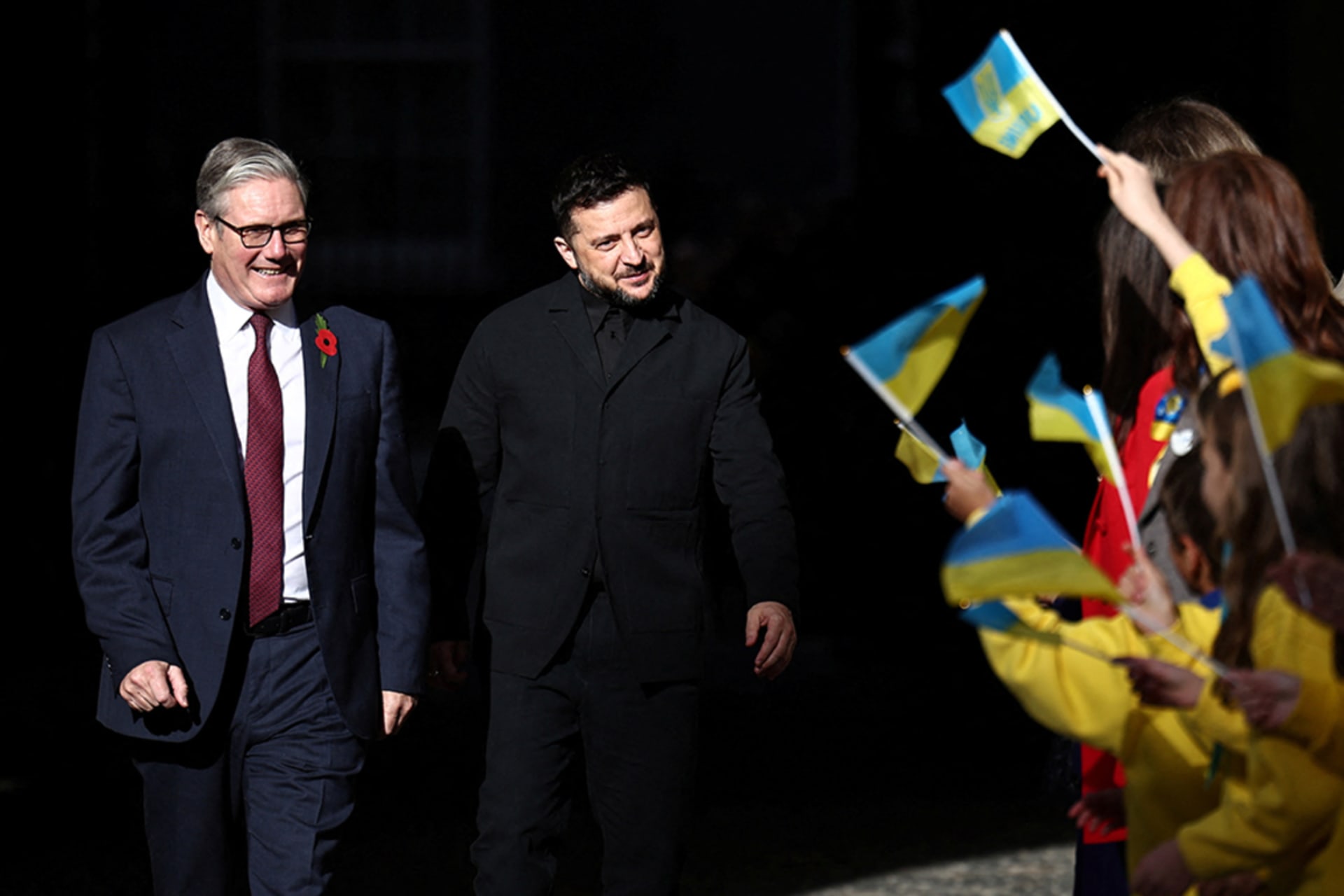
The latest from Kyiv’s European backers. UK Prime Minister Keir Starmer was expected to discuss weapons support for Ukraine at today’s meeting. Yesterday, European countries delayed a decision on a $163 billion loan guaranteed by frozen Russian assets. Belgium, where the assets are held, called for repayment guarantees and for broader participation in the loan. The European Council said yesterday it was committed to addressing Ukraine’s “pressing financial needs for 2026-2027” and called for further consultations. Ukraine and European partners are also preparing a twelve-point peace plan that would see financial restrictions on Russia snap back if it attacked Ukraine again, Bloomberg reported.
“American and European leaders can provide Ukraine with a real postwar guarantee. But to do so, they will have to stick to promises that are credible. And that means committing to a more intense version of their current behavior in the event that Russia violates a ceasefire deal.” —RAND’s Samuel Charap and the European Council on Foreign Relations’ Jeremy Shapiro, Foreign Affairs
Across the Globe
U.S.-Canada trade talks on ice. U.S. President Donald Trump cancelled all ongoing trade talks with Canada yesterday after a Canadian province aired a political ad featuring a recording of former U.S. President Ronald Reagan criticizing tariffs. The Ronald Reagan Presidential Foundation and Institute said the Canadian province of Ontario “did not seek nor receive permission” to use the remarks. Trump announced a similar freeze on trade talks with Canada in June, but restarted them after Canada dropped a tech tax.
European space merger. Leading aerospace and defense firms Airbus, Leonardo, and Thales will merge to create a company that aims to be a “leading European player in space,” they announced yesterday. Aerospace firms in Europe had been in talks about how to create a regional rival to firms such as SpaceX. Airbus will be the majority owner of the joint venture, which could be operational as soon as 2027.
U.S. pushback on West Bank. After Israel’s legislature advanced a bill to annex the West Bank, U.S. Vice President JD Vance called the passage a “political stunt,” while Trump told reporters “Israel is not going to do anything with the West Bank.” U.S. Secretary of State Marco Rubio, who is in Israel today to discuss the Gaza ceasefire, said there was “no plan b” to Trump’s peace plan, which had broad regional support.
Morocco’s deadline for coal. The country set its first-ever deadline to phase out coal power as part of its new emissions target. It pledged to do so by 2040 if it received more than $30 billion of external financing to support its climate mitigation plans, and some time in the 2040s if it does not. The country has already stopped planning new coal plants, its energy transition minister said.
U.S.-China trade negotiations. The two countries are holding trade talks in Malaysia today ahead of a highly anticipated meeting between Trump and Chinese President Xi Jinping next Thursday. Before departing for Malaysia, U.S. Treasury Secretary Scott Bessent said he was “optimistic” about the negotiations, but that China’s new rare earth restrictions were “unworkable and unacceptable.”
China’s economic plan. Chinese officials agreed to pursue tech innovation, self-reliance, and increased domestic consumption at a multiday meeting this week that focused on the country’s next five-year economic plan, a readout said. The final version of the plan is expected to be approved in March. China’s focus on export-led growth—rather than stimulating domestic consumption—has been a hallmark of its economic policy in recent years and has reshaped the global economy.
UK anti-espionage sting. British police arrested three men in London yesterday suspected of spying for Russia. The head of London’s counterterrorism police said such cases are on the rise in the UK. Three people were arrested in Essex as part of a similar probe last month, following a series of convictions for acting on behalf of Russia in May and July.
ICC v. the Philippines. The International Criminal Court (ICC) yesterday rejected a challenge to its authority to rule on a case against former Philippine President Rodrigo Duterte. The court is trying Duterte for crimes he allegedly committed during the country’s deadly war on drugs. The Philippines’ withdrawal from the ICC took effect in 2019, but the court ruled that countries could not “abuse” their right to withdrawal “by shielding persons from justice” in matters it was already considering. The ICC opened its preliminary investigation into Duterte in 2018.
What’s Next
Today, the United Nations marks the eightieth anniversary of its 1945 charter entering into force.
Today, Ireland holds a presidential election.
Tomorrow, Ivory Coast holds a presidential election.
- Sunday, the Association of Southeast Asian Nations (ASEAN) summit begins in Malaysia.
- Sunday, Argentina holds midterm elections.