How I Got My Career in Foreign Policy: Gina Raimondo
Gina Raimondo is perhaps best known for her time as commerce secretary under President Joe Biden and her two terms as governor of Rhode Island. CFR sat down with her to chat about how she navigated career shifts and the benefits of having a business background in government.
Gina Raimondo didn’t start in foreign policy. She found her way to it first via law then venture capital, co-founding the firm Point Judith Capital. Eventually she entered state politics, serving two terms as governor of Rhode Island—the first woman to hold the position—and a stint as the state’s general treasurer. A phone call led to her role as U.S. Secretary of Commerce under President Joe Biden from 2021 to 2025. Now, she is a distinguished fellow at the Council on Foreign Relations. Read more for how her background helps her ask different questions, why she’s worried about AI, and what’s a “Miss Gina Special.”
Here’s how Gina Raimondo got her career in foreign policy.
What did you want to be when you were little?
Truthfully, I never had any role model. My mom stayed at home, my dad worked in a jewelry manufacturing company, and I never really knew any professionals. I think at some point along the way, I decided I would be a lawyer, but only because that seemed like what kids who did good in school did.
But you did go to law school, and you’ve had a wide-ranging career. You first went into venture capital before you went into state politics and federal politics. First of all, why venture capital?
I started out in law—did not like law. I did not like fighting over the most minute details. What I love to do is get a team together, lead a team, and accomplish specific things. And that’s what venture was. But truth be told, I had a ton of loans, like $150,000 worth of loans—some crazy number. So I needed a job to make money.
What I was drawn to in law was public interest law and public service. But I couldn’t do any of that because I had to pay the loans off. So I needed a paying job. I didn’t like the law, so venture business was a way that allowed me to pay the bills and do something I enjoyed.
You eventually transitioned to state politics. What about your experience in venture capital prepared you for that transition?
I think if I had had the financial means, I might have done some kind of public service sooner, because that’s where my heart was. That being said, I’m so happy I did venture first.
First of all, you learn financial skills. Just plain old financial skills, which are essential. Second of all, you learn how to run things. You learn how to operate things. Operation skills are sorely needed in the government. You learn how to be practical—you can’t stand on principle if you’re trying to build a company and make money. Of course, you have to be principled, but you have to find a way to get things done and be practical. You learn how to build coalitions to get things done, to work with employees, to work with investors, and to work with customers.
In both of those roles, you’re obviously interacting with economic issues—including investments, global markets, supply chains. Was foreign policy an interest you had at that time or was that something that you discovered along the way?
It was something I discovered along the way. I started to get more interested in foreign policy as governor—helping businesses in Rhode Island export and attracting companies to the United States. By helping small businesses in Rhode Island and learning from them, I realized how powerful exports were, and that started my interest.
How did the opportunity to become commerce secretary come about?
The president called me and said, “Would you like to serve?”
Had you worked with him before?
No. You know, I was a high-profile governor. I had a good reputation as a successful, two-term governor.
Was there anything about transitioning from state government to a cabinet position that surprised you?
It’s a good question. Honestly, I thought the bureaucracy at the state level was challenging and slow. But the bureaucracy at the federal level is unbelievably slow and bureaucratic, so I suppose that was a surprise.
How do you think your roles in the private sector and in state government prepared you for the larger scale of federal government work?
It’s all the same, whether you’re running a fifty-person operation, a one hundred-person operation—which is maybe what I did in venture—overseeing fifteen thousand employees as governor, or fifty thousand employees as commerce secretary.
The concepts of: a clear vision, recruiting amazing people, caring about the details, and execution beats policy every day. All of these things are kind of the same. Also, the thing that I really learned in Rhode Island as governor was working with a legislative body, and all the various stakeholders, to get things done. Learning those skills in my six-and-a-half years as governor helped me a lot as secretary.
As secretary, you also spearheaded the implementation of some of the administration’s biggest acts, like the CHIPS and Science Act. How do you think your professional experiences, specifically in the private sector, shaped how you approached balancing national security and economic interests?
I think because I had been in the private sector—specifically as a venture investor, investing in innovation—I brought to government a view that, you know, I didn’t inherently distrust anyone in the private sector. I looked to listen to businesses. I looked to learn from business. I looked to partner with business.
I believe that when you embrace business and bring them into the solution and have public-private partnerships, good things can happen. And I think that some people, for example, if they spent their whole career in government, maybe didn’t have that appreciation.
Was there a moment when you were commerce secretary where you thought, “Whoa, this is such a bigger scale, I’m not in Rhode Island anymore”?
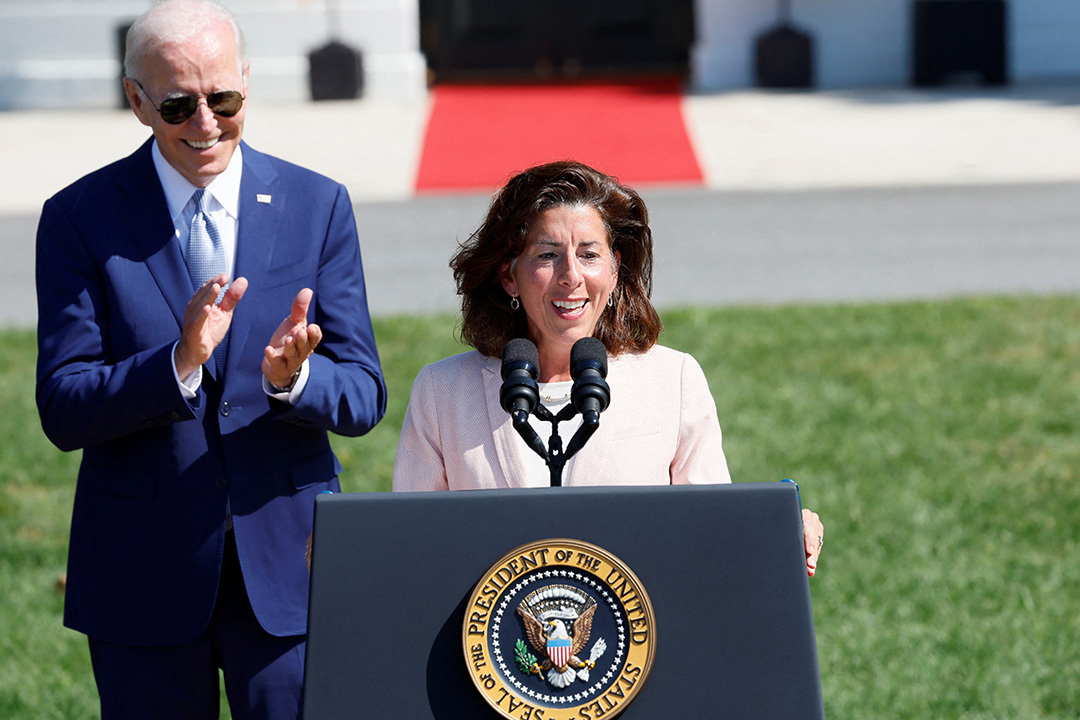
Definitely the global aspect, like getting off the plane in China and having meetings with world leaders. The Commerce Department has thousands of employees and offices in eighty-six countries around the world. I traveled extensively. I led a presidential mission on behalf of President Biden to the Philippines. I traveled with the president to Tokyo and Korea. I was at many meetings with the president with world leaders. So that was all new to me.
You had a less traditional route to foreign policy work—you didn’t go through the State Department or other diplomatic channels. Do you think there’s a unique benefit to coming in through a different path, versus a more traditional one?
I do. Because if everyone goes through the same path, they think the same way.
I think that my background—coming from the private sector, from being governor, not having familiarity with all the think tanks in Washington, not being part of the same system—you just ask different questions. That allows for different perspectives, and I think better answers and solutions.
That being said, for young people, don’t be overly anxious about the decisions you’re making in your twenties and thirties. Because your interests will change. You can change your career, and most people in their career take a meandering path. So the important thing is, always work with people who are high quality and who will respect you. Work on things that you think matter to the world, and enjoy what you’re doing at that stage. A career is thirty, forty years—you might do ten different things.
Do you have any other particular advice for young people who are seeing the landscape change and are wondering how they should craft their careers?
I think that artificial intelligence (AI) is the big question. If AI is going to get rid of entry-level jobs for lawyers, accountants, actuaries, and sales people, how is anyone going to learn to be great at something? To be a great negotiator, you’ve got to start somewhere and you’re going to make a lot of mistakes. So I do worry about that. I have two kids—a twenty-one-year-old and an eighteen-year-old, and I’m worried about that.
But I really think that the hardest thing for anyone—older people, younger people—is to be very self-aware. What am I truly good at? What is something I could do all day and not get tired of, that I can get paid for? Who are people who I respect and who will respect me? Try to land in those spots. If you have a series of those kinds of jobs over your career, you’ll have a very good career. And you’re probably going to jump around a lot.
Can you share with us a most memorable work trip or a memorable meal that you had while on a work trip?
Anyone on my staff, if they were here, would be laughing because—well, I’ll tell you this: I became famous in the Commerce Department. My own team, they called it a “Miss Gina Special,” in that I didn’t really allow for any downtime or fun time or unnecessary social activities in my travel because I just always wanted to get in and get out.
So a Miss Gina Special would be like going to Abu Dhabi for a couple of days and never staying in a hotel. Frequently, we would get a hotel room just to shower, because I figured, you can sleep on the plane—so why would you need to actually sleep overnight? You go, shower, do your work, get on a 1 AM flight, and go home. That was a very common thing I did. For example, I went to the AI summit in the United Kingdom: fly, shower, do the whole global summit, get back on the plane, go home, and go back to work.
I actually had a room in the same hotel in Abu Dhabi—I don’t think I ever slept in the bed, because we had this routine: you fly, you shower, you work, you work all day, you have dinner, work at night, and then there’s a midnight flight that leaves and you fly home. So I became quasi-famous for those kinds of crazy routines. They’d be like, “Okay, secretary, we’re going to Africa, it’s a week.” They’d say we have to meet with the president, we have to meet with this person, we have to do this, we have to do that. I’d say, “Excellent. Same agenda, three days.”
That is impressive, actually. Scary, but impressive.
Also no one was ever allowed to check baggage. We went to China for a week and everyone could only take a carry-on.
Okay, some great packing skills.
This interview has been edited for length and clarity. It represents the views and opinions solely of the interviewee. The Council on Foreign Relations is an independent, nonpartisan membership organization, think tank, and publisher, and takes no institutional positions on matters of policy.