Italy and Japan Hold U.S. Trade Talks
By experts and staff
- Published
- CFR Editors
Welcome to the Daily News Brief, CFR’s flagship morning newsletter summarizing the top global news and analysis of the day.
Subscribe to the Daily News Brief to receive it every weekday morning.
Top of the Agenda
Officials from Italy and Japan traveled to Washington with hopes of negotiating down U.S. President Donald Trump’s tariffs. Italian Prime Minister Giorgia Meloni is meeting with Trump today at the White House following Trump’s unexpected attendance at U.S.-Japan trade talks yesterday. These meetings could offer an early glimpse of whether—and how much—Trump is willing to step back from the sharp tariffs he imposed on U.S. trading partners last month. They come as both the U.S. Federal Reserve and the World Trade Organization (WTO) issued new warnings yesterday about the trade war’s consequences.
The latest on talks.
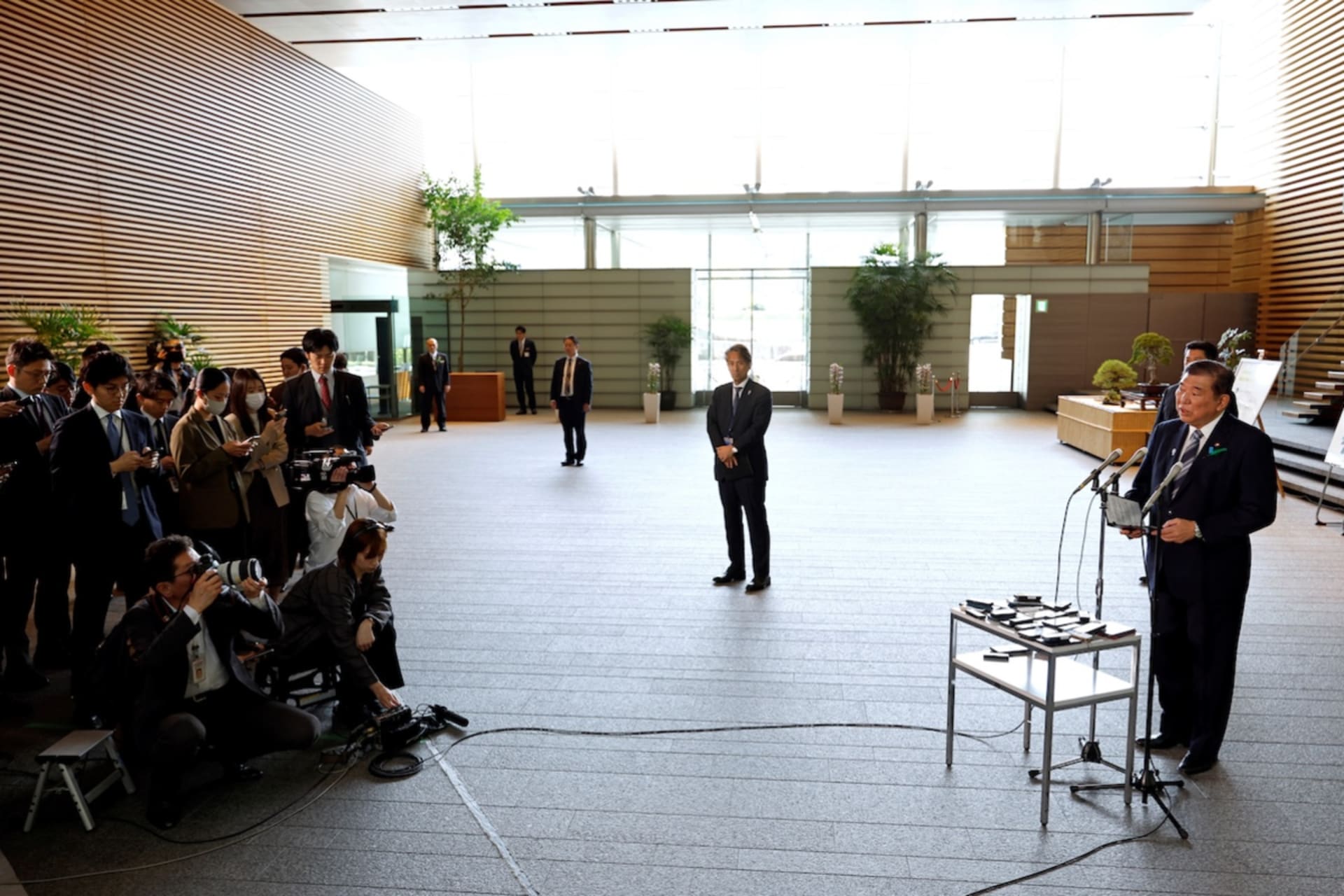
- Trump wrote on social media yesterday that there had been “Big Progress” after he met with the Japanese trade delegation. Trump did not offer further details, while Japan’s top trade negotiator said the countries agreed to hold another meeting later this month and called Trump’s tariffs “extremely regrettable.”
- Meloni is expected to propose that the United States and the European Union (EU) remove most tariffs on industrial goods, Bloomberg reported. The EU trade commissioner’s visit to Washington earlier this week yielded little progress.
The big picture.
- U.S. Federal Reserve chair Jerome Powell said yesterday that on the current trajectory, tariffs are “highly likely” to spur a temporary rise in inflation. He said a “challenging scenario” could arise in which the bank’s dual goals of encouraging both stable prices and employment are in tension.
- The WTO, meanwhile, warned yesterday that the trade war is on track to reduce exports from North America by nearly 13 percent this year. That calculation was based on a scenario in which Trump’s blanket 10 percent tariffs remain in place, but none of the higher levies are restored after his ninety-day pause.
“China possesses scale, and the United States does not—at least not by itself. Because its only viable path lies in coalition with others, Washington would be particularly unwise to go it alone in a complex global competition.”
—CFR expert Rush Doshi and The Asia Group’s Kurt M. Campbell, Foreign Affairs
Across the Globe
U.S. senator in El Salvador. Salvadoran authorities denied Senator Chris Van Hollen (D-MD) access yesterday to Kilmar Abrego Garcia, who had lived in Maryland before the United States mistakenly transferred him to a Salvadoran prison. El Salvador’s vice president said Abrego Garcia was not being released because Washington was paying for him to be incarcerated, according to Van Hollen. The U.S. Supreme Court has ordered Washington to facilitate Abrego Garcia’s return. Separately, a U.S. federal judge yesterday said he found probable cause the Trump administration was in contempt of court for disregarding an order to halt deportations.
Israel’s plan to hold “security zones.” Israel will keep troops deployed in certain zones of Gaza, Lebanon, and Syria indefinitely, Defense Minister Israel Katz said yesterday. He added they would create buffer zones to protect Israeli communities. Lebanon and Syria have called Israel’s military presence on their territory a violation of sovereignty and international law. The plan appears to “meet the dictionary definition of military occupation,” the AP reports.
Iran negotiations. Israel planned to strike Iranian nuclear sites as soon as next month with U.S. assistance before Trump rejected the proposal in favor of nuclear talks, unnamed sources told the New York Times. The U.S. and Israeli governments did not comment. After U.S. Middle East envoy Steve Witkoff hardened his public comments ahead of weekend U.S.-Iran talks, Iran’s Foreign Minister Abbas Araghchi said yesterday that Tehran’s ability to continue to enrich uranium is “non-negotiable.
UK gender ruling. The top court in the United Kingdom (UK) ruled yesterday that the legal definition of a woman refers only to biological sex, excluding transgender women. The ruling could lead to changes in government guidance on the use of same-sex spaces. One of the judges said that the decision should not be read as the “triumph of one or more groups” against the other and that UK law continues to offer protection for transgender people from discrimination and harassment.
Foreign disinformation office closed. The U.S. State Department closed a unit responsible for tracking foreign disinformation yesterday, Secretary of State Marco Rubio said. Around forty employees were put on paid leave. The office had tracked efforts by governments and terrorist groups. Rubio claimed that it had been engaged in censorship of Americans, without providing details. A former official who ran a previous version of the unit said its closure amounted to “unilateral disarmament.”
Consultations on Ukraine. Secretary Rubio and Witkoff met with French President Emmanuel Macron in Paris today to discuss the Russia-Ukraine war. Meanwhile, Qatari Emir Sheikh Tamim bin Hamad al-Thani is meeting with Russian President Vladimir Putin in Moscow. Qatar has attempted to mediate on the war in the past and also plays a role in U.S. negotiations with Iran.
Air strikes in Somalia. The Somali and U.S. militaries carried out air strikes in central Somalia late yesterday that killed twelve al-Shabaab fighters, Somalia’s government said. Mogadishu also reported striking and killing the crew of ships in Somali waters that it had identified as carrying weapons for the militant group. Hours earlier, fighters from al-Shabaab had attacked a town some 150 miles north of the capital.
Nigeria-South Africa minerals pact. The two countries signed a memorandum of understanding in Abuja to increase cooperation in mining, Nigeria’s mining minister said today. They plan to work together on geological mapping using drones, sharing mineral data, and mineral exploration. Nigeria’s mining sector currently accounts for less than one percent of the country’s economic output.
What’s Next
Today, International Monetary Fund (IMF) director Kristalina Georgieva speaks ahead of the World Bank and IMF Spring Meetings.
Today, Malaysia’s prime minister is scheduled to hold talks with Myanmar’s junta chief in Bangkok.
- Tomorrow, the Art Dubai cultural festival begins.