Will Trump’s Firing of the Labor-Data Chief Raise U.S. Financing Costs?
By experts and staff
- Published
 Benn SteilCFR ExpertSenior Fellow and Director of International Economics
Immediately following publication of the recent dismal jobs report from the Bureau of Labor Statistics (BLS), President Trump fired its top official, Commissioner Erika McEntarfer. Trump asserted, without evidence, that her numbers were “RIGGED in order to make the Republicans, and ME, look bad.” Dr. McEnfarter, who was confirmed in her post by an 86-8 Senate vote in January 2024, is well-regarded by economists across the political divide.
Wall Street and the Federal Reserve have long treated BLS labor-market data as essential input into their decision-making, making its impartiality critical to sound investment and policy formulation. Whoever the president now appoints to fill the post, questions will linger as to whether BLS reports can any longer be trusted—and not manipulated to suit the president’s preferences.
What effect might this have on the U.S. economy?
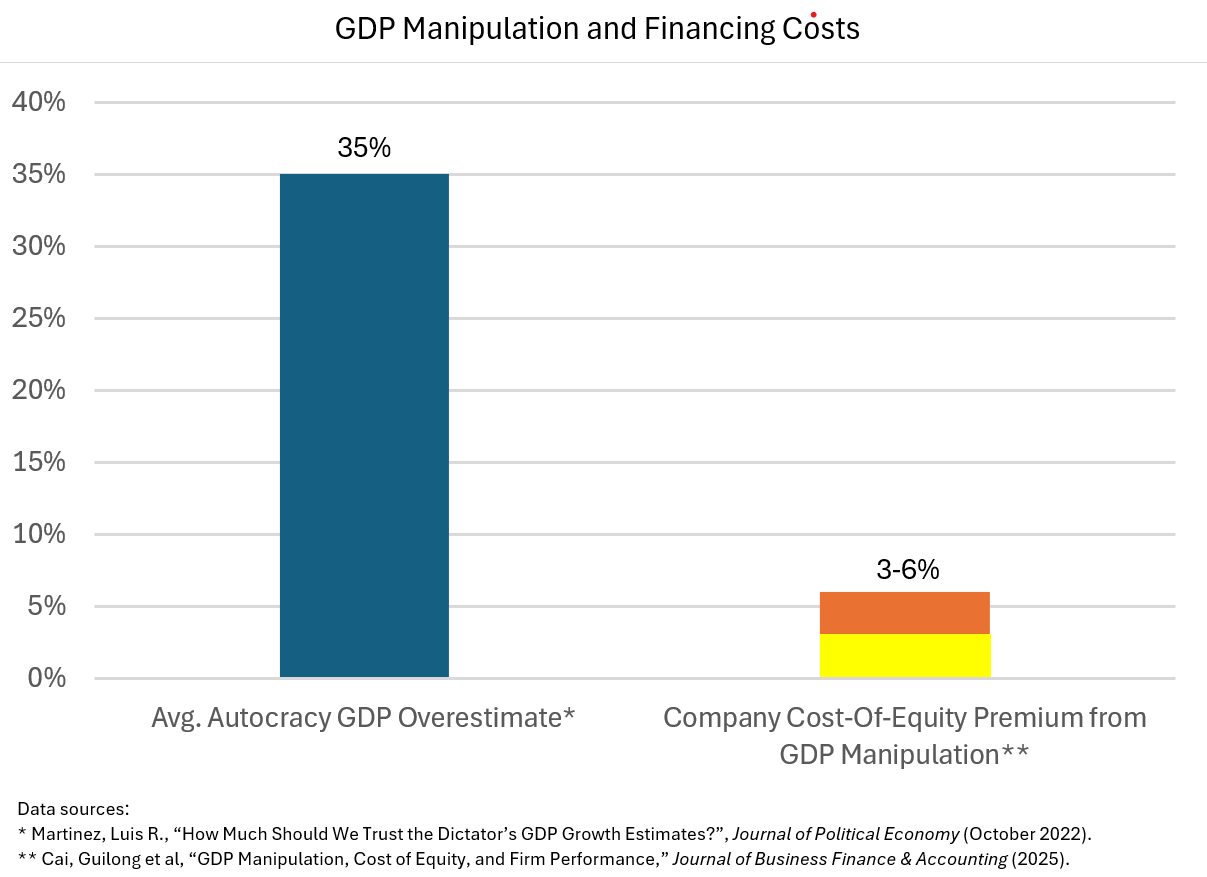
Some clues come from two recent studies of GDP data manipulation by governments. The first found that autocracies overstate yearly GDP growth by an average of 35%. The second, looking at Chinese provincial data, found that firms in high‐manipulation provinces suffer higher cost of equity—in the range of 3-6 percent higher. These findings are shown in the graphic above.
Since labor-market data, like GDP data, is relied upon by markets and policymakers to gauge the health of the economy, any degrading of their impartiality can be expected to have a similar effect—that is, to raise the cost of financing for U.S. companies. For this reason, the political firing of the BLS commissioner should be considered a material harm to U.S. economic performance going forward.