A Conversation With Foreign Minister Asaad Hassan Al-Shaibani of Syria
Event date
Speaker
- Minister of Foreign Affairs and Expatriates, Syrian Arab Republic
Presider
 Host, Fareed Zakaria GPS, CNN; Member, Board of Directors, Council on Foreign Relations
Minister Asaad al-Shaibani discusses U.S.-Syria relations and Syria’s international reengagement, including sovereignty, sanctions relief, global partnerships, and foreign policy priorities.
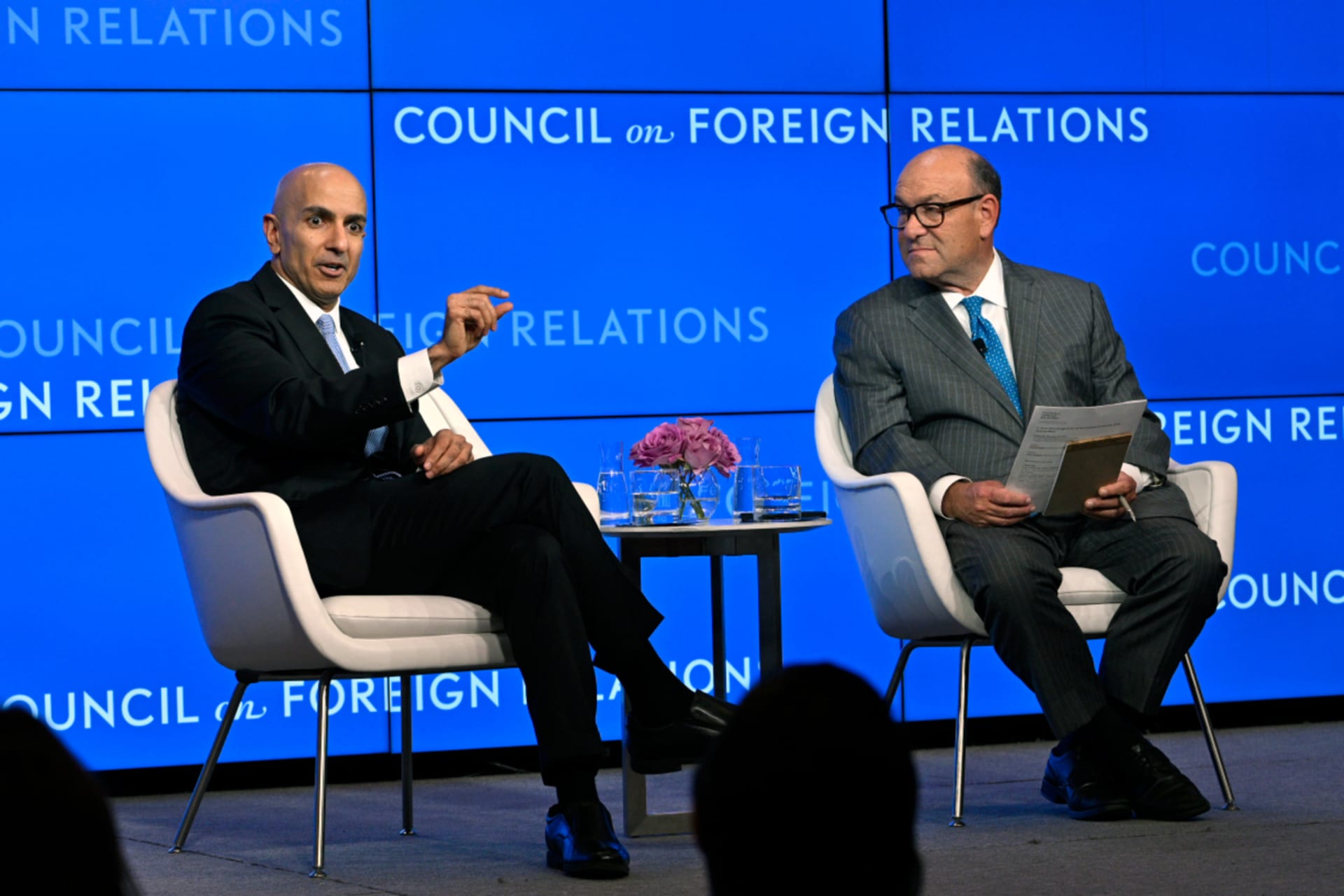
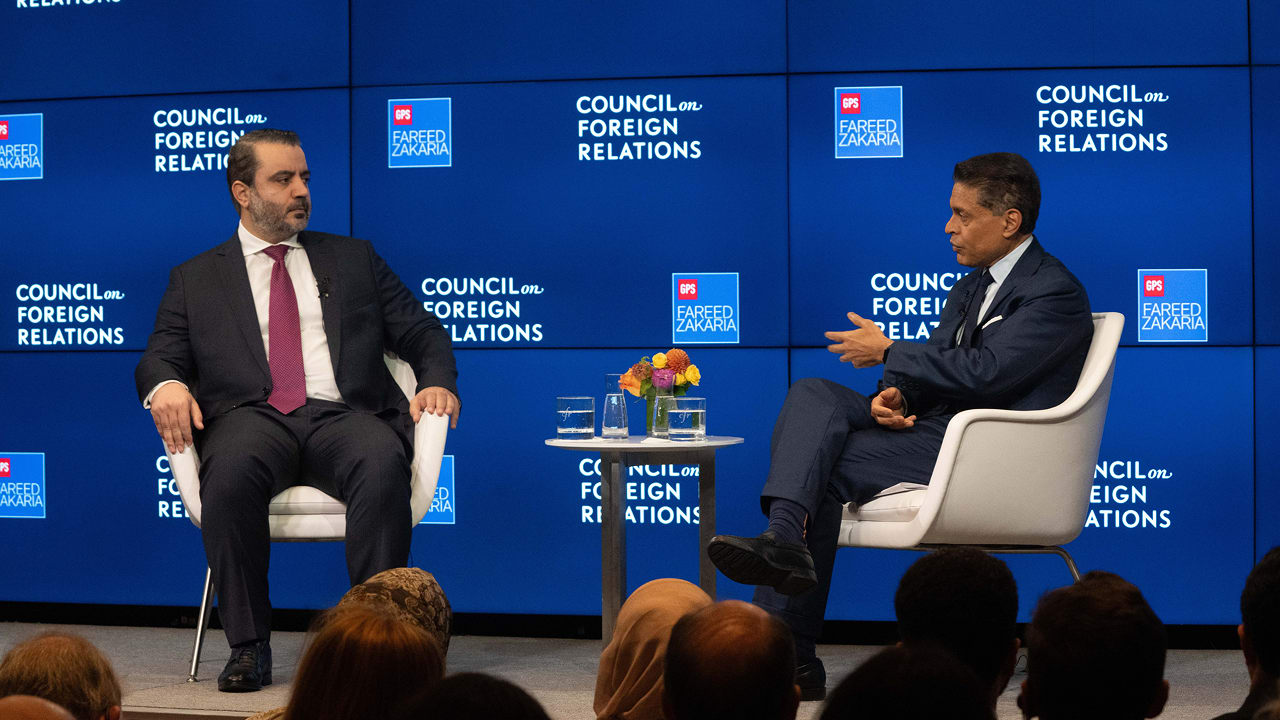
ZAKARIA: Welcome to the Council on Foreign Relations meeting with the foreign minister of Syria, Asaad Hassan Al-Shaibani. The foreign minister is an extraordinarily important figure in Syria. He is also, I should tell you, a scholar of English literature. This was his bachelor’s degree, a scholar of international relations. For those of you who don’t know, I’m Fareed Zakaria. And I’m trying to think, if there’s anything else I need to tell you. I don’t think so.
So, Mr. Foreign Minister, are you ready? (Laughter.) As ready as you will ever be.
Welcome, Mr. Foreign Minister. The first thing I think I have to ask you is something we’re all fascinated by. What is it like to have been a rebel, a militant? You were involved with Al-Nusra and now you are a foreign minister. What is the transition like?
AL-SHAIBANI: Hmm. Should I speak in English, or?
ZAKARIA: Yeah, in English, if you can.
AL-SHAIBANI: To make an introduction. Yes. First of all, I thank your presence here in this meeting. And also I thank you for this, to host us.
Of course, we are—we came from the free Syria. Syria is now free, without Assad regime. The Syrian people now is rebuilding his country without any—without any authoritarian regime. Of course, now we are also open a new page with all the world—a page of peace and of cooperation with the region, with the world. Syria, now it’s a new phase for the region, for the Middle East. And we are also with our own people. We can say that Syria, it will be inspiring model for all the world.
ZAKARIA: So tell me what it’s like, though, to go from being a rebel, an opposition leader, people called you al-Qaida. You know, Al-Nusra was allied with al-Qaida. How do you go from that to being part of the government?
(Note: Minister Al-Shaibani speaks through an interpreter for the remainder of the event.)
AL-SHAIBANI: I will speak in Arabic. This transformation you mentioned gives me the impression that you’re talking about a robot or a machine. But we’re not. We are a free people who’s been patient for sixty years of totalitarianism and dictatorship. There was no political life that we could look up to. And we chose our dignity and our freedom through peaceful protestation. And we continued on the side of the Syrian people in all the difficult phases we’ve been through since 2011 until 2024.
ZAKARIA: It doesn’t surprise me that you were in opposition to the Assad regime, father and son. What I’m talking about more is you come out of an opposition that was very Islamic, and politically Islamic. And in many ways, you know, the kind of—the kind of governments that were—that were started by groups like that tended to be like ISIS—so, you know, Sharia law. Here you are in a suit and tie talking about Syria being reintegrated into the world. This is very different from Khomeini. This is very different from Baghdadi. This is very different from the Taliban. Why? Why are you different from the other Islamic militant groups that came to power?
AL-SHAIBANI: The way we are today is a confirmation of what I said in the beginning. We are a popular movement. We are completely in unison with the Syrian people. We participated in its revolution. We’re not strangers to this society. We support all the aspirations of the people. When they chose to manifest peacefully, we joined them. And when Syria was liberated we were at the level that they expected. You wouldn’t expect a model like Taliban in in Syria. Every people, every country, has its own experience and history. Our experience is in unison with what we aspire to, to the aspirations of the Syrian people, a civilized people that can ably represent itself without any—without any resort to models like Daesh, or Taliban, or anything that does not go well with the Syrian nature.
ZAKARIA: So does that mean there will be no Sharia law in Syria under this government?
AL-SHAIBANI: There will be the law, the law that is accepted by the Syrian people. Within nine months, we’ve been able to issue the constitutional declaration that has the support of the majority of the Syrian people. And now we’re working on parliamentary elections that will enable the different Syrian regions from participation. There is also a constitutional committee that will draft a new constitution to be accepted by the people. We will lay down our laws. Some of these laws may be based on some Sharia laws, but it’s not going to be Sharia law per se. We cannot jump the gun. We wish that our constitution would be truly representative of the Syrian people.
ZAKARIA: But it sounds like we can report to President Trump that while there may be Sharia law in London, there will not be Sharia law in Damascus? Is that fair to say that, there will not be Sharia law in Damascus, as you said? No Sharia, per se?
AL-SHAIBANI: I believe it would not be correct to focus on this particular issue, the cliches in which the Middle East is seen. We have a Muslim majority. We have Christians. We have other factions. And we would rather call them all the Syrian people. The Syrian people will be represented by its government, the entire population. Of course, we cannot jump the gun and decide a certain model for the Syrian people now. The Syrian people is a Muslim people. It has cultural diversity. We would not impose Sharia on anyone. I believe it would be left to the individuals, either in the Middle East as it is in the West.
ZAKARIA: Let’s talk about the violence that has taken place since the Syrian revolution towards two groups in Syria in particular, the Alawites, the small minority that used to be the ruling elite that the Assad family came from, and the Druze, the Christians. Both of these episodes of violence had been quite dramatic, quite brutal. Is Syria now descending into the kind of sectarian war that Iraq went through after the removal of its dictator? The pattern seems very worrying and familiar.
AL-SHAIBANI: We believe that Syria today is free from a civil war. It has overcome the biggest problem the Syrian people had faced. That is, the criminal regime. Now we would like to reinstate trust and confidence in the Syrian society, that we found divided and not in agreement. We are working on achieving harmony and agreement amongst different factions. These factional wars were used by the former regime in order to divide the population. But we are now working on this particular issue. We want it to be a harmonious society that is not at war anymore, and a unified Syria that enables every Syrian of his rights with a law that represents all and not based on cultural or religious background. The Syrian model is very different. I do not believe we can compare it to other models. It is very special in that way.
What happened in Al-Hasakah and Sweida, there is a particular context. In the Al-Hasakah, it was a state that dispatched the security forces to protect the Alawites there. And the different factions and areas that were not liberated is the reason why things deteriorated. But now we are very keen on keeping the peace. We have stopped all clashes. We have established a committee of investigation that has popular and international support, and that is working with the United Nations Commission on investigation to reach the site of the incident and do its own investigation. And the reports by our committee and the U.N. commissions were very close. We would not allow any further injustice after what we’ve seen from the former regime.
Also, the context is different. We cannot consider what happened in Sweida as a targeting—particular targeting of a certain group. The Druze are in the east and in the northwest. And I do not think there are any reason to clash with them. Their forces have not been amalgamated in the Syrian forces yet, but we are working on it. And we have come a long way dealing with all problems. If you look at what the Syrian government has done since these incidents. You will see that we are working on tranquility and peace. However, external interference sometimes hinders our efforts. We have participated in joint efforts with the United States of America and with Jordan. And we have laid a plan that has acquired the international and local support and also meets the aspirations of the Druze. And the international community has actually supported this plan, since it would lead to the achievement of peace and stability. We continue to work on all problems from a national perspective, in the interest of our local population and not those from outside. Thank you.
ZAKARIA: I bring up the example of Iraq only because there are similarities. It was a minority government that Saddam Hussein represented. The Sunnis were a minority in Iraq. The Alawites were a minority in Syria. You now have had a majority uprising. And there is some tendency toward revenge and things like that. And in that context, what seems to, after a very long, bloody process, have stabilized Iraq was that they have accepted a decentralized state. The Kurds have their region, the Sunnis have their region, the Shia have their region. In Syria, you are—as far as I can tell, your government is insisting on a strong, unitary, central state. Why? Why not devolve power so that the Druze can have greater autonomy, the Alawites can have greater autonomy?
AL-SHAIBANI: I still disagree with the comparison between our model and the Iraqi model, or the Saddam Hussein regime and the Assad regime. They were very different. There are radical differences, socially speaking and in terms of the population. What happened in Syria is that we had a popular revolution. But in Iraq, there was an American invasion. There was a civil war. There was instigation. There was a lot of violence. But our problems in Syria were greater and much more complex, at the time. Now, it’s different. We have a Syrian government that is keen on national peace and justice. The entire population of Syria was a victim of the injustice. Even the Alawite faction was mistreated by the former regime. So I still believe there is no comparison between the two models of Iraq and Syria.
I would also like to add that the weapons available to the population were available in the context of revolution, and in the absence of a government that does not represent them, because such would lead to conflict and civil war. Any government does not want the weapons to be readily available to the population. It should monopolize that, since it is responsible for the application of the law and providing protection to the population. Those who were bearing arms during the revolution should lay them down now. We need a national army that protects the Syrian people, its territory, and its interests—not an army that stood against the population as before. And now the opportunity avails itself. We have gathered all the different divided factions. In northern Syria, for example, we achieved an agreement on the tenth of March for that region. We do not want the arms to be available to the population at large. We want it to be available to the army, and only the army.
ZAKARIA: Let’s talk about the foreign involvement, in particularly the episode regarding the Druze. What did Israel do to interfere, as your government has claimed?
AL-SHAIBANI: Which intervention are you talking about?
ZAKARIA: Between the Druze and the Bedouin, when—in Sweida. Can you describe what it was? What was Israel’s role?
AL-SHAIBANI: Any foreign intervention will lead to chaos. We all have families. And if anybody interferes in the affairs of your family, this would lead to divorce and family problems. We are a very fragile society still in Syria, because of fourteen years of civil war and the fifty-five years of basic authoritarian regime. We were unable to talk about politics, the shape of the state, or even for social relations, because of fear. In order to overcome this transitory period, we should give an opportunity, a chance for dialogue, and to solve our own problems. And that intervention that happened in Sweida, I think that there were some who invested in that strife. And that was not good for the Druze. They tried to seize power in that area and form a division and add to the problems of the Syrian state. But because there are reasonable Druze and reasonable people in Sweida, and the rejection by the Syrian people of these things, we in Syria have a better situation now.
And, as I said, we’re committed to civil peace. And this is going to be the first time in Syria without foreign intervention. That can only lead to chaos. And whoever thought that this would divide Syria or make it weaker, if we believe that Syria is divided and weak and has many problems this is not going to be very good for the rest of the region. It’s not just our problem in Syria. It would be a problem for the whole region. We want a unified, strong Syria. And this would lead to stability and security in the whole region.
ZAKARIA: Why do you think Israel intervened? You think Israel wants a divided and weak Syria?
AL-SHAIBANI: There’s an Israeli position that says, we want one Syria, a unified, strong Syria. But the practice is completely different. And I really don’t understand the real reasons behind that. But a strong and unified Syria would be good for regional security. And that will benefit Israel, definitely.
ZAKARIA: And, to be clear, what exactly—because there is some lack of clarity on this—what exactly did Israel do in its intervention in Sweida?
AL-SHAIBANI: It supported outlaws, outlaw groups. And this obstructed and hindered the Syrian government from solving the problem between the Bedouins and the Druze.
ZAKARIA: Did it threaten to bomb Damascus also? Did it threaten to bomb Damascus?
AL-SHAIBANI: Definitely. Damascus was targeted several times. Damascus was bombed several times. A thousand positions, military and civilian, 400 operations on the border, and occupation of new, other areas in Syria, especially under the 1974. And that obstructs the Syrian government from doing anything.
ZAKARIA: Now, when your government came to power some of your officials talked about the possibility of normalizing relations in the context of an expanded Abraham Accords. Is that possible now, given what Israel has done? Or is that idea completely dead?
AL-SHAIBANI: Perhaps. We’re talking about Israel before and after the eighth of December. Before the eighth of December our focus was to bring down the Assad regime and to re-establish our own state where we seek dignity and freedom and rebuild the country after the Civil War. Israel wasn’t part of that equation. But after the eighth of December, the Syrian people were stunned by these continued, and almost daily, attacks on Syria. And we don’t understand why. The threats, that they talked about the militias of Iran or Hezbollah. All of these militias left with the late regime.
And what we have now is basically what we say in public. We are no threat to anyone in the region, including Israel. But these new policies of cooperation and peace were met by these threats and strikes. So to talk about normalization and the Abraham Accords is a bit difficult, especially that Syria faces an occupying Israel, occupying the Golan and other areas. The buffer zone, for instance and other areas were occupied by Israel, that we have to restore the situation before the eighth of December. And to send positive messages to the Syrian people that would reassure them against these practices. And then we can talk about the future of the area. But the way we coexist after all of these years of war and what we suffer in terms of internal migration and displacement, we want to live in peace and we want to conduct dialogue among everyone.
ZAKARIA: There are people who believe that the Israeli government has been so active in striking Syria because it wants to demonstrate that it is protecting the Druze. There are Druze in Israel. Those Druze in Israel are very strong supporters of Prime Minister Netanyahu’s government. And that this is, in some sense, a product of Israeli domestic politics. You believe that that is the case?
AL-SHAIBANI: This is what is said every now and then. But we don’t believe that this is true because the Druze of Syria are not targeted. And if we apply this to every country, then everybody’s going to go and interfere in the affairs of the of other states—whether it’s based on religion or ideology or the votes in a domestic election. And then we will have chaos, not just in the area or the region, but the whole world. So Druze, again, let me say, are not targeted. And what Israel did just complicates matters and made the Druze in a very difficult and embarrassing situation. And now they left them behind in the way that they are now.
And now the government is extending a hand of cooperation and assistance in a language of dialogue and peace, and letting humanitarian assistance go there in a way that shows that this is a national cause. We are not proceeding from anywhere where we pay heed to this community or that community. No. Druze are all over Syria. They live very safely. They conduct their life in a very normal way. And then the exception is in Sweida. This is because of an armed rebellion. And these people need to reconsider their situation and their place within the state. If it’s a protection of minority, the state does that, not any other group.
ZAKARIA: What is the Syrian government’s position on what is going on in Gaza? And specifically, what would it take for Syria to, for example, agree to some kind of normalization with Israel, assuming you can deal with the issues relating to Israeli strikes on Syria? But what is the—what do you would—what needs to happen in Gaza for you to feel that it’s possible to imagine a different kind of relationship among Arabs and Israelis?
AL-SHAIBANI: The situation vis-à-vis Gaza is not just our situation. It’s the world’s situations. It’s the world’s position. We want to end the suffering of humans there. We want a Middle East that is free of war. And this language of forced migration, this is something that we don’t ask for. Arab, Islamic, and other countries of the world are asking for the same thing.
ZAKARIA: What do you think of what the Trump administration has done in Syria? He relaxed sanctions. Obviously, you welcomed that. Do you want more American involvement? Do you want less?
AL-SHAIBANI: Yes. The position of the United States vis-à-vis Syria since the day of liberation is a very positive position. And it actually was met by great support among Syrian people, including the lifting of sanctions, which was the—met by admiration from Syrians. These sanctions were imposed on the late regime. They were imposed for the Syrian people who were a victim in prisons, and everywhere else, because of the practices of that regime. So these sanctions were imposed. Therefore, lifting them is only normal, natural, and reasonable.
If you send a criminal to jail, and that criminal dies in jail but still has three years on its sentence, we don’t ask the victim to come and finish his sentence. So there is no more reason for these sanctions. And it should not be negotiated or anything like that, as some say. Well, you know, let’s negotiate the freedom and dignity of the Syrians in return for lifting the sanctions or rebuilding the countries. There are certain sanctions that are still left because of the Caesar law and the fact that Syria is a terrorism-sponsoring state. This was in 1977. The Syrian people had nothing to do with that—either these resolutions or these sanctions.
We hope that through our round in Washington around the negotiations and with the participation of President Sharaa in the meetings of the General Assembly, as well as the talks that we had with the U.S. government, we believe that this would help the Syrian people rebuild the country, removing the sanctions, meaning stability, meaning development, development meaning better conditions for Syria, return of refugees, and moving from being a state that represents a threat to a safe, stable country, and actually sets a model for stability after a civil war.
ZAKARIA: What is your vision for a Syria of five years from now? Is it going to be a democratic country trading with the world? Are positions like yours going to be democratically elected?
AL-SHAIBANI: If you look at the past nine months you will see that we have achieved only little of what we aspire to. We want a strong, stable Syria, with a population that believes in that state, loyal to it, and views that investing in Syria is the logical option, and not to flee. We look forward to an economically strong Syria with the participation and involvement of all walks of the Syrian society, a population that is known for its improvisation and cleverness. Also, we believe that our location geographically gives us an advantage in the Middle East.
We have a long political experience that goes back a long time in history. And we are trying to achieve an example that provides the representation, the justice, the stability, and the safety for everyone in a Syria that is rich in resources and in location, a Syria that is stable, working for economic development. A Syria which all Syrians all over the world would wish to come back to. A Syria that has friendly and cooperative relations with all the countries of the region, open to the European Union, and with strategic relations and cooperation with the United States.
ZAKARIA: You didn’t tell me whether your position will be filled democratically or by appointment. Will the foreign minister be unelected? Yes?
AL-SHAIBANI: A foreign minister is not elected. A president is elected. And the president forms the government. And the government appoints the foreign minister.
ZAKARIA: Will the president be elected?
AL-SHAIBANI: Of course. (Applause.)
ZAKARIA: All right. We’ll open it up. Steve Cook from the Council. We have we have them.
Q: Mr. Foreign Minister, thank you very much. This is very interesting. I’m Steven Cook from the Council on Foreign Relations.
There’s been a lot of discussion in Washington and New York about external actors in Syria. Fareed asked you a lot about Israel. There are others—Turkey and Saudi Arabia. And there’s been lots of discussion which country would be a patron of Syria. But not part of this discussion is what Syrians want. So what do you want from your neighbors? Which big country around you do you want to play that role? And as part of that is would you allow the Turkish armed forces to have access to Syrian bases? Thank you.
AL-SHAIBANI: Certainly. Any country wishes to be self-sufficient, self-reliant, with a strong army, that has relations of respect for territorial integrity by all its neighbors. All countries want that. But what we have inherited was U.S. forces, Turkish forces, two bases, Russian bases, also Israeli forces that occupy the buffer zone. We would wish for no foreign forces on Syrian territory. We want full sovereignty. However, every phase has its requirements. And right now we are paying attention to the balance of power in our management of the different alliances that we see around us. We want to build relations of cooperation with all countries. However, if there are ever forces, foreign forces, on Syrian territory they must be there in the interest of the Syrian people and with its agreement. Do they weaken Syria or make it stronger? Do they benefit our political relations with the rest, or not? Those are all the issues that we have tackled in our discussions with Turkey and with all others. Syria is not required to be on the side of this state or the other. We would like to be friendly with all countries. We want to establish relations based on cooperation and agreement by the Syrian people and its population.
ZAKARIA: The lady there.
Q: (Speaks in Arabic, then continues in English.) My name is Sarah Leah Whitson. I’m the executive director of DAWN.
I wanted to ask you, in terms of the many problems that Syria faces today, what would you say is your top priority? Is it ending the presence of Israeli forces and the bombardment of Syria? Is it finding support for the Syrian economy and the lifting of sanctions? Is it reassuring the Christian population and other minorities in Syria that they will be safe and secure—something near and dear to my heart as I was baptized in Aleppo? Thank you.
AL-SHAIBANI: (Laughs.) All that you have mentioned are priorities. We have a most important priority and that is to establish peace and stability. That requires reaching solutions with Syria—with the Israeli side. We also need big efforts in the field of development, economic development, rehabilitation, rebuilding the country, reestablishing contacts between Syria and the rest of the world. We’d been isolated for a very long time. In his statement yesterday, President al-Sharaa mentioned that. And we can see from that statement how far we’ve been—how secluded we have been. Now, we have security priorities that enforce peace and stability. We have the ability to provide certain services to the population. We have political priorities, reestablish contacts with the region and the world. And of course, once we’ve done all that, we will continue our economic efforts to make Syria an active member of the region.
ZAKARIA: Let me follow up on that. If you look at Syria, roughly when the civil war started, there were about three million Christians in Syria. There are now 300,000. The population has literally been decimated. What will you do to try to protect Syrian Christians, this community that goes back, you know, to the beginnings of Christianity, and ensure that, unlike so many Christian communities in the Arab world, they don’t get destroyed or disappear? Again, look at Iraq, the Christian community that has essentially disappeared.
AL-SHAIBANI: Our population then was around twenty-four million, ten of whom were dislocated. Many of them were Muslim, Christian, and others. The war has driven many Syrians out. But now, by the end of the war, and according to U.N. census, I believe about a million Syrians have returned. But I believe we need further improvement, further repairs of the services, and of the—all the establishments and institutions that provide these as services to the Syrians. We wish for all Syrians, particularly also the Christians, to come back to Syria, to become part of us once again, as they have always been.
ZAKARIA: Can they rebuild their churches?
AL-SHAIBANI: They have reopened the churches in Aleppo and in Idlib. They are practicing their religious activities. They have celebrated Christmas. We make that available to the entire population. Every Syrian living in Syria should feel that he lives in his country with full rights and duties, that the state protects their rights.
ZAKARIA: Here.
Q: Thank you. Jeff Laurenti with New Jersey’s Capital City Redevelopment Corporation.
Minister Al-Shaibani, could you tell us what is the priority, and perhaps what are the envisioned processes, for accountability for the war crimes and atrocities that have been committed by the departed regime? And what potential outreach to the international community does the new and, inshallah, soon to be democratic regime going to reach out to? What conversations may you have had with countries that have taken in some of the leaders of the now departed and unlamented regime? And, to follow—
ZAKARIA: No follow—no follow ups.
Q: OK. No follow up.
ZAKARIA: It’s a very good question. We’ll let the minister answer it.
AL-SHAIBANI: Thank you. Thank you. As I’ve said, the Syrian people has suffered bombardment by the Assad regime, the use of chemical weapons. We have almost 250,000 lost in those aggressions. Transitional justice is extremely important for us. We have established a committee on transitional justice. And it includes representatives of all the different regions of Syria. We are keen on transitional justice. And we are going to focus on the systemic crimes perpetrated by the former regime. However, we would like to prevent any retaliation. We want to uphold justice through real and responsible institutions that enjoy the support of the Syrian people.
There is, as I said, also panel on transition justice in the foreign ministry. We are working as much as we can, in order to give that issue the importance that it deserves. We know that everything that follows, either economic development or establishing relations with other countries, should happen after we have achieved transitional justice in a way that is accepted by the victims, that does not allow anyone to escape justice. And because it will also help strengthen the fabric of the society. We are on this path. And we believe that it is absolutely important in political transformation.
ZAKARIA: Hand in the back.
Q: Thank you for being here. I’m Lauren Leader. I run an American women’s civic education organization.
My understanding is that right now, there is just one woman appointed in the leadership of the Syrian government. There have been concerns about the ongoing participation of women in the Syrian government. What is your intent in terms of assuring the full rights and democratic participation of Syrian women, especially given the advancing rights and progress in your neighboring states?
AL-SHAIBANI: The formation of the Syrian government had to happen within a short period of time after the fall of the former regime. We wanted to fill the political vacuum so that our institutions do not collapse. And we also need to reeducate those institutions and make them completely in conformity with the law. Thirty thousand government employees were kept in their positions. The government pays their salaries. We will need them to help move from the past government to the new one. Many of the former ministers also have conveyed their capacities to the new ministers. Also we have diversity. We have an Alawite minister, a Christian minister, a Druze minister. The language we speak is that everyone must have equal rights. Nothing is exclusive to one group or the other.
The Syrian people has many capable women, many qualified women who are able to represent their country and to bear the responsibilities of their positions. We are going to open a discussion on this in the parliament. And women will have a quota in that parliament, since the Syrian woman is a woman that enjoys all forms of respect and freedoms. She is allowed to work at home, in the labor market, in official positions—anywhere. And we try to protect the full rights of women through government institutions and also through our current efforts focusing on that particular issue. We need to lay down the basis. And then, further down the line, we develop them into a state that enables us to achieve the other goals.
Q: Mr. Minister, I’m Doug Silliman, the president of the Arab Gulf States Institute.
The Syrian people and the Syrian economy have suffered from more than a decade of terrible conflict. What is your government’s plan to rebuild Syria, bring in foreign capital, encourage the private sector, and, frankly, bring a lot of the capital that is in the hands of expatriate Syrians back to help the country?
AL-SHAIBANI: Luckily, His Excellency President al-Sharaa pays special attention to the economic issues. We’re also lucky, in a way, that the Syrian people is a very creative people and is very clever when it comes to economic activity. As of now, more than 600 factories have been transferred from Turkey and Egypt back to Syria. Many workers have come back. However, on the political side, we believe that not lifting the sanctions is a problem. We aspire to the international community, the European community, and the United States to consider the complete lifting of the sanctions to enable us to achieve further development in a free market, open to all Syrians, working to rebuild their country.
We have been successful, to a large extent, in the lifting of the sanctions. Also in attracting foreign investment. We’ve opened the door to foreign investors. We’ve encouraged foreign investors to come and invest in Syria. Almost $2 billion have been invested already in different sectors of the society. Lifting the sanctions, opening the door to foreign investment, providing stability and the equal opportunity before all Syrians would all prove that we are on the right track.
Some issues affect the economy, such as stability and security. We know that when the former improves, the latter does as well. We are making intensive efforts also to put an end to Israeli aggression against Syria. This is a factor that deters investors and other people from returning. We look forward to making Syria competitive, economically free of the weight of the sanctions, encouraging U.S. and other investors to come to Syria, and also rebuild the country. Rebuilding is extremely important, in all sectors—in the energy sector, the water sector, health care, education.
So there are many investment opportunities. We encourage that. And we are working on laying down laws that protect those investors and, as I said, look forward to the lifting of the sanctions and other legal obstacles. We are optimistic. And we believe that we will succeed. Our economy will be strong again.
ZAKARIA: Do you believe that in a few years foreign observers will say that Syria is a free market democracy?
AL-SHAIBANI: Certainly.
ZAKARIA: On that hopeful note, Foreign Minister, thank you so much.
AL-SHAIBANI: Thank you. (Applause.)
(END)
This is an uncorrected transcript.