A Conversation With Foreign Minister Gabriela Sommerfeld of Ecuador
Event date
Speaker
- Minister of Foreign Affairs and Human Mobility, Ecuador
Presider
- Shannon K. O'NeilCFR ExpertSenior Vice President, Director of Studies, and Maurice R. Greenberg Chair, Council on Foreign Relations; CFR Member
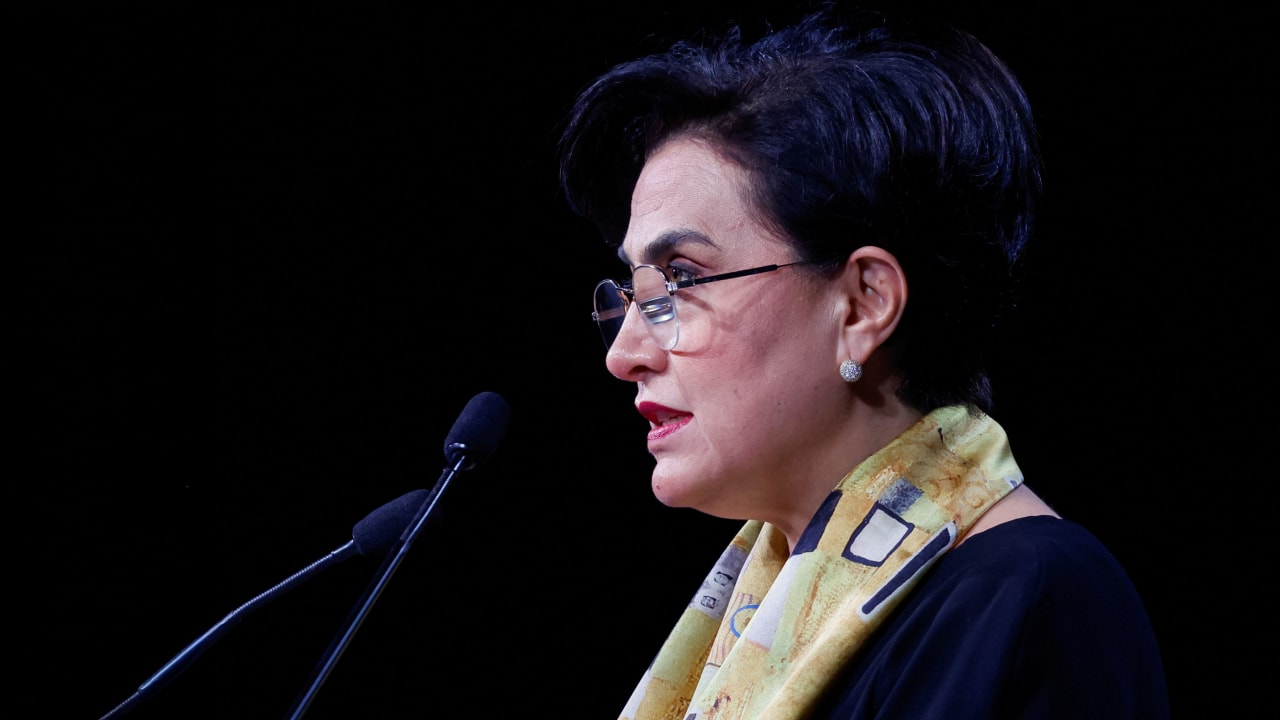
Foreign Minister Gabriela Sommerfeld of Ecuador discusses the country’s foreign policy priorities, focusing on challenges to national security and criminal activity, while emphasizing initiatives to strengthen trade relations and international partnerships.
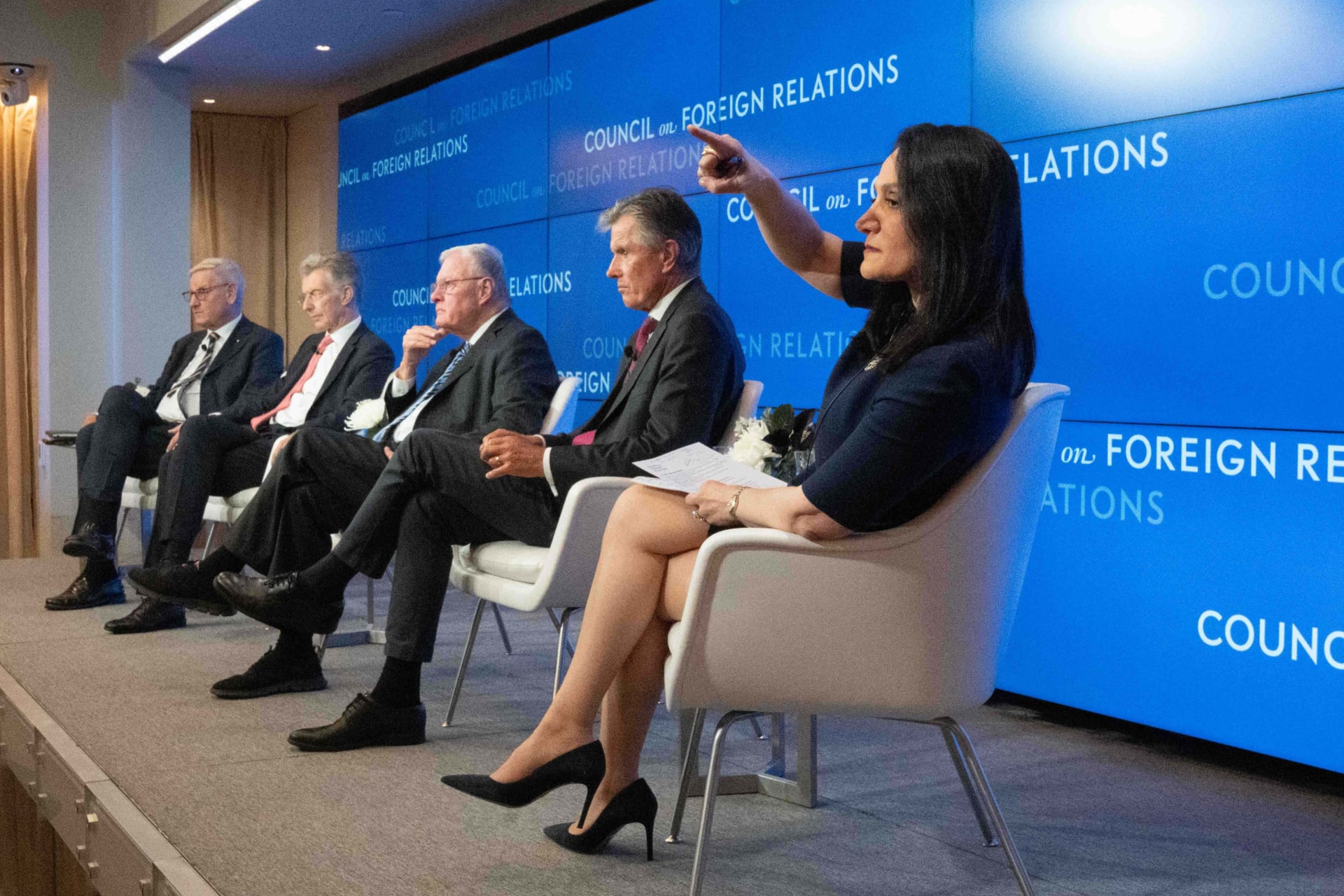
O’NEIL: Good afternoon and welcome to the Council on Foreign Relations. I’m Shannon O’Neil, and I’m a senior vice president and director of Studies here.
And it is my great pleasure to preside over this meeting about Ecuador with the foreign minister, Gabriela Sommerfeld. She is known to many of you. You have her bio, so you have the longer bio. But she is the foreign minister. And she has a long career working in the public sector, in tourism and other areas, as well as in the private sector, in real estate, in renewable energies, and as the CEO of an airline company. So she has lots of experiences across a whole host of economic sectors.
Today I’m going to let her speak for a while and present some ideas. Then I will join her on the stage for a conversation. And then I will invite all of you into that conversation. We have here many members in the room as well as many members online. So we’ll be opening up for questions as we go forward. So please, Minister.
SOMMERFELD: Well, thank you. Thank you for receiving us today, for having us here. We’re very honored to be sharing some things, an interesting story about what’s going on in Ecuador lately. And I can start saying that when President Noboa took office in November 2023, Ecuador was going through one of its darkest moments. The economy was virtually in shambles. And the government could not meet its minimal obligations. We adopted immediate actions to redress such an unprecedented juncture. For instance, we enacted some major laws aimed at reactivating the economy and establishing fiscal discipline. This was achieved despite opposition from entrenched political parties and a judiciary infiltrated by criminal groups.
We rescued Ecuador from the economic collapse and financial catastrophe that others had left us in. From day one, we began to redirect the course of the economy, restore hope to the people, and tackle terrorism and corruption with determination. Neglected by the past administrations, the narco-terrorist threat has posed major challenges to our nation’s security. This led us to declare an internal armed conflict in January 2024, that has allowed for an effective deployment of our security forces, enabling us to confront criminal organizations that can draw on an infinite supply of resources.
Organized crime and its tentacles exacerbate corruption and corrode the social fabric, generating violence, political destabilization, and economic recession. By recognizing the severity of the situation and responding with decisive measures including funding our security forces, we have strengthened our capacity to protect our citizens, uphold the rule of law, and take significant steps to confront the narco-terrorist.
These measures were followed by a referendum in April 2024 that was overwhelming approved by the people in reaffirmation of the collective determination to safeguarding our nation and reinforcing our resolve to meet the current challenges.
After months of tireless work and having restored the capacity of the state and earned the trust of citizens, President Noboa won the presidential election again in April 2025 by a wide margin and took office last May.
Our form of government remains firm against crime, devoted to its people and visibly in its actions. As a fundamental measure to revert the current situation of violence, we address the social dimension of insecurity by investing in our people, especially our youth.
Providing conditions for the creation of jobs is fundamental as any young person deprived of opportunities can easily fall prey to criminal gangs. To further assist our youth we have launched and implemented the biggest scholarship program in the history of Ecuador, ensuring they have the resources and opportunities to build a brighter future.
Waging the war against narco-terrorists and organized transnational crimes request and requires the support of the international community based on the principle of shared responsibility. It is essential in responding to the multidimensional and multinational nature of this scourge that corrodes the social fabric of our democracies.
Effective and strengthening international cooperation is crucial to confront this common enemy whose resources far exceed those of any single state such as Ecuador. We acknowledge the support and material assistance of several countries in this matter, particularly United States.
Since 2024, in cooperation with the United States government, hundreds of tons of drugs have been seized in Ecuadorian territory. Money laundering has been combated and members of organized armed groups have been arrested. The United States designated the organized armed groups in Ecuador known as Los Lobos and Los Choneros as foreign terrorist organizations—FTOs—which allows us to draw on a broader range of tools to confront more effectively these gangs. The recent visit by Secretary of State Marco Rubio to Ecuador strengthens our alliance with the United States to combat organized crime and to open more opportunities for investments and employment as well as the pursuit of a secure and prosperous region. Protecting our diaspora and collaborating in their adaptation including by helping in job searches constitute a priority, including for our foreign service.
A key performance indicator—KPI—for our embassies—we work as a private company right now—for our embassies around the world is identifying job opportunities for Ecuadorian immigrants. Promoting agreements on circular migration as well as on mutual recognition of diplomas and studies contribute significantly to this purpose.
Ecuador is also writing a new chapter in its development model. The new Ecuador moves forward with stability and responsibility. To achieve this we have projected an ambitious yet steady path of economic, social, and institutional transformation.
Moreover, our efforts are oriented towards diversifying Ecuador’s energy metrics. The development plan for the Ecuador—the new Ecuador ’24-’25, and the National Development Plan Ecuador does not stop. That’s how we call, Ecuador does not stop: ’25-’29, aligned with the SDGs, embodying the vision of a state advancing towards sustainable development that guarantees the welfare of the population. The 2025-2029 plan is the guide that will steer public policy and government action over the next four years, prioritizing citizen’s wellbeing, social equity, and sustainable development.
Today, we face an increasingly complex and demanding global economic environment. Market volatility, geopolitical tensions, supply chain uncertainties, and rapid technological changes require us to adapt quickly and effectively. In this regard, the government of Ecuador is actively engaged in reconstructing a competitive economic playing field. Ecuador is open for business and offers attractive conditions for international investment, including a wide array of natural resources, a strategic location in South America, and the U.S. dollar as national currency—which has granted a stability to the economy. Additionally, Ecuador is one of the few megadiverse countries in the world, with clean energy as its main source of power, and rich cultural heritage.
Our country risk indicator continue is its downward trend, standing at 710 points as of yesterday, reaching the lowest level in the last year. When President Noboa took office in November 2023, the country risk reached 2,000 points. So that’s a major achievement. Our economy grew by 4.3 percent in this first half of the year. Growth around 5 percent is forecast for the second half of the year. The economy is improving despite existing challenges, such as in the area of security. It is also important because we didn’t have economical growth in the last, maybe, decade. As of July 2025, adequate employment rose to 38.6 percent. In other words, almost 300,000 more Ecuadorians have adequate employment compared to 2024. This represents a 30.7 percent positive change compared to July 2024.
These achievements are also related to the laws that the national government has been crafting and submitting to the National Assembly. These laws seek to protect peace, transparency, and the fight against terrorism and crime, as well as to generate employment and economic stability. The United States is Ecuador’s main trading partner. And it is crucial for Ecuador to be inserted into the global and regional supply chains. For instance, by taking advantage of nearshoring and friendshoring strategies, which have become commonplace among democracies and allies. Ecuador is a stanch U.S. ally, as acknowledged by Washington, with which we share common values and principles—especially democracy and rule of law. Hence, Ecuador’s position is pursuing and supporting initiatives aimed at boosting democracy in countries like Venezuela and Nicaragua.
At the global level, as a nonpermanent member of the Security Council for 2023-2024, Ecuador has condemned Russia’s invasion of Ukraine. We urge a peaceful resolution of peace with the participation of all parties involved in this conflict. At the multilateral sphere, Ecuador believes that the concept of peace and security must be broadened in order to respond in a timely and effective manner to new threats to democracy, human rights, and sustainable development—including transnational organized crime, a phenomenon that undermines governance, perpetuates violence, and erodes prospects for progress.
The new Ecuador implies embarking on a bold and transformative journey for our nation. This is not just about policy changes but about embracing a new vision for our future, one that prioritize sustainable development, social equity, and economic prosperity. It represents a commitment to building a society where every citizen has the opportunity to thrive and where our collective efforts lead us towards a brighter, more inclusive tomorrow.
We have achieved a series of measures that benefit the population and the country in less than two years in office despite facing several challenges. We have turned the page on history and institute a new style of government, digitally enhanced, both domestically and abroad through a consular network. This new style of government is headed by young men and women—I am the grandmother—(laughter)—free from past—(laughs)—political ties and engaged in fighting all forms of corruption. Of course, much remains to be done. The government of the new Ecuador will continue to work on the pillars of education, the economy, new markets and trade, security, and partnerships to ensure the development of its country and its people, while at the same—at the same time eliminating narco-terrorism, corruption, illegal mining, trafficking in persons.
To make these efforts a reality, there will be a referendum next November 16. We will undertake the necessary reforms to build a stronger state and achieve the trust of the international community.
With all these elements, I want to convey a clear and forceful message: Investing in Ecuador today is not just another financial opportunity, but a strategic commitment to a process of real and sustained transformation. It means joining a country that is opening up to the world with transparency, seriousness, and a long-term vision; a country that recognizes that the true engine of development is the talent, the effort, and innovation of the private sector, and that does not seek to depend exclusively on the state but rather to promote joint growth with the business community. Ecuador is now a market where investments can thrive with confidence and generate real impact, both for our economies and our societies.
We are investing heavily in infrastructure—road rehabilitation, port modernization, and digitization of procedures. We want to make life easier for entrepreneurs and reduce logistics costs to be more competitive. At the same time, we have cut the time required for permits and licenses, and have developed key reforms that are underway to strengthen legal certainty and improve the efficiency of the state.
We are committed to an orderly and attractive energy transition for the private sector. Our country has enormous potential in renewable energy, together with transmission lines. We are facilitating investments in solar, wind, hydroelectric, geothermal, and biomass energy. And we have already attracted more than 1.5 billion in green financing, positioning ourselves as leaders in sustainable bonds in Latin America.
In summary, Ecuador’s foreign policy aims to expand its economic, commercial, and investment relation with countries that share a similar vision and approach. I believe that the United States and many other countries clearly ally us with these foreign policy objectives, as both nations share common priorities and complementary interests.
In the new Ecuador, we foster innovation, entrepreneurship, and support for fresh ideas. We trust in the youth—in our youth. We embark in this journey in the belief that we can make a difference, achieve great things, and lead by example. Thank you. (Applause.)
O’NEIL: Excellent. Well, thank you, Minister. And I will start a conversation here, and then I’ll open it up to those of you in the room. And so many things to pick up on in your—in your speech.
But let me start with this one. And you know, as we look around the global economy today, it really is in flux. There’s lots of changes happening. Sort of the old—(inaudible)—whether the WTO or the structure of tariffs, are really up for grabs and fundamentally shifting. And you know, countries like Ecuador, which are, you know, smaller economies but quite open, right, trade is 60 percent of your GDP, often they are the kinds of countries that benefited most from these set rules. So as you look to navigate these fundamental changes that are happening, how are you navigating? How are you working with the president? How are you thinking about Ecuador’s role in a in a very changing sort of global trading structure?
SOMMERFELD: Well, it depends where you are. At the moment any country take the decision—for example, for Ecuador when the U.S. establishes new tariffs we didn’t have, and we still do not have, a commercial or a trade agreement. Which was very bad for Ecuador because most of the countries of the region, mainly the ones that are around Ecuador, had a trade agreement with the U.S. So we were not competitive. At the moment the tariffs came, at the moment the U.S. started negotiating with each country at a time, it gives us a chance, a moment that we can be competitive if we know how to negotiate, and to value a very great partner like the U.S., our main market. And we have great products. So it will be a win-win situation for both Ecuadorians and U.S. citizens. And we see it as a good opportunity.
It’s also very important to mention that at the precise moment when these measures were announced, we called the U.S. embassy in Ecuador, in Quito, to have the meeting the same day. So we had the meeting around 7:38 at night with the mission in Ecuador—U.S. mission in Ecuador. And what we understood from this is that they were trying to do and to work with the near- and friendshoring, especially with the nearshoring—something that we have been requesting as Latin American countries for a while. I do not—come from the private sector. Actually, you just mentioned, I come from the private sector. This is my second time in the public sector, first one in the government. Before I was in charge of a public company, but not in the public sector.
So my understood was that U.S. was trying to work over the nearshoring and that’s what we told to the diplomats that came from the embassy so we can have the meeting. And what they answer was that, yes, that is what they explained to them in a call they had. They were trying to work the nearshoring. Why I say this? Because Latin America only got 10 percent tariff. Too much, not that much. It was good. It was bad. But it put in a different position Latin America rather than the rest of the world. So Latin America had an advantage. And it was a clear message that it was being worked in—like, with a nearshoring vision.
O’NEIL: Mmm hmm. Let me ask, Secretary Rubio, the U.S. secretary of state, was just down visiting you a couple of weeks ago. And you had a lot of conversations and some announcements of security assistance and the like. And I’d be interested if you can expand a little bit on the conversations that happened, and particularly because the United States has moved its, you know, overall security policy pretty significantly over these last eight months.
So we’ve seen, you know, particularly some of the organized crime groups you talked about moving—becoming terrorist organizations, being designated as terrorist organizations. We’ve seen the U.S. government leaning into the Department of Defense, particularly on the Caribbean side. Not as much on the Pacific. But it’s a bit of a different approach. So as you—you’ve worked with different governments, right? President Noboa worked with the previous government, is now working with the Trump administration. What are some of the continuities? What do some of these changes mean for the way you’re thinking about the security cooperation?
SOMMERFELD: Well, I can tell you that Ecuador, with President Noboa, was working over a very strategic and clear agenda with the U.S. Firstly, illegal migration, because we had a lot of Ecuadorians that were violated in many, many ways when these criminal groups, transnational criminal groups that respond to terrorist groups. So they be in, like, a beautiful dream when they reach to the U.S. And that’s not true. In order they can reach here, they have to walk from Ecuador through Colombia, violent country; through El Darién, violent jungle, before they come into Panama; through many violent countries around Central America, Mexico; and then maybe they will come in an irregular way to the U.S.
We are not against migration. We’re against irregular and non-safety migration. We believe migration should be accompanied through programs that are (considered ?) by two countries with private companies that will give opportunity to foreigners no matter if it’s Ecuadorian, U.S. citizens, or from any other country, and they give this opportunity respecting their rights and in a safer way.
So we have been working in that way. That was one of the points that we talked in the visit with Secretary Rubio and President Noboa to Ecuador—immigration. Then we talk about security issues. Even though we received Secretary Noem from Homeland Security weeks before and we talk about the security agenda, it is a topic that we usually talk with any single authority from the U.S. regarding Ecuador-U.S. agenda.
So we talk about security issues. We talk about the groups now that the U.S. considers them as terrorist groups—Los Lobos/Choneros—to explain who they are, that affects also U.S. citizens’ interests. The problem comes from around the region but it doesn’t start or end in Ecuador. Actually, it doesn’t start in Ecuador—narcotraffic issues, illegal mining issues.
We do not produce cocaine. We do not consume the amount of cocaine that goes through Ecuador. We were responsible for being an easy and cheap country to go through in order it can be distribute all the cocaine that was produced around Ecuador.
Right now we’re fighting against that. That’s our main goal. That’s our main issue. We’re fighting against narco-terrorist groups that want to move through Ecuador their products to the U.S. or to Europe and that’s why we keep cooperating so closely to the U.S.
We had three major agreements that we signed last year—two years ago with the U.S. and we have been implementing during these two years of government of President Noboa, and we will keep strengthening—oh—(inaudible)—OK—and we will keep strengthening these kind of agreements and working in security issues with the government of President Trump.
The last thing that we’re working together is a more prosperous economy for both countries, saying that Ecuador has great products because our location, because our soil, because the processes that our farmers and our industries have for our products. We have great products to offer to you and we also have a lot of goods that we need to demand from the U.S. to Ecuador.
President Noboa always tells an example. Ecuador buys a lot of machinery, U.S. brand, U.S. industry—for example, John Deere. That’s what he always uses, or Caterpillar.
But we buy them from the industry in Brazil because it’s cheaper for Ecuadorian. We have lower tariffs and we bring them to Ecuador from Brazil. So we have a deficit with Brazil because we do not send any kind of product to Brazil.
But what we’re doing right now because of the tariffs we’re negotiating a trade document, agreement, however we can call it, that will allow us to bring these kind of products from your industries in the U.S. so you can create more jobs because there will be more demand not only for Ecuador but for any other country and we can sell you better products that you do not produce or we produce in different seasons.
So we have complementary economies and that’s a win-win situation. That’s what countries should be working on—to develop our economies, to create more jobs, to bring new opportunities so people dream in their own country, not dreaming in any other country. To create values and to have family, to keep growing in their own country. Go and visit for tourism, for whatever, to other countries but develop in their own countries.
O’NEIL: I’m going to ask one more question and then I’m going to open it up to those of you here, the members and online.
So the last thing let me ask you is about Ecuador and we’ve talked about Ecuador and the United States. Let’s talk about Ecuador and China. China is a big investor in Ecuador. It’s a big trading partner, and President Noboa’s first international trip was to go to China. There are some tensions, obviously. You know, we were talking about before how I visited the Galapagos. Mike has visited the Galapagos. Chinese, you know, fishing boats are known to sort of circle the Galapagos and, perhaps, enter the waters at times.
But as you think about, one, what are the opportunities for Ecuador with China? And, two, as you sometimes see the U.S. government asking other governments to choose between the United States and China we’ve seen that some in the—as you were saying, the trade frameworks or conversations that are going on with Europe and the like—how do you see Ecuador navigating the balance between these two great powers?
SOMMERFELD: Two important facts. President Noboa has been president for twenty-three months by now—twenty-two months. We have flew to twenty-six different missions. In each mission we can visit one or two countries or three or four. One time we visit five countries.
So it was not the first country to be visited.
O’NEIL: First of his second term, let me say.
SOMMERFELD: OK.
O’NEIL: Yes, first of his second term. (Laughs.)
SOMMERFELD: We didn’t feel we had a—
O’NEIL: Sorry about that. Yes.
SOMMERFELD: Because people working—yeah, working very hard.
But we visited China, yeah, and we have to say the second—the second fact is that China is our second market. That’s how Ecuador is. That how things goes in Ecuador, and it is our second market. We sell a lot of bananas, shrimps, pitahayas to China, mainly, and right now we’re going to sell dairy products as well.
So we have to keep that market open because the worst thing that can happen to Ecuador is to close any market, to lose jobs, and to throw our youth to the criminal groups. What they are doing right now is they are bringing our youth people to those groups. There are 50,000 armed men fighting against our army forces, our police, who try to bring security to our people.
So what we cannot do is lose a single job. We need to keep creating and to bringing and opening new markets in different parts of the world. Better if we’re aligned countries but if not we need to keep these kind of relations.
So how it goes, how we manage this agenda with China or this agenda with the U.S., we have an agenda for each country. There are some countries like European countries, U.K., Japan, Korea, Canada, U.S. that we work in immigration issues, in economic issues like corporate trade issues, and security issues. There are other countries that we just work in trade issues.
So we cannot have the same agenda for all the countries. These are really hard. We can see what’s happening here in the U.N. Assembly. Everybody has a really radical position. Not everybody understands each other.
But we are looking for the best of Ecuador and the Ecuadorians and we need to keep it that way because we’re in a very sensitive moment that we need to create a lot of opportunity and evaluate which kind of partnership we have with each and every single country.
O’NEIL: That’s great.
So I’m going to open it up. Please raise your hand, introduce yourself, and ask a brief question.
I’ll start with Alex right here.
Q: I’m Alexandra Starr with International Crisis Group. Thank you for your remarks.
The CECOT in El Salvador has received a lot of attention internationally since the Trump administration sent immigrants from the United—living in the United States there. I was wondering if the Noboa administration still sees CECOT as a model it wants to replicate, or is in the process of replicating on Ecuadorian soil.
SOMMERFELD: Pardon me. I didn’t understand—
O’NEIL: (Speaks in Spanish.)
SOMMERFELD: Ah, CECOT. OK. OK. No. No, we do not see as a correct model to develop in our country. We have our own policies. We have our own way of developing prisons. And we have some agreements with the U.S., not to bring prisoners to Ecuador, but we already signed a third country agreement that will allow U.S. to send us some people that are requesting a refugee, how to say—
O’NEIL: Asylum?
SOMMERFELD: Asylum, yeah, uh huh. Yeah, refugee asylum. And you can send us that kind of persons to Ecuador, up to 300 per year. It was not easy to take that decision because we already have received a lot of immigrants through different agreements that we have signed with the U.S., with you, yeah? And we are one of the countries that have received the most—a great amount of immigrants from other countries. And we have a very good policy regarding migration and human mobility.
But this time was not easy to take this decision, and to sign, and to announce that we were bringing refugees from third countries to Ecuador, because of the situation we are living. We need more jobs. We have—we’re facing security issues. We’re living a war inside Ecuador. Even though you won’t feel it in most of our country, because you won’t feel it that we’re living a war. There are some provinces in the coast—mainly in the coast of Ecuador and in the northern border with Colombia, that they are living a daily war, armed war. So it’s not easy.
But we evaluate with President Noboa. And we knew it was very important for our ally, the U.S., for President Trump, signing this third country agreement. It was really important. So we decided to extend the support that it was very important for President Trump. And it was—it will support our main partner, the U.S. And it was not easy. Next day the press were hitting us. But we have to give in order we can take also.
O’NEIL: OK. Back there.
Q: Hi. Thank you very much for your comments. Elizabeth Champion, Morgan Stanley Investment Management.
I wanted to ask about the potential for U.S. support for Ecuador’s electricity sector within the context Secretary Rubio’s visit a few weeks ago. Just with the knowledge that there’s the potential for another round of blackouts this year, and how damaging those were for the economy last year, it seems like we’re on track to have blackouts this year. So wanted to ask about U.S. investment there, and what those conversations have been. Thank you.
SOMMERFELD: Thank you for the question. Firstly, it’s very important to say that we are open for business. That we want U.S. investments. And that we are always launching new bidding process so U.S. companies may come and may invest, especially in energy. We issued a new urgent economic law, which has a beautiful framework for investors in energy—high prices and a multilateral guarantee of payment. So even though if Ecuador do not pay you because of whatever, you will get paid through World Bank or through DFC here in the U.S.
We have these two institutions that extends guarantee for your investments in energy industry—not only generation, but also transmission. We need new transmission lines. So there is a good opportunity for you to bring your companies to invest in transition lines. Which is a great business because there is no competition. Once you have the transmission, nobody else will build a new transition line together with yours. So is a great business. And also in generation. We want sustainable energy. So we are promoting to invest in solar, wind, and geothermal generation plants. So there is a good opportunity.
The other part of the question was?
Q: Stave off blackouts.
SOMMERFELD: OK. Why we had blackouts last year? Because Ecuador didn’t give maintenance to our power plants at the moment they were supposed to be given. So we didn’t have our diesel plants working the way they were supposed to be working if there was a lack of hydro or any other kind of generation—energy generation. What happened last year is that we didn’t have before sequía—how to say sequía?
O’NEIL: Drought.
SOMMERFELD: Drought in the last sixty years like the one we had last year. You can see the rivers without water. The huge rivers that goes to the hydro plants didn’t have water. So it was—we had a lot of fires. President Noboa came here last year for the General Assembly. And he couldn’t stay the third day. He had to leave in the second day because our country was burning. When I was—when I say our country, it is because all over around our territory was burning out because we were out of water. No rains. No water in the rivers. We have to request support to other countries to bring their helicopters, their planes, so they can help us with the huge fires we had. U.S. supported us a lot to our firefighters with lots of equipment as well.
So what we live in Ecuador was the perfect storm last year. Firstly, no rains, no water. We depend on hydros. So it was a huge problem. And in the other side, we didn’t have the power plants that are fueled with diesel in a good shape so they can be turned on and start generating energy. Right now, we have floods at this moment, OK? So the world is crazy. Climate is crazy also. And September we have floods, lots of rain. All the hydros are working. But still, why we need these energy investments? Because we’re going into mining—regular mining, non-illegal mining. The mining that will take care of our environment with sustainable processes.
And we have lots of gold. We have lots of silver. We have not invested yet in that kind of industry. And we’re starting to invest in those kind of industries. So, you know, mining needs a lot of energy. And we need to start focusing in having more energy. We are growing. We’re an economy that it’s growing. And in order you can grow, you need energy. We keep growing in our population. And, at the moment, you keep growing in population, you need more energy. So we do need to invest in energy. And it’s a good opportunity to invest in that industry in Ecuador.
O’NEIL: So, Minister, you can see that a lot more questions here and people would love to keep you, but your team has told me that you have one more. I can take one more. OK, how about right here? Thank you.
Q: Thank you. Daniel White, former deputy assistant secretary for strategy.
A question I had is, the Department of Defense is in negotiations as far as having a DOD military base down in your country, in Ecuador. And now it’s going to be for a referendum to the Ecuadorians. And I’m curious kind of how you all are selling that to the Ecuadorian people, as they have it on the referendum later—you know, next—in the following months. And then, also, how do you think the perception of—China will have, given that it’s now permanent U.S. military basing in the region?
SOMMERFELD: Well, thank you for your question. When I mentioned about—I don’t know if I mentioned when we talk about the narco-terrorist groups, they start working in our country fifteen years ago, and they have get stronger these last fifteen years. And it is the same amount of years that the moment that a president—a former president in Ecuador request to leave to the military base the U.S. used to have in Ecuador. So bringing back this kind of support is just an exercise of our sovereignty—(changes pronunciation)—sovereignty. Sorry my pronunciation.
O’NEIL: Perfect.
SOMMERFELD: And it’s good for both countries. It is good for civilians. It’s good for our people. It is not selling country. It’s not selling any country. It is just working together in a huge problem that impacts Ecuador and the U.S. So it’s good for the interests of both countries.
Hopefully, that will happen. But who has the right to say it will happen or not, because we live and we believe in democracy, is our people. So we are going to a referendum. The good thing is that the survey says that 75 percent of our people wants U.S. military bases back in Ecuador, so hopefully it will happen. We will see what happen on November 16, when we go into the referendum.
Thank you.
O’NEIL: Excellent.
Well, thank you, Minister Sommerfeld, so much for joining us today. (Applause.) Those of you who want to see this again, it will be posted on CFR. So thank you.
SOMMERFELD: Thank you so much.
(END)
This is an uncorrected transcript.