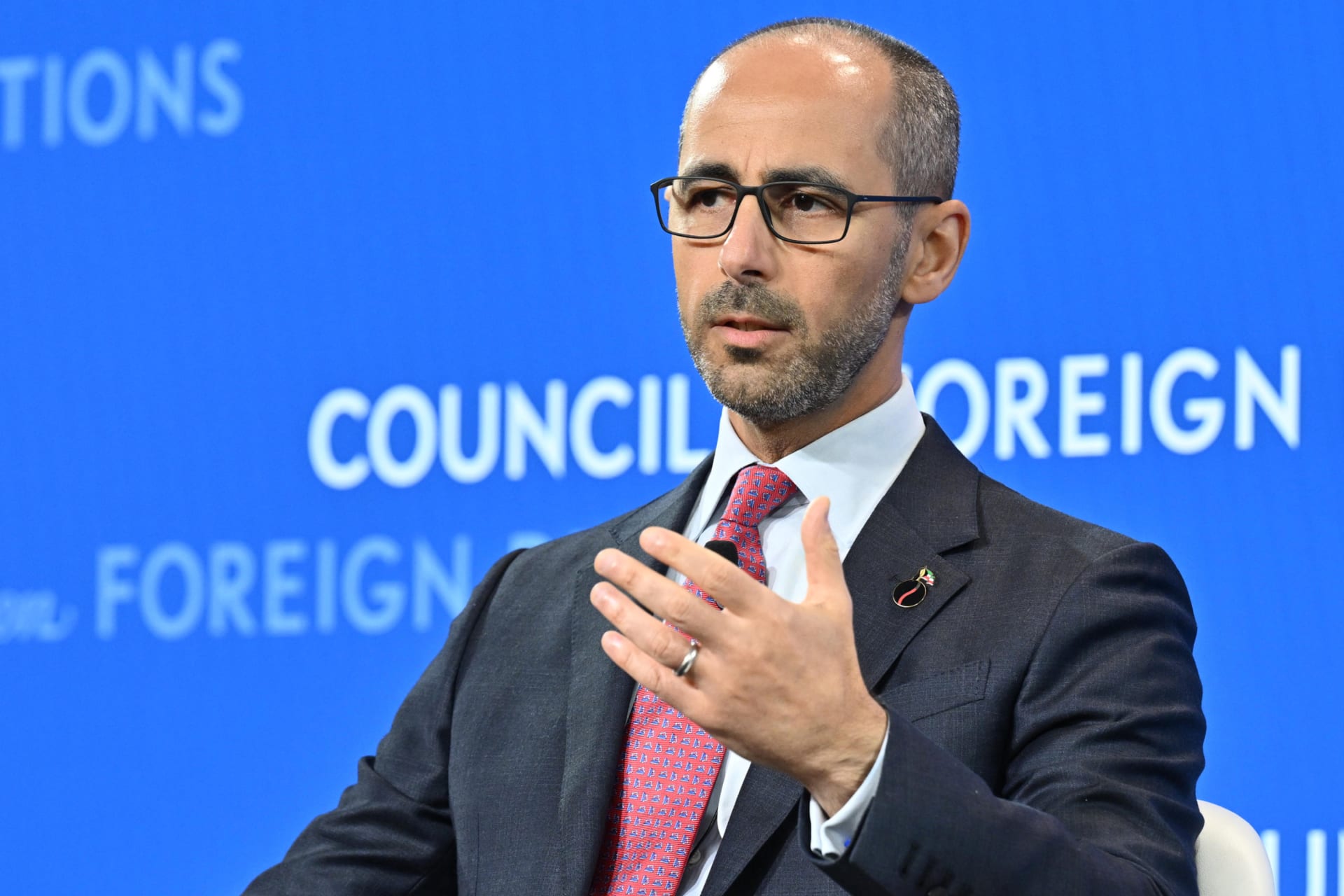
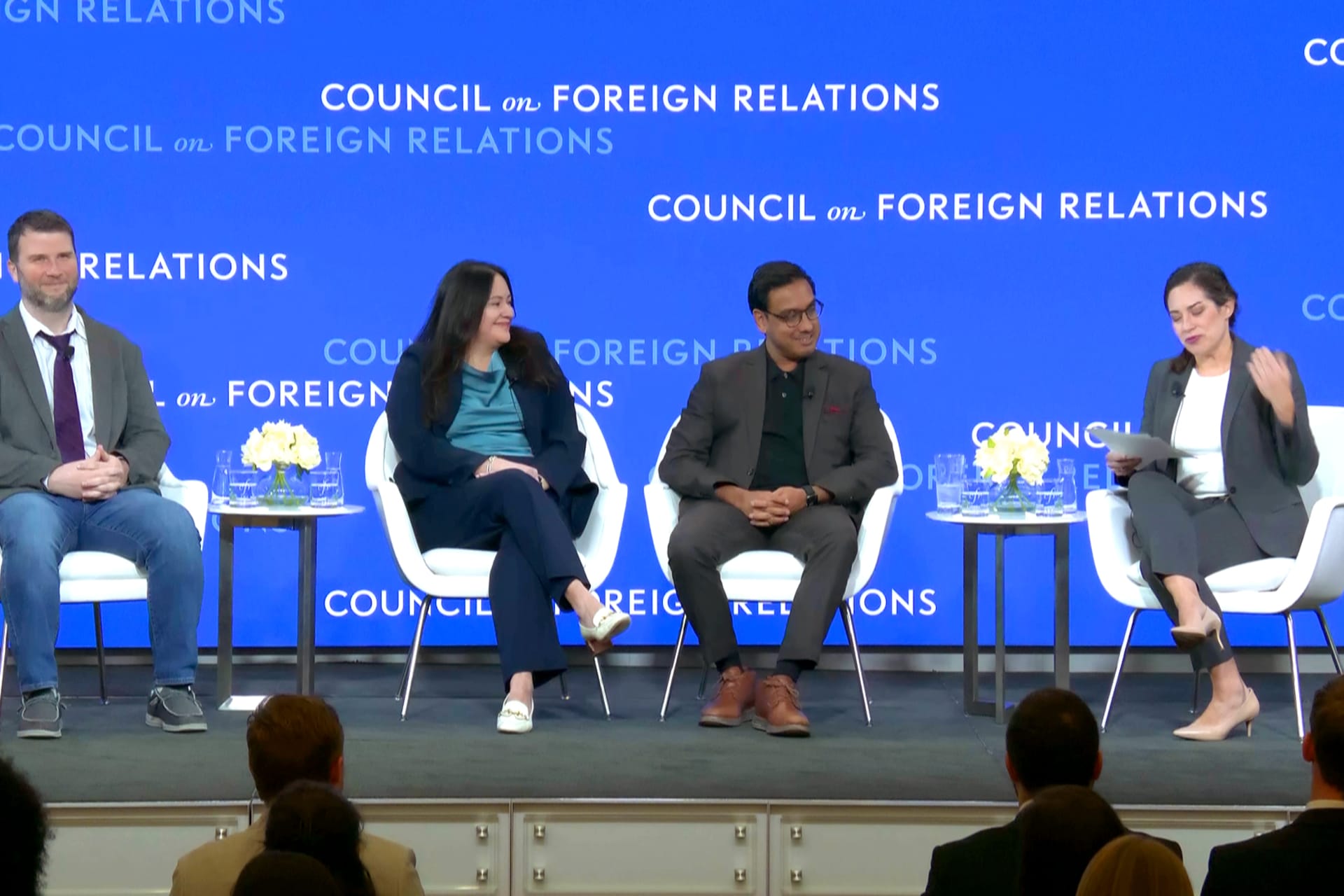
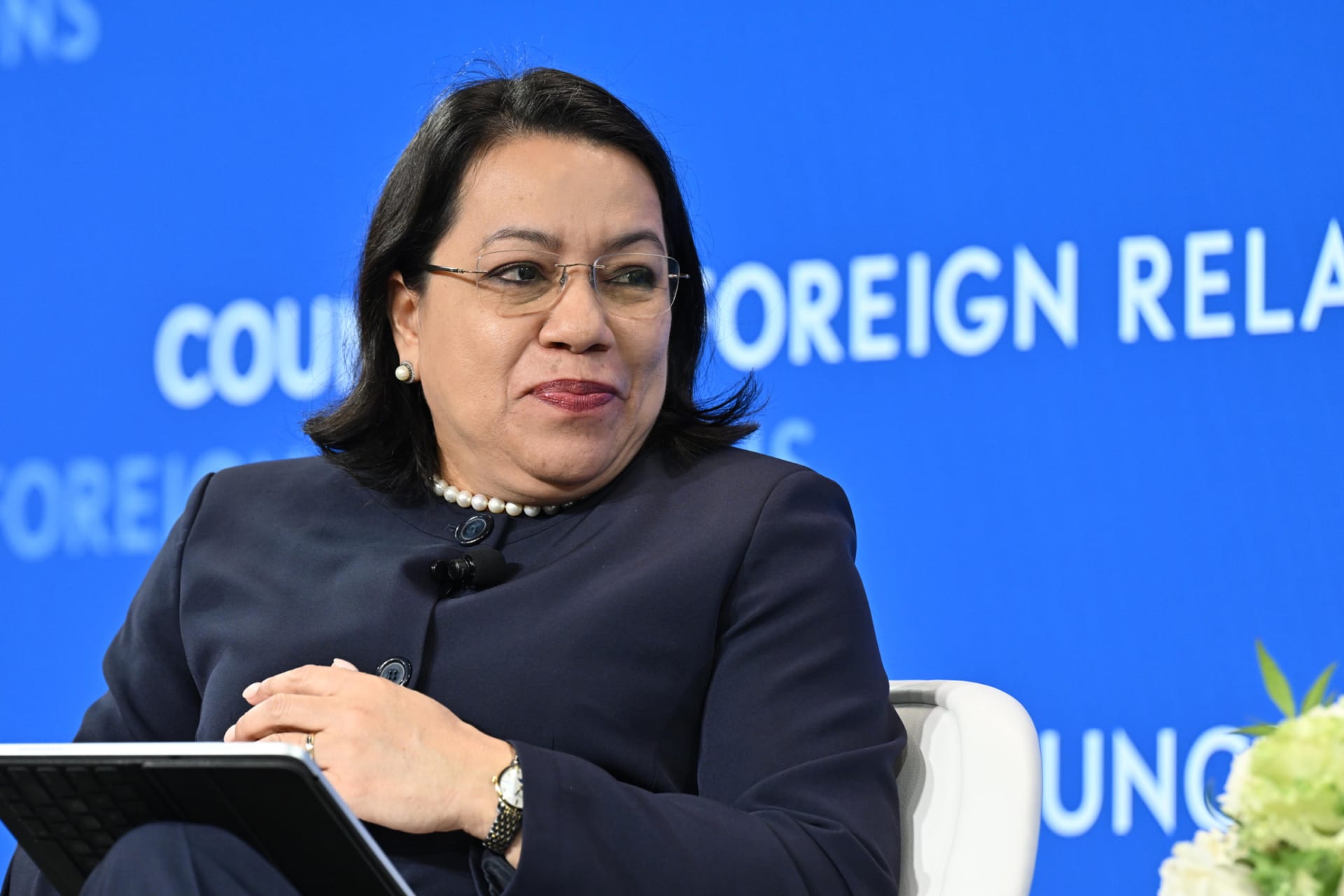
C.V. Starr & Co. Annual Lecture on China: Reassessing U.S.-China Relations
Event date
Speaker
- Gaston Sigur Professor of Asian Studies, Political Science and International Affairs and Director of the China Policy Program, Elliott School of International Affairs, George Washington University; Distinguished Visiting Fellow, Hoover Institution; Author, Breaking the Engagement: How China Won & Lost America
Presider
- Rush DoshiCFR ExpertC.V. Starr Senior Fellow for Asia Studies and Director of the China Strategy Initiative, Council on Foreign Relations
David Shambaugh, author of the new book, Breaking the Engagement: How China Won & Lost America, discusses the evolution of U.S.-China relations from the 1970s to today’s escalating trade war and evaluates the legacy of engagement.
Video Highlights
The C.V. Starr & Co. Annual Lecture on China was established in 2018 to honor the trailblazing career of C.V. Starr and the Chairman and Chief Executive Officer of C.V. Starr & Co., Maurice R. Greenberg. This meeting is presented in partnership with CFR’s China Strategy Initiative.
DOSHI: Can you hear me OK? There we go. I hope you all enjoyed lunch. There’s still food in the back, of course. Welcome to the Council on Foreign Relations. My name is Rush Doshi. And I’m the C.V. Starr senior fellow for Asia studies and director of the China Strategy Initiative here at the Council. I’m excited to welcome you all to our annual C.V. Starr & Company lecture on China, delivered today by our distinguished speaker, Professor David Shambaugh.
This lecture series was established in 2018 to honor the career of C.V. Starr and the chairman and chief executive officer of the C.V. Starr Company, Maurice, or Hank, Greenberg. I’d like to also welcome his son, L. Scott Greenberg, executive vice president of C.V. Starr & Company, who’s also joining us today virtually. And alongside him, we have a hundred of you in the room, as well as more than 300 watching online right now. So we’re very excited for the turnout for this fantastic lecture.
Today’s lecture is also part of the CFR’s China Strategy Initiative, one of our four cross-cutting initiatives here at the Council. And particularly relevant to today’s lecture, one of the core pillars of the initiative is to consider how we manage competition with China, more fundamentally, how we understand the ebb and flow of U.S.-China relations.
And there is no one better to help us navigate that question than Professor David Shambaugh, an award-winning author—and I had to double check this, I had to fact check it—but an award-winning author of more than thirty-five books on China and Asia. Yes. That’s thirty-five. That’s a book a year for him, for his entire life. There is no one better than him to help us understand these questions. He’s the Gaston Sigur professor of Asian Studies, political science, international affairs, as well as the founding director of the China Policy Program in the Elliott School of International Affairs at George Washington University. In addition to his position at GW, he is a distinguished visiting fellow at Stanford’s Hoover Institution.
He was previously on the staff of the National Security Council in the Carter administration, and for twenty years was a non-resident senior fellow at the Brookings Institution. Now, prior to joining the Elliott School, he was a lecturer, senior lecturer, and reader in Chinese politics at the University of London’s School of Oriental and African Studies, where he also served as editor of the famous journal, the China Quarterly. He has served on the Board of Directors of the National Committee on U.S.-China Relations, the advisory board of the National Bureau of Asian Research, and the East-West Center Fellowship Board. He’s also a member of the board of studies here at the Council on Foreign Relations. He has lectured all over the world, received countless scholarships, and is an active public intellectual and frequent commentator on international media.
Most recently, and of direct relevance today, he is the author of the book, Breaking the Engagement: How China Won and Lost America. If you haven’t purchased a copy, they’re right outside. I don’t want to say too much about the book just yet, because David will, of course, make its core argument. But I did want to take the opportunity to endorse the rich book’s content. I think it will be a core part of the literature on U.S.-China relations for years to come. So, with respect to the run of the show, in just a moment I’m going to invite Professor Shambaugh to the stage to offer some opening remarks, about fifteen minutes’ worth. After that, I’ll join him for question and answer for about twenty minutes. Then we’ll turn it to the audience, both in the room and online, for your questions as well. We hope this to be an interactive discussion.
And with that, let’s welcome to the stage Professor David Shambaugh. (Applause.)
SHAMBAUGH: Well, good afternoon, everyone. And thank you very much for coming, on this rainy, rainy day here in New York City. And thanks to everyone watching online. And, Rush, thank you very much for your overly generous and kind introduction. It is a real honor and personal pleasure for me to give this year’s C.V. Starr & Company Annual Lecture on China. And I’m deeply grateful to the Council—(coughs)—excuse me—for the opportunity.
For those of you who don’t know, Cornelius Vander Starr had a remarkable career in China, establishing the first American insurance firm in 1919 in Shanghai. It was then called the America Asiatic Underwriters, which later morphed into the famous and giant American International Group, or AIG, led by Maurice Greenberg. During the Second World War and the Japanese invasion of China, Starr worked for “Wild Bill” Donovan—I’m sure you know who that is—and the OSS in China, and including doing intelligence work in support of Claire Chennault’s Flying Tigers. Since its founding in 1955, the C.V. Starr Foundation has played, really, an instrumental role, I feel, in funding Chinese and Asian Studies in key American universities, notably Columbia and Cal Berkeley, which was Starr’s alma mater, and nongovernmental organizations, such as Council on Foreign Relations, National Committee on U.S.-China Relations, and others. So I think this is important historical context when we consider the past century’s evolution of U.S. China relations.
Now I’m going to use this opportunity to discuss the long evolution and trajectory of U.S. relations with and policy towards China, and will do so by discussing my brand new book—literally out this week. So it’s a big book, 430 pages or thereabouts. And what I’m going to do with what time I have allotted to me, fifteen, twenty minutes, is to just really try and summarize some of the key takeaways, and then Rush and I are going to have a—dive further into it during our discussion. But, before I summarize it, let me first note that I dedicate the book to Winston Lord, who I think needs no introduction to this audience, former president of the Council from 1977 to 1985, when, in fact, Win and I first met, here in this building, in a different conference room.
Winston, of course, played an instrumental role in the 1971-72 Nixon-Kissinger opening to China, and was on that first trip, secret trip, from Pakistan into Beijing in ’71. He served as ambassador to China ’85 to ’89, and held many other senior positions in several administrations, both Republican and Democratic. Now, I admire Winston enormously professionally, but he’s also become really a close personal friend over the years. Amongst other things, we share sports—not a passion for, an addiction to sports. (Laughs.) So we’d hoped to have Winston here today in person, but I believe he’s tuned in online from Banff, Canada. So, Win, hi. So that was, I think, important to mention, being where we are.
OK. What can I tell you about a 430-page book that covers really half a century of American China policy? Well, in temporal terms, it covers three broad periods, the Cold War period of estrangement, the four-plus decade period of engagement from 1972 to 2017, when engagement ended, and the past eight years of disengagement and comprehensive competition—(coughs)—excuse me. So it covers a long period of time. And there’s even an historical discussion of America’s relations with China during the Qing Dynasty and the Republican period of 1912 to ’49. Since it’s, I think, important, crucial context for understanding our more recent interactions with the country, its government, and its people.
So in observing the U.S.-China relationship over a very long period of time personally, and teaching about it—I have an annual graduate seminar on U.S.-China relations—I’ve puzzled with—well, I’ve wrestled with, I should say, two principal puzzles. One more historical, one more contemporary. First, I’ve grappled on the historical side with what are the deep, underlying drivers of this relationship? And what has caused, in particular, the repetitive fluctuation in the relationship over time, from amity to enmity and back to amity and back to enmity—and the cycle just seemingly repeats endlessly.
In what the late, and I think great, historian Warren Cohen, who, sadly, just passed away about a month ago in Washington, D.C. Warren used to refer to this fluctuation as the so-called love/hate cycle in U.S.-China relations. So that’s the first historical puzzle. And the first chapter of the book is called “Elusive Equilibrium.” Why can’t these two countries just—not just get along, but find some sort of modus vivendi? So if you look for one pattern over time in U.S.-China relations, it’s fluctuation. It’s not a linear relationship at all. OK, so that’s the historical.
Now, the second more contemporary puzzle is why, after four decades of American engagement with China, in which the American and Chinese governments and societies became deeply entwined with each other, and bilateral cooperation was predominantly the norm—despite, you know, periodic frictions and occasional crises. Why over the past decade has engagement given way to comprehensive competition, where frictions and systemic disengagement have become the overriding character of the relationship? How is it that America—that China’s previously positive image among the American public has taken a nosedive since 2012, whereby last year in 2024, 80-plus percent—83 (percent), I believe—of the American public today view China unfavorably? Forty-two percent view China as an enemy, 50 percent view it as a competitor, while only 6 percent see China as a partner, according to the Pew Research Center data.
So the answer to these puzzles, and the basic argument of my book, is that over the five decades or so from the 1970s to the 2010s, China won over America through its generally reformist domestic policies and its foreign policies, which coincided with the premises and expectations of America’s engagement strategy towards China. So American expectations of China, you might say, are the independent variable, and China’s own policies and behavior are the dependent variable over time. And in short, when China’s policies and behavior conformed with American expectations, the two could cooperate, and generally had non-conflictual relations. But when China did not conform to American expectations, frictions followed.
So the first half of the book traces the evolution of the engagement strategy and tactics from Nixon through the Obama administration. I have four strategies that were what engagement was premised on, and seven tactics for how the Americans went about trying to implement it across Democratic and Republican administrations. But to fully understand this fluctuant evolution requires recognizing, I really believe, the long-standing and deeply embedded paternalistic missionary impulse to mold and shape China that lies at the core of the American approach to China over several centuries, including C.V. Starr’s period a century ago.
American attempts to shape, mold, and change China far predate President Nixon’s opening. Indeed, they date back to the 1800s and the first two American ambassadors to China, Anson Burlingame and J. Ross Browne. Burlingame and Browne both sought to move the Qing Dynasty leaders in more modern and liberal directions. But, interestingly, they also epitomize two really radically very different alternative approaches to doing so. Burlingame advocated for what he called the cooperative policy. In fact, he gave a speech here in New York City when he laid out his cooperative policy, which might be described as patient paternalism to work with the Chinese reformers of the late Qing in a cooperative fashion. By contrast—(laughs)—Ambassador Browne, who came after him, favored a coercive policy to pressure the Qing court.
So Burlingame indulged the Chinese, you might say, even learning the Chinese language. And the Qing court liked him so much they appointed him as the representative of all foreign—(laughs)—embassies in Beijing. So we like you so much, Burlingame, you get to represent the Europeans and everybody else. So by contrast, though, Brownd was condescending, advocated tough diplomatic pressure, moral condemnation, and the threat of force. So I mention these two early emissaries because their radically different approaches—one to accommodate the Chinese, the other to pressure them—because they precisely encapsulate the twin alternative approaches, I think, that Americans have pursued vis-à-vis China over the subsequent 150 years. Right now, we’re in a kind of J. Ross Browne—well, we don’t know right now, in this Trump 2.0 administration. But at least Trump 1.0 reflected Browne’s sentiments.
OK. So despite their different tactical approaches, their strategic goals remained the same, to change China. This is in the American DNA, I feel and argue. And it constitutes a core element of the American approach to China over time—imperial China, republican China, communist China. So the engagement strategy of recent decades, I think, has its—has its antecedents in Ambassador Burlingame’s cooperative approach. Moreover, though, however ironically—(laughs)—I find in the book, in the research, that the deeper the engagement and presence of each side in the other country, the deeper the suspicions and the greater the frictions that emerged. Now this is counterintuitive and surprised me. There’s a real irony, because engagement is premised on the assumption—the Liberal assumption, with a capital L, that the deeper and broader each side’s presence in and interactions with the other, the greater the cooperation and the stronger the relationship would be.
Well, I lay it out in several chapters in the book. Beginning around 2010, and on to the present time, a variety—a wide variety of American actors began to encounter considerably increased obstacles to their work in China, NGOs, journalists, American companies, foundations, universities, and educational exchange organizations, the U.S. embassy and its consulates, all began to encounter increased impediments and obstacles to doing their normal work in the country. I too personally experienced it. I was a senior Fulbright scholar at the Chinese Academy of Social Sciences in 2009 and ’10. And they did their best to impede my research, not facilitate it. Looking back historically, 2010 was the turning point in recent Chinese history, not 2012 when Xi Jinping came into power. Two years before, under Hu Jintao. Rush Doshi has written very well about this in his own book.
OK. But in 2012, when Xi Jinping did come to power, over the last thirteen years, these trends and obstacles have only dramatically increased domestically in China. And what international China specialists refer to as China’s so-called assertiveness and wolf warrior public diplomacy has ensued. Everything in China has become increasingly securitized—that’s ānquán huà in Chinese—over the past decade. And this securitization has negatively impacted a wide range of American and other foreign actors inside of China. Moreover, beginning about a decade ago, China has stepped up its own influence and interference activities in this country, and other countries—many other countries, which began to negatively impact American society and laws, American states, universities, civil society, media, and national security.
So I say “stepped up,” because such influence and interference activities in this country have long been present. But beginning in the 2010s China’s intelligence, media, and united front organs have all expanded their presence and malign activities inside of the United States. As a result, the American government has also securitized the relationship. You know, mutual securitization has definitely contributed to the downward trend of the relationship over the last twenty years. Each government sees the other as subversive, which is parallel. So, as a result, over this past decade or so China progressively has lost America. Hence, the subtitle of the book, How China Won during the engagement period America and lost it over the last twelve, thirteen years of the Xi Jinping regime. Because it has—the Xi Jinping regime has undermined both the premises and goals of American engagement, and the actual interests of a variety of these American actors that I named—NGOs, companies, universities, and media, and so on. And those different actors comprise, what I argue in the book, is called the engagement coalition, right?
So, in short, make no mistake, Xi Jinping broke the engagement. This echoes the, I would say too—just observe that this finding, argument echoes the same argument of Susan Shirk in her recent book, Overreach, how Xi Jinping derailed China’s peaceful rise, which won the Council’s Arthur Ross Book Prize last year for the best book in foreign affairs. So my book is somewhat parallel to Susan’s. Follows on. Looks at different things, but we echo each other.
OK, so the engagement strategy, I argue, and the coalition domestically, and any foreign policy of the United States, must have broad-based sort of stakeholder-ness and buy in from different actors for it to be sustainable. The beauty of the engagement policy was precisely its elasticity. There was lots of space for different actors to buy into it. But over the last decade, one by one, they’ve peeled off, I argue, and become alienated from, impeded from, and found difficulties working with the Chinese. OK, so the whole second half of the book is about that. I won’t go into that. I have two chapters, one called “Inside the Beltway,” how the national government in Washington—namely the executive branch, the Congress, the military, the intelligence, and the counterintelligence communities—all have turned against China. Then there’s a chapter called “Outside the Beltway,” where American universities, media, states, NGOs, and business actors have all also encountered great difficulties.
OK. So then there’s a whole chapter in the book I call—and Rush and I may want to talk about this—called “The Great American China Policy Debate of 2019 to the present,” which is still ongoing. What should America’s policy towards China be? Well, like all American domestic and foreign policies, there’s disagreement and a wide range of voices and narratives. So I actually sort of try and put—I look very carefully at these debates. And I place different advocates and authors into five categories, which I won’t bore you with now. But there’s a whole chapter that looks at the current or recent American debate about China policy. OK.
And then I have my own—I put my own cards on the table in this—in the last chapter. And I argue for a(n) American policy of what I call assertive competition and competitive coexistence. OK, by the way, competitive coexistence I hold intellectual property rights over because I first used it in an article more than ten years ago. Now it’s become—I’m just teasing, but it is true—you know, now it’s kind of crept into—I think even the Biden administration used this term, Rush.
So and then there’s finally an appendix to the book, which flips the script, you might say, and looks at China’s America specialists. OK, I look at a wide range of internal Chinese language materials, in Chinese. I read Chinese, yes, and speak it. And I’ve visited the country for forty years and lived there for over five. And I look at a number of these materials, including neibu, restricted circulation materials, to say, what do these America specialists—how do they understand the engagement policy, and then what’s happened since 2017, the disengagement policy? It’s kind of ironic because I wrote my own Ph.D. dissertation, gosh, almost four decades ago at the University of Michigan on China’s America watchers. A book called Beautiful Imperialist: How China Perceives America. (Laughs.)
Well, here we are, four decades later, and I have to say, China’s America watchers—so-called specialists—despite all the time they’ve spent in this country, all the money Americans have invested in educating them about the United States, they still do not understand the United States very well. Well they could—you could argue American China specialists don’t understand China very well. Chinese argue that. So maybe that’s the case. But I have this appendix just to—for readers to sort of see how the Chinese have looked at what the rest of the book looks at.
So that’s a very brief summary. Apologies for a little bit too long. But the book unfolds, and you have a chance to buy it if you like afterwards. And I’m happy now to dig into any dimensions with Rush, and with you, and the audience online. Thank you very much. (Applause.)
DOSHI: Thank you. Well, wonderful. Thank you for that extraordinarily comprehensive overview of the book. I think we’ll dig into a few of the specific arguments together now. And I want to begin with a question, Professor. There was a rich debate, as you mentioned, in the last few years about whether America’s engagement policy, as it’s called, whether it worked or whether it failed. Of course, you cover that debate extensively. But I thought it might be helpful, just for the sake of the audience, to take a second to answer the fundamental question: What was the engagement policy? As you note in the book, there’s no master document that explains what engagement is. It’s not written down in one place. We’re piecing it together. I don’t think engagement was called a strategy until the Clinton administration, as you observing the book. So what was engagement really all about?
SHAMBAUGH: Right. Actually, it was the—well, it was the Clinton administration that made it official narrative, as American government policy, engagement—the second Clinton administration—although George H.W. Bush first used the term.
Anyway, the term has a history, but the concept is good, fair question. So, in brief, there is no master document—secret document in the National Archives. Each administration kind of has their own secret documents. And they tweaked the engagement strategy from one to another. But I think the engagement strategy had four kind of core features. One, to modernize China economically and technologically. I worked in the Carter administration under Michael Oxenberg on the National Security Council staff at the time of the run up to and normalization. That was very much a big part of Oxenberg, and President Carter’s, and Zbigniew Brzezinski’s view about China. We have to help China modernize. Well, this echoes the republican period and the Qing period. This is why I say this is a continuity. So that’s element number one—modernize China.
Second element, liberalize China. And notice, I did not say “democratize.” I said “liberalize.” There’s a difference. The Chinese political system and society, including thought and civil society. Third element of the engagement strategy, I argue, is to socialize China and integrate it into the international post-World War II international order. What order? The liberal order. (Laughs.) We all know that China was outside the international order prior to the 1980s. So, yes, bring China in, give it its rightful place at the table. Fifth of mankind. Very important. Give them stakeholder-ness, but at the same time socialize them into the norms of the order. Thereby, stabilizing the order and changing China.
And then the last element is what I call engagement as process to exchange, jiāoliú in Chinese. This is the way most people think about engagement. If you ask, you know, people, what was engagement, most of them would define it as exchanges at different levels. Yes, that is a big part of it. States, universities, societies, you know, all the actors in both societies. But that’s only one of four elements, I argue. And quickly, I think, you know, modernize China, you have to give the Chinese credit for that. You know, the Americans did not accomplish that. Although no country did more—has done more than the United States to contribute to China’s modernization over the last thirty-forty years. And that’s done not just through investment and trade. It’s done with training students, all kinds of different ways.
Well, yeah. I guess we succeeded in that element of engagement. Liberalize China? Failure. Complete failure. Well, not complete, because this is not North Korea. This is not a full-blown totalitarian regime. I call it a neo-totalitarian regime under Xi Jinping. Prior to Xi Jinping, not at all. It’s authoritarian, but not like it’s been last ten years. So there’s basically a failure on the second pillar, political and social liberalization. Third pillar, international socialization, partial success, partial failure. Yeah, China is in the international system now. It does abide by and contribute to a number of the institutions of the international order. But it’s also increasingly illiberal and revisionist. So it’s chewing away, eating at that order at the same time. So the third pillar, there’s sort of a yes and no. And then exchange, sort of engagement as exchange, as I argue, well, that worked for three-plus decades. But in the last decade, actors on both sides have pulled apart, so.
DOSHI: Yeah. I have to say, when I was reading the book you mentioned four strategies and seven tactics. And I thought that sounded like a very Chinese formulation. You know, these are the four strategies, the seven tactics. Study them. I
want to turn to an interesting anecdote, though, from that period. Something I learned and we were discussing earlier that maybe the audience isn’t familiar with. I thought it was very interesting. That there were some—there were some moments in history where engagement could have happened even earlier, a decade before, in a sense, the Nixon-Kissinger opening to China. You mentioned in the book that Dean Acheson signaled an openness to diplomatic interaction with China before the Korean War. And you have a very interesting anecdote. Just eight days before President Kennedy was assassinated, where he was actually considering a turnaround in American China policy. Could you take a second to share with the audience kind of those anecdotes, and also what could have happened differently had it not been for the Korean War or President Kennedy’s assassination?
SHAMBAUGH: Indeed. I wish I had the quote—actually—
DOSHI: Actually, I have some of it here. And we have the book, too. But if I may, “If the red Chinese indicated a desire to live at peace with the United States,”—this is President Kennedy eight days before at a press conference—“then the United States would reappraise its policies. And then he essentially says that, you know, we would depart from a policy of hostility. That’s a pretty remarkable bombshell quote that I haven’t seen much circulated in the literature. I thought it was a big deal that eight days before he died he had made this statement, and Johnson shut the window. What could have been different had that actually happened ten years earlier?
SHAMBAUGH: Yeah. That’s quite right. He said, “If the red Chinese, as they were called then, indicated a desire to live at peace with the United States and with other countries surrounding it, then quite obviously the United States would reappraise its policies. We are not wedded to a policy of hostility red China.”
DOSHI: There it is, yeah.
SHAMBAUGH: Eight days before. Well, that didn’t just jump out of the president’s mouth at that last press conference. It was in fact, like most presidential statements at press conferences, planted by his advisors. And in the weeks or couple months prior to this, several of his advisors, including my professor, Allen Whiting from the University of Michigan, who was one of his key advisors in the State Department, head of INR, had drafted, along with Roger Hilsman, and George Ball, and others—they were trying to find some mechanisms for outreach, or carrots, to China.
And Kennedy authorized Hilsman to draft and give a major China policy speech. And Whiting and others were actually—I remember Allen telling me this in graduate school—drafted much of the speech. And Hilsman polished it. And then he was about to give it at the Commonwealth Club in San Francisco, and the President was killed, tragically. But he did give it one month later. The new Johnson administration, despite everything else going on in the aftermath of that tragedy, authorized Hilsman to go ahead to San Francisco and give the speech. You all should go look it up online. It’s a remarkable speech.
OK. So that was the first, you know, sort of foray. It was—and then Johnson administration, we all know, then had its views of China. The Vietnam War was a product of China, President Johnson felt, so that was the end of that potential opening. They were going to lift controls on supply of agricultural products and wheat. The Canadians had already done that. This is in the middle of the Great Leap Forward famine, so—and pharmaceuticals. They wanted to allow medicines and food stuff into China. So there were—and journalists. They wanted to exchange Chinese journalists, the Kennedy administration. But, unfortunately, like the Korean War stopped what Acheson was contemplating, his assassination and Johnson’s assumption of the presidency stopped what the Kennedy administration, so.
DOSHI: It is remarkable, in every decade there was sort of a moment where there was reconsideration on China. And it wasn’t until the ’70s where we finally have that actually sustained. I thought it was a very interesting anecdote. And I wanted to ask you now, in your remarks you talked a little bit about the American contemporary discussion of China, the policy discussion. You offered some of your own proposals. You mentioned that you had begun your career as a sort of watcher of the watchers, right? We’ve got China watchers. We have people who watch the China watchers. China has America watchers. And it’s actually quite enjoyable sometimes read what they have to say about the United States and learn from them. So as a watcher of watchers, I wanted to ask you: Could you tell us a little bit about the contemporary lines of debate in this new phase of American consideration on China? And, similarly, how is it that this debate is unfolding in China, as they look at the United States? Because we have this kind of interesting dynamic. Both countries are reappraising each other. And their scholars are writing prolifically as that process goes on.
SHAMBAUGH: Sure. I don’t want to take much time with this, because we want to get to further discussion and questions. But I parse the debates of last, you know, eight years or so. First, there was—there were two debates. Chapter one goes into, did the—did engagement fail debate. That was a finite debate, from 2017 to 2019. Kurt Campbell started it off with his article with Eli Ratner.
DOSHI: Eli Ratner, yes, in Foreign Affairs. In Foreign Affairs, of all places.
SHAMBAUGH: Yes, in Foreign Affairs. And that kicked off a really intense two year back and forth, you know, did engagement fail? And then there were those who said yes, and then there were those who pushed back and said no. But that debate ended in 2019. Then started another broader debate of what should American China policy be? And that continues, not as intensely now as it has done. And I put the debaters—(laughs)—you say I’m a watcher. I wrote my dissertation—Ph.D. dissertation on China’s America watchers, because I was—had a professor at Michigan who was a specialist in Soviet America watchers, Amerikanisti. (Laughs.) And I thought, this is an interesting concept. Maybe I’ll look at China’s America watchers. That was forty years ago. But so I’ve been watching watchers in different countries. (Laughs.)
So the five American schools, I divide them into—the first is called the stealthy rival school. Basically, those who think China has a long-term grand strategy, informed by Sun Tzu and, you know, other Chinese ancient strategists, to overtake the United States and dominate the world. And that means undermining the global liberal order. That’s one school. Second school is the reengagement school, who argue that engagement never should have been abandoned in the first place. It worked fine for the United States. Benefited the United States. We should just sort of get back to it. Extend our hand to Beijing. It’s the deterioration of the relationship over the last number of years is the American fault, this school argues. So they want to sort of—(laughs)—get back to the old strategy.
And then I have what I call the managed competition school, which really comes out of the Biden administration. And Rush personally, I think, deserves a lot of credit for this, together with Kurt, and Jake Sullivan, and others, and Tony Blinken. That, yes, we are competing. That is the leitmotif of our policy. But competition, not zero sum. You have to manage the competition so that it does not become a full-blown adversarial relationship. Competitors and adversaries are two different things, ladies and gentlemen. We’re competitors. We don’t want to become adversaries, where war is a real possibility. So I look at a number of individuals who argue for managed competition. I’m just trying to remember what my other two schools are. Let’s see here. I have a—
DOSHI: The competitor school itself.
SHAMBAUGH: Oh, yeah. Comprehensive competition, which is where I think we have been and still are. The United States is in a comprehensively competitive rivalry with China—an indefinite, comprehensive competitive rivalry. Those are my four adjectives. It’s competitive comprehensively across all domains—from, you know, ideology, to science and technology, to economics, trade, everything, military, security. And—
DOSHI: And strategic empathy school is, I think, the last one.
SHAMBAUGH: Oh, that’s right. And it’s going to be indefinite. And it’s a classic great-power rivalry. So that’s my own view, the comprehensive competition. Then the last one is?
DOSHI: Empathy, right? Strategic empathy.
SHAMBAUGH: Empathy—strategic empathy school, right? So there are some interesting advocates and scholars who argue essentially that the deterioration of the relationship is the fault of the Americans. And we, Americans, just need to kind of get inside the heads of the Chinese leaders and society, and understand their various insecurities, their various neuralgia—(laughs)—their various, you know, pressure points, and not provoke them. You know, these strategic empathizers, which is a fair concept. Mind you, there’s a wonderful historian, Zachary Shore, who’s written a wonderful book on strategic empathy. It’s very important to understand what one’s competitors are thinking, and why they think it, and how they might behave. That’s called the work of intelligence, right? That’s what the CIA does twenty-four/seven—or should be doing—(laughs)—getting inside the heads.
But empathy should not mean sympathy. This school, I argue, goes a little too far. They say, oh, we Americans are too provocative to the Chinese. Our military is right up against them in the western Pacific. Taiwan is our problem. You know, our harassment, about human rights, about this, that, and the other thing. So the strategic empathy school tries to look at the relationship through the Chinese eyes. Those are the five schools in the American debate.
DOSHI: So I think what we’ll do now is turn to audience Q&A. I want to put down a marker that before this talk ends we’re going to have a very interesting anecdote about an assassination attempt that you helped thwart.
SHAMBAUGH: Oh my gosh. Oh my gosh.
DOSHI: So I’m putting down the marker that would be a fun anecdote at the end, for everybody online. But before we get to that, let’s turn to audience Q&A and see who we have in the room. Maybe in the back. That was the first hand up. If we could get a mic to the gentleman in the back for our very first question. And if it’s already with you, Professor, I’m going to take questions two at a time so we can get as many as possible.
Yes, sir.
SHAMBAUGH: Hi, Bob.
DOSHI: Is the microphone on? Can we make sure that we have it on for the gentleman? Thanks, Bob.
Q: Good now?
DOSHI: Perfect. Thank you, sir.
Q: Great. Bob Hormats. Thank you for a terrific lecture with some very deep insights.
I had the pleasure of being Kissinger’s economic advisor. We went to China numerous times together. And I wanted to just quiz you on a particularly interesting element of the first visit—the first visit of Nixon to Mao. And that is, it’s commonly thought that the reason we went was to show the Vietnamese that we were undermining their relations with what we considered to be their closest ally. It turns out, we realized later that China did not like the Vietnamese much, and vice versa. But the other point, and this goes back to—this goes to the current environment.
That is, the biggest concern for Mao was the Soviet Union. There were forty-two Russian divisions on the Chinese border. And he wanted us to come to show that we were supporting him. And we didn’t want—because we were engaged in a cold war with Russia—we didn’t want them to take a slice of northern China off, which would have strengthened their position. I wonder if you could dig a little deeper into that. And also take that to where we are now, which is that there seems to be little murmurings of growing distrust, despite the great relationship on TV that the two leaders have, concerns on at least the Russian side about China, but perhaps vice versa. And what you see this—what does this mean for American policy? Is there a way you can—I wouldn’t say separate them, but reduce the degree to which the Chinese support the Russians in some of the nefarious things they’re doing, or can count on the Russians to support them if they decide to do other things?
DOSHI: Perfect question. Before we answer I’ll take one more from the front right here. If we can get a mic to the very front of the room. And if you’ll introduce yourself as well, we have a mic coming from right behind.
Q: Very good. Thank you. Robert Pietrzak. Excellent presentation.
Of the five American schools of thought, which do you see as most meritorious, A? And, B, which do you think will ultimately prevail?
DOSHI: OK. Let’s take one more question. I’m just going to have him give the mic in the back here to Isaac.
Q: Thank you. Isaac Stone Fish, CEO of Strategy Risks.
David, the book sounds fantastic. Quick question. Contemporarily, how do you think universities like Harvard and GW should manage their relationships with the Chinese Communist Party and the united front?
DOSHI: And, interestingly, there’s a significant section of the book on this very question. So to kind of summarize the questions. From Bob in the back we had triangular China-Russia relationship. Here in the front, which school may be the best, getting it right. And from Isaac, university education. Sir, over to you.
SHAMBAUGH: OK. Thank you for the reminders. I was trying to hold all six, five questions in my mind.
DOSHI: I’ve got them here, don’t worry.
SHAMBAUGH: Bob, I—first of all, great to see you. I wish Winston was here today because he can answer your first question, for sure. No. The American outreach did have to do with Vietnam. I think the record—the now-declassified record’s pretty clear about that. Nixon was looking—this was after his Guam speech—looking for, you know, not a way out, but a peace with honor, right? So that was a piece of it. But the major motivation was more geopolitical vis-à-vis the Soviet Union. And for China, very much so too. And we now know that the Chinese came to their own conclusion in 1968. Mao asked three marshals to do a kind of strategic assessment of China’s security at the height of the Cultural Revolution.
These three men came back with a document and said, sir, the situation is pretty dire. Those Soviets have forty-two, fifty divisions on our border. And they have just invaded Czechoslovakia and pronounced the Brezhnev Doctrine. And we may be next. And it’s a flat plain from Mongolia to Beijing. And they’ve got—so, you know, the Chinese were really worried, and they were sending signals that were not picked up on by the American side—for example, inviting Edgar Snow to stand next to Mao on the rostrum at Tiananmen during Chinese National Day in 1969, as if that’s supposed to be a good signal to the Americans. As far as the Americans are concerned, Edgar Snow is a communist, you know, sympathizer. So the Americans missed that signal. But both sides were signaling for two years before Win and Kissinger took the famous trip. OK. But the Soviet Union, I think, is the short answer. That was the impetus for the opening.
Your second question—
DOSHI: On the question of which of the five schools do you think sort of gets it right. The contemporary dimension.
SHAMBAUGH: Oh, the—so, yeah, I don’t think the—as long as Putin is running Russia, I don’t see any daylight there. You know, the media is full of this reverse-Nixon nonsense narrative; Trump administration has this grand strategic, you know, view to try and split the Chinese and the Russians apart, as Nixon did. No. I don’t see any daylight between China and Russia. Yes, there’s some interesting recent articles this week about intelligence—Russian intelligence. But no. So I argue in the book, until Putin leaves the scene, this relationship is going to be what it is, which is the closest it’s ever been. And they are close for a variety of reasons, not just Ukraine. They are close because of the United States and the international liberal order. That’s what they are trying to undermine. I didn’t say tear down. From Putin’s perspective, it’s tear down, I think. But they have commonalities there. But I don’t see any potential to split the two for this administration.
As for your good question, sir, of the five schools, I think managed competition is really the most efficacious. Under what I call conditions of competitive coexistence. We have comprehensive competition. That defines the relationship. That’s not going to change. I don’t think there’s space for another Nixon opening either. Some people say, oh, well, we need another bold gambit. Send, you know, somebody from the American side to China or vice versa, and just turn this relationship around. Nonsense. So the best we can do is competitively coexist and manage the tensions. I tell my students this is a very bad marriage where divorce is not an option.
DOSHI: And then from Isaac we had a question about universities, you know, and their relationship with China. You have some interesting statistics about this in the book. Maybe you can take a minute on that subject as well.
SHAMBAUGH: Well, I would refer you—I mean, not to dodge the question—but to refer you to the book, I am in a university. I’m in the thick. This is the one issue area I work in all the time and think about, not just with my own university, but broadly. And I’ve been a participant in. I was the first—or, one of the first, actually the second, American delegation—not delegations—groups of students to go to study in China in the early 1980s. I’ve been going there every year for thirty-six consecutive years. I’ve lived there for over five, in the academic domain. So I—but it’s complicated. There are many pieces to this puzzle.
There’s, you know, peer monitoring of Chinese by Chinese in our American classrooms. There’s training by American institutions not just of students, but what we call executive education, the kind of thing the Kennedy School does and has been doing for China, and has shown up in the media this week. Well, the Kennedy School is not alone. Most of our universities, mine included, we had a Ministry of Foreign Affairs training program. Mao Ning, who is now the Ministry of Foreign Affairs spokeswoman for the PRC, is an Elliott School graduate.
DOSHI: Oh, I had no idea.
SHAMBAUGH: (Laughs.) So, you know, that was a big part of engagement for several decades, to train their professionals in a whole variety of fields. So, but now that’s an issue. Should American universities be involved in the executive ed of training Chinese professionals? It’s an open—it’s a debatable question. There’s so many dimensions now. Donations. Well, there’s law, anything over $200,000 a year has to be reported to the Department of Education. And now the American universities, the previous—the previous Trump administration actually began to hold American universities to account for this requirement. And now they’re doing better. But so there’s—this isa—you say universities. You have to unpack the whole university element.
And then there’s research in China by Americans. It’s very difficult. First of all, we only have 900 American students in the whole country right now. Being a student in China is not easy. Being a scholar trying to do research, the kind I’ve had to do, I’ve been a resident fellow in six different Chinese Academy of Social Sciences institutes in my career—six, more than any other foreigner I’m aware of. Well, that’s not possible today. You can’t go be a resident fellow in the Chinese Academy of Social Sciences, or any other place. And much less do interviews, archival research, libraries, field work. Just basic scholarly research. Can’t do it. That’s what I mean. Xi Jinping has securitized scholarship, amongst other things. So you ask a good question about universities. It’s a complicated question. There’s a long section in the book I would refer you to.
DOSHI: Very interesting. I think we’ll take our fourth question, Olivia, online. We have one or two questions online.
OPERATOR: We will take our next question from Bob Tuttle.
DOSHI: Thank you.
Q: Yes. I’m Bob Tuttle, a member of the Council on Foreign Relations.
Do you think that China will invade Taiwan, as they threatened to do, in 2027 or afterwards?
DOSHI: OK, and do we have any other online questions at the moment? No. So we’ll go ahead and have you take that one, and then we’ll do another final round in the room. An easy one.
SHAMBAUGH: Oh, yeah. (Laughter.) Well, and one I told myself years ago, don’t wade into that minefield. You can’t. I mean seriously, one cannot predict a lot of things, especially the mainland’s plans for Taiwan. What we do know is that Xi Jinping has told the People’s Liberation Army to be ready by 2027. That we know. And they are getting ready. What we have witnessed in the last two years in terms of their military activities—and here I want to cite Admiral Paparo, the INDOPACOM commander, he says, these are not exercises. These are dress rehearsals.
And what we’ve seen in their various dress rehearsals—naval, air, cyber, other dimensions—that’s getting ready, OK? That’s what their commander-in-chief told them to do, and that’s what they’re getting ready to do. And no military wants to be ordered to fight and not be ready to fight. So they’ve had a ramp. They’ve had a long lead time. Not just the last three years since Xi Jinping told the military to be ready. This goes back much further. So I am not saying—I’m not going to even address your question whether they’re going to do it, but they are definitely getting ready. Yep.
DOSHI: I’ll just take the prerogative to add one point, which is that it’s not only Admiral Paparo who says these are rehearsals. Chinese scholars, academics, and propaganda tell us these exercises of rehearsals outwardly. And there’s a reason for that as well.
Let’s take at least two questions from within the room here. In the front, ma’am, and then in the back, in the purple.
Q: Thank you. Cynthia Roberts. I’m also a university professor. And I work on Russia, so we don’t go at all anymore, archives, et cetera.
SHAMBAUGH: Right.
DOSHI: Right.
Q: So much worse. I’m not going to ask you a Russia-China question. I want to ask you, all of your five categories under the periods, even going back centuries, of U.S. watchers, were all under the guiding assumption of the U.S. being the dominant power, right? So this has never been a case, until arguably now, that the U.S. was not a dominant power when we approached either change China, engaged China, compete with China, and now have rivalry with China. So I am interested, in your view of China watchers, how has the change in the balance of power reflected their perspectives? Are they more emboldened? Do they see the U.S. as in decline? And in particular, what do they see as China’s greatest source of leverage now against the United States? Thank you.
DOSHI: Terrific question. Why don’t we take that first and then we’ll go around for a few more.
SHAMBAUGH: It’s a great question. Thank you. They do feel emboldened, I would even say hubristic. And they have been predicting America’s decline for decades. I can tell you from my own dissertation, back in the 1970s they were predicting it. And they’ve, you know, been predicting it all the way through. This time they think, finally happening. And so that’s filled them with, you know, some overconfidence or some hubris, I would say. And terms of leverage—so there’s an arrogance. There’s a kind of, ah, we got these Americans this time. They’re doing it to themselves. And we now have leverage, you were very right to point out.
The relationship has always been an asymmetrical relationship. The Americans have been stronger, the Chinese weaker. The Chinese needed us for decades to modernize. So they were—they sublimated their complaints and their dislike for the United States, which has always been there. (Laughs.) But they would sublimate it for larger strategic reasons, and economic and technological reasons. Now they think that they’ve pulled even, if not ahead. And they think in terms of leverage, well, they think in terms of technology, in particular, weaponizing rare earth minerals. We are seeing it in real time at the moment in magnets and things.
But this is a—it’s not just wolf warrior diplomacy. Wolf warrior diplomacy comes out of the same phenomenon. You know, this country—which they’ve toned down their wolf warrior—Xi Jinping told them to turn it off a couple—about a year ago. And Zhao Lijan got sacked, or moved to some other place in the bureaucracy. But it come—there’s a sense of, our time has come. And these Americans, they are not disciplined, they’re weak, they’re lazy. They’re disunited, they’re dysfunctional in their democracy, et cetera, et cetera, et cetera. So, you know, if you’re sitting over there in Beijing, not to mention other parts of the world—but now they feel that things have changed because it’s more symmetrical, the relationship, in terms of power. And so they’re ready to push back.
DOSHI: You know, I think we are pretty much almost at time. I did want to promise the audience one exploration of a critical angle. We have a few minutes left. So instead of taking a final question, why don’t we do this? And the professor will be here for a little bit afterwards, if people want to corner him. But I’d like to talk a little bit about your interesting experience as a student in China in the Reagan administration, when you overheard an assassination plot that was being discussed regarding President Reagan. This is the first time that I’ve seen this story in print. So maybe you can take a second and regale the audience with that story, and then we can take the event to a close.
SHAMBAUGH: (Laughs.) Well, just to tease you to buy a copy of the book, it’s in chapter four, I think. (Laughter.) I’ve told friends about this story, real story, but this is the first time I’ve ever committed it to print. So I was in the first group of American scholars, or students I should say, doing my Ph.D. dissertation research at Peking University, 1983, ’84, ’85. In 1984, President. Reagan paid a state visit to Beijing. And about some, oh, six days or so before his arrival I was in a party in a dorm room at Beida—at Peking University. You know, about fifteen young people crowded in the dorm room, cigarette smoke, beer, noisy. And I was seated between two Czech girls. Now, we Americans in those years couldn’t meet people from Eastern Europe. There were East Germans there. There were North Koreans at Beida. There were Czechs. There were—you know, so I was talking to these two young ladies from Czechoslovakia.
And then to my right were seated a Palestinian guy named Nazir (sp), who was from the PF—the Popular Front for Liberation of Palestine, PFLP. And next to him was a Venezuelan named Wilfredo (sp), who was, even though Venezuelan, he was a member of the Shining Path guerrilla movement. And these two guys, you might ask, how did they get to China? Well, they were sent by their respective, today we call them terrorist organizations, for guerrilla training in China, both of them, and then they stayed on in China after their training ended. So their common language, these two guys, was Chinese. So Nazir (sp)—I was sitting between the Czechs on one side and these guys in the other. And Nazir (sp) says to Wilfredo (sp)—(speaks in Mandarin). That’s fine. Next week, you know, Wilfredo (sp), the American president, Reagan, is coming to Beijing? And then there was this pregnant pause. And Nazir (sp) says—(speaks in Mandarin)—it would be really easy to kill him or assassinate—shā is “to kill.”
And that got my attention. So I leaned over, but I continued to pretend to talk to the Czech girls. And I listened, and Nazir (sp) went on. He says, yeah—(speaks in Mandarin)—he’s going to give a speech in the atrium of the new Sheraton Great Wall Hotel, which he was. And then Nazir (sp) tells Wilfredo (sp) there are these balconies around the atrium, and then he starts to gesticulate—(speaks in Mandarin)—as if he had a rifle. That really—I didn’t turn and confront him, but I—you know, I was really—needless to say, very disturbed about this, and I left the party more or less straight away. So I told my wife about this. She was a student at a different university in Beijing, the Central Academy Fine Arts, downtown. The next day, she calls me. Telephones were very rare things in Beijing in those days. There was only one in the dorm. But she called from her dorm to my dorm. And she said, you know, I was up in the Sheraton Hotel shopping today, and I saw Nazir (sp) walking around the balconies of the atrium.
And I thought, oh my goodness, this was no drunken conversation, these guys. And where are they going to get a rifle anyway? But you know, I was disturbed. But when Ingrid told me this I thought, well, I better—I got to do something about this. So I got on my trusty flying pigeon bicycle and rode down to the American Embassy as fast as I could. It took you forty minutes in those days; today, it would take you six hours. But I went down there. The only person in the American Embassy I knew was the cultural affairs officer, Leon Slawecki, who was in charge of us in the student exchange program. So I went to Leon’s office and I told him this story. Leon said, oh, stay right here in the chair. So I sat there and he left his office. He comes back a few minutes later with these two gentlemen in suits and ties, you know, classic G-men. They were the Secret Service advance team that just happened to be in town. We’re five days out from Reagan’s arrival.
And Leon said, please tell these gentlemen what you just told me. So I told the story again. They said, stay right here. I sat there. (Laughter.) They all left the room for a few minutes, then I came back with this burly gentleman. This is Deputy Chief of Mission Chas Freeman. Would you please tell Mr. Freeman what you just told us? So I told Chas this—and he can vouch for this story—I told Chas the story again. Chas says, thank you very much for your patriotism. Don’t tell a soul. Get back on your flying pigeon bicycle. Ride back to the university. We’ll take it from here.
So what happens, within twenty-four hours the Chinese public security bureau swept, is the only word I can use for it, all the universities in the northwest part of the city, these technical universities—Iron and Steel Institute, and medical this, and technological academy that. Every student, hate to say it—talk about profiling—every student who came from a country, shall we say, south of the equator, and a few others, were—(laughs)—put on buses and taken straight to the train station for a mandatory two week holiday in Yantai, which is way out in the Shandong Peninsula.
They took, I don’t know, several hundred of these students from third-world countries to Yantai for two weeks. And to this day, those kids don’t know why they had a mandatory vacation. As for Wilfredo (sp) and Nazir (sp), I saw them not for a month or so, but then—we lived on the same floor of the dormitory. You know, I’d see them, but I didn’t engage them. So they were probably interrogated, but they were released and went back to their studies at Peking University. But that’s a real story, folks, so.
DOSHI: And it’s in the book, which you can find behind you just out those doors. Thank you, Professor Shambaugh, for joining us today. Let’s give him a round of applause. (Applause.) Thank you all for coming. Terrific.
(END)
This is an uncorrected transcript.