U.S. Policy Options After the Twelve Day War
Event date
Speakers
- Vice President of the Kathryn and Shelby Cullom Davis Institute for National Security and Foreign Policy, The Heritage Foundation; Former Deputy National Security Advisor to President Donald Trump
 Steven A. CookCFR ExpertEni Enrico Mattei Senior Fellow for Middle East and Africa Studies and Director of the International Affairs Fellowship for Tenured International Relations Scholars, Council on Foreign Relations
- Director, American Security, America First Policy Institute; Former Advisor to Vice President Mike Pence
Presider
- Carlos Kelly McClatchy Visiting Lecturer, Stanford University; CFR Member
Panelists discuss U.S. policy options in the Middle East following the Twelve Day War, with particular attention to security commitments, regional stability, and avenues for diplomacy.
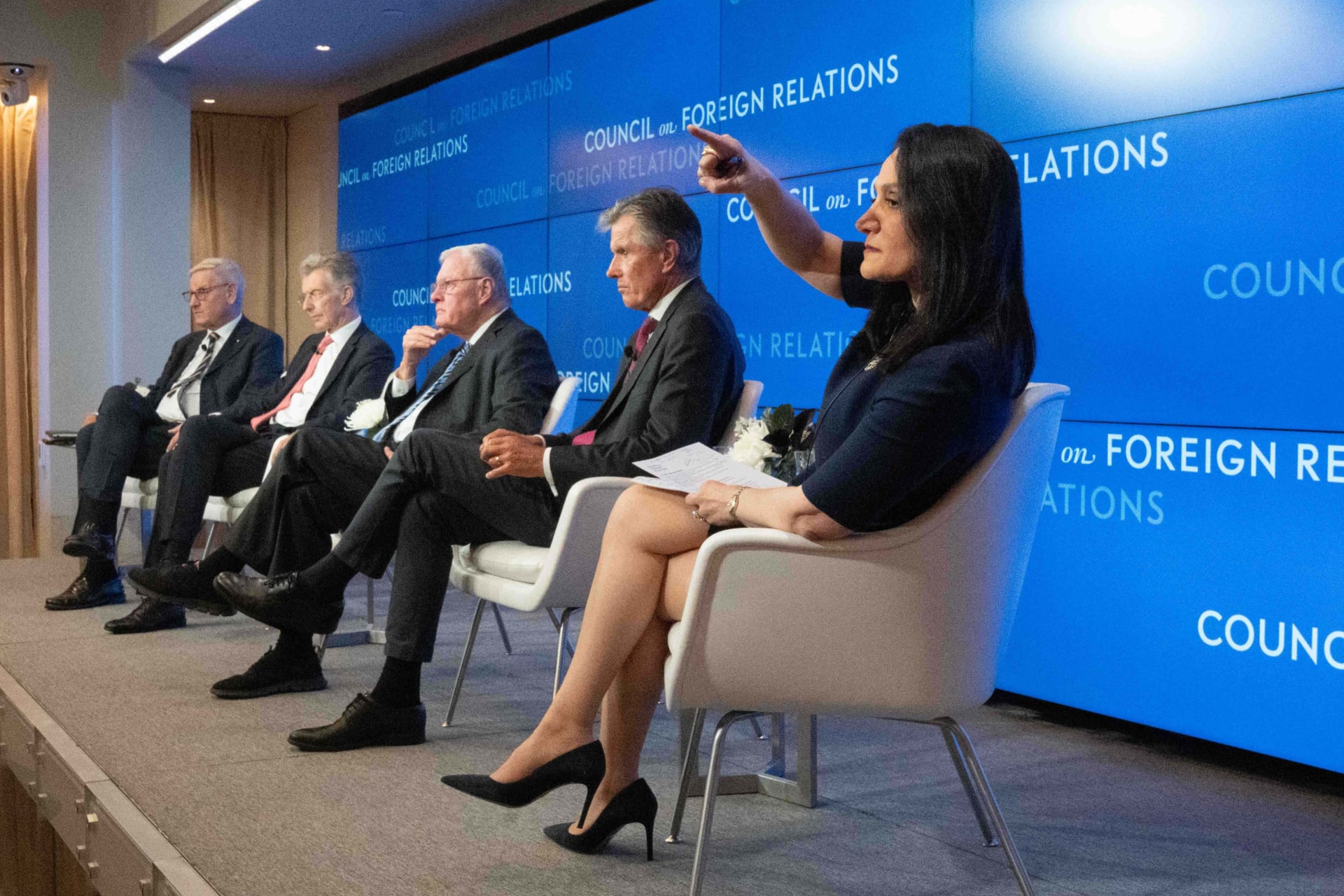
ZACHARIA: Thanks, Deanna. Welcome to today’s Council on Foreign Relations meeting, “U.S. Policy (Options) After the Twelve Day War.” My name is Janine Zacharia. I am a former Jerusalem bureau chief for the Washington Post and now the Carlos Kelly McClatchy lecturer at Stanford University. I will be presiding over today’s on-the-record discussion, a video recording and transcript of which will be posted to CFR’s website later.
Joining us today are: Victoria C. Coates, the former deputy national security advisor to President Donald Trump and now the vice president of the Kathryn and Shelby Cullom Davis Institute for National Security and Foreign Policy at the Heritage Foundation. Steven A. Cook is the Eni Enrico Mattei senior fellow for Middle East and Africa studies at the Council. And Jacob Olidort, a former advisor to Vice President Mike Pence, is now the director of American security at the America First Policy Institute.
I will engage the panelists in a discussion for the first half-hour. And then, starting at 1:30 p.m. Eastern, you will have an opportunity to pose your questions to the panelists. And we will wrap at 2 p.m. sharp.
The Twelve Day War, as it became known, began on June 13 with a surprise Israeli attack on Iran’s top military figures, nuclear scientists, air defenses, and facilities—nuclear facilities. Iran retaliated with more than 550 ballistic missiles and more than a thousand drones. With regard to this Twelve Day War, I hope we can answer two key questions: One, what was the actual outcome? And, two, what can we expect going forward in terms of future Iran-Israel conflict, potentially involving the United States, and talks with—any prospect of talks with Iran over its nuclear program and other issues.
But before we get to that, we need to start with a look at the breaking news today of Israel’s military strike in Doha, which reportedly targeted Hamas’ top negotiator, Khalil al-Hayya, and perhaps the broader Hamas leadership. Arabic media is saying that the leaders were gathering to discuss President Trump’s envoy Steve Witkoff’s ideas regarding a Gaza ceasefire when Israel struck. I think it’s hard to overstate the implications of the strike for the prospects of ending the Gaza war, expanding the Abraham Accords, and possibly even U.S.-Gulf relations more broadly.
But, so, before we begin to talk about the Twelve Day War itself, I’d like to go to the panelists to get their initial reactions to the news out of Qatar. Steven, would you like to begin?
COOK: Well, sure, I’m happy to. Thanks so much, Janine. It’s a pleasure to be here with you, and Jacob, and Victoria.
It strikes me that, you know—that the strike is perfectly consistent with what Prime Minister Benjamin Netanyahu said on October 8, 2023, which is—which he vowed that Israel would change the Middle East; that Israel wouldn’t—would no longer rely on deterrence, would no longer rely on its military might alone, and would no longer permit hostile forces on its borders. And I think that over the course of these nearly two years the Israelis have achieved much in that way, although they have not truly, truly changed the Middle East, and have also demonstrated that they will go far and wide to go after their adversaries.
I think the implications of this are pretty clear. There is no negotiated end to the war—this is from the Israelis’ perspective. Negotiations had come to an end, and that the best way to bring this conflict to an end is through military means. This comes as the Israelis are ramping up their operations in Gaza City, the implications of which are enormous given the numbers of people that are there.
It also, I think, demonstrates once again that in general we’ve underestimated the coordination between the United States and Israel. I want to remind people that over recent days President Trump has said to—that Hamas should accept the deal, the offer on table—on the table, otherwise, there would be consequences. I think we all have to assume that what we’ve seen today are the consequences of not immediately accepting the deal as Israel has.
So this, I think, suggests that, you know, the Gulf states will, you know, obviously—there has been a lot of interest in expanding the Abraham Accords. In fact, the Emirati leadership has warned the Israelis over annexation over the West Bank and what the future of the Abraham Accords would mean. So relations are already frayed between the Gulf states and Israel. But I can imagine that in private Gulf leaders are not terribly dismayed if the Israelis have, in fact, decapitated the senior Hamas leadership.
I’ll leave it there. I’m super interested in what Jacob and Victoria have to say on this topic.
ZACHARIA: Not only in private; the UAE is coming out, standing with Qatar, and whatnot. Victoria, would you like to respond as well? Can you unmute, please, Victoria?
COOK: I think you’re still muted, Victoria.
ZACHARIA: OK. Somebody will unmute you, perhaps, for you.
COATES: Oh, there we go.
ZACHARIA: OK.
COOK: There you go.
COATES: (Laughs.) I was clicking on it; nothing would happen. We’ve learned nothing from COVID.
But, no, I think I largely agree with what Steven said. I have a little bit of a different—a different take. And thanks to the Council for hosting this very interesting, interesting gathering.
I think, you know, what you’re not hearing out of the Gulf today is pretty interesting. I mean, yes, MBS and the Emirates came out and declared their brotherly solidarity with Qatar, which is kind of extraordinary if you think about it, but at the same time nobody’s really doing anything. I think the prevailing sense is relief. I don’t think anyone’s sad that these folks were eliminated if they were, and of course we don’t have the, you know, firm reports yet so we have to be a little bit cautious. And you know, what we’re seeing is really part of what you were talking about, Janine, in terms of the paradigm shift of the Twelve Day War, because think of the unprecedented things that have happened in both 2024 and ’25: Direct strike from Iran on Israel, first time that’s ever happened; direct Israel response; the war, you know, direct Israeli strikes on Tehran; you know, the elimination of the leadership of Hezbollah; you know, the attacks on Yemen; and now—and now this, you know, a direct attack on, you know, an ally of the United States to eliminate a terrorist group with really, at best, a rhetorical response from the Gulf. This is a new universe.
And so, you know, I have a somewhat more optimistic view on the Abraham Accords, as we’ve discussed at other events. I think that train is moving along. It may move more slowly for a while, but that’s the future. Everybody knows it. And if this—if this happened today and the response is as I current assess it—and I don’t have a crystal ball, so I may be eating these words in twenty-four hours—but right—
ZACHARIA: Well, it’s just been a few hours, right, so—
COATES: Yeah. (Laughs.) But right now, you know, that’s—what’s remarkable is what’s not happening.
ZACHARIA: Mmm hmm.
Jacob? You can unmute too, Jacob.
COATES: I don’t think he can. I think he—yeah.
ZACHARIA: You got it.
OLIDORT: Well—sorry. I’m also learning from the pandemics. But thank you, Janine, for hosting, and wonderful to be here with friends Steven and Victoria.
I do want to say just as a caveat at the America First Policy Institute we’re a 501(c)(3). We don’t speak on behalf of the president or his team, so these are my independent thoughts.
I have very little to add to what—to the great observations from Steven and Victoria. I think the only maybe additional element that I see here which is interesting is that this is—there’s no, obviously, immediate military threat that comes from these individuals, unlike, let’s say, Israel’s strikes in Lebanon or in Tehran, and so it’s really Israel kind of sending a political message through military means. This is a shelling, coercive use of military power to affect a political-diplomatic process. And so I think to Victoria’s point about the new geopolitical landscape here, I think Israel is navigating that kind of in a new way kind of building on its strong record over the last two years, but trying to shape the diplomatic-political conversation as well coming, obviously, as Steven mentioned, in the context of deliberations over the ceasefire deal. So I think for me that was kind of the only footnote to the great observations Steven and Victoria made.
ZACHARIA: You know, when Israel launched the attack on June 13 I think it was—the United States was on the verge—I think two days later they were supposed to have indirect talks with Iran, the fifth or sixth round. And then you had the strike. And now you have a situation where if the media reports are correct the reason the Hamas leaders were gathering in Doha was to discuss, as I mentioned, the president’s envoy’s ideas on a ceasefire. So what does this say to you all about—some of you mentioned it, but the coordination that’s going on, or lack thereof, between Prime Minister Netanyahu and President Trump?
COOK: Well, since I said it, I’ll follow up. I think, just to be clear, my understanding is that Hamas had rejected the most recent offer on the table that the Israelis had accepted. Now, we’ve been ping-ponging all summer long—the Israelis had accepted something that Hamas rejected, Hamas accepted something the Israelis rejected—and now we’ve flipped again where the Israelis had accepted and Hamas had said it was basically a surrender document.
I am putting pieces together here and noticing that, like you had in other episodes where the president had warned a party that unless they complied that there would be consequences—that again the president has in recent days made the statement that there would be consequences unless Hamas agreed—and here the Israelis then undertook this operation. I know that the Israelis have been at pains to say that they are solely responsible for what has happened, but it seems to me that this is part of a pattern, and that too much was made earlier on in the administration of differences between President Trump and Prime Minister Netanyahu on a variety of key—on a variety of key issues. I think we have to at least entertain the possibility that there’s a lot more agreement among those two leaders then there—than we suspect, and I think we’re seeing the possible consequences of it.
ZACHARIA: Victoria and Jacob, can you weigh in on this idea of the relationship right now or what you think’s going on between the prime minister and the president?
COATES: Yeah. I mean, that’s not a particularly well-understood relationship. Obviously, they’re both sort of outsized political personalities and characters, but they also have a very fundamentally allied worldview. So whether or not they’re personal friends, you know, there’s this kind of parlor game in the U.S. and the Israeli press of, oh my gosh, was there a contentious phone call. I mean, they’re dealing with some contentious issues, so, you know, that there occasionally is some friction is natural. But overall, they’re in the same place. And I think, you know, with the Iran strike, I mean, the president gave every opportunity to the Iranians to—you know, to come to the table and make a deal, and he had a deal in mind.
ZACHARIA: But to be clear, they were in the middle of negotiations when that—right? Was I misremembering that?
COATES: No, no, there were ongoing talks, but I think the president had come to the conclusion that talks weren’t going to go anywhere and that they were trying to string them out till October to avoid snapback sanctions. And so I think he then made the decision that it was—it was time to cut that off, and I think that was also the decision the prime minister made last night about this action.
ZACHARIA: OK.
Jacob, do you want to add there, or should we move on?
OLIDORT: Well, just very briefly, I think it was the Wall Street Journal that made this observation in the spring at some point that Netanyahu is Trump’s leverage in the Iran talks. And I—the piece that I wrote just after the Twelve Day War, I zeroed in on this phrase that I think was very intentional about—the president said that the U.S. and Israel acted as a team. And my takeaway from that is that in some ways the expectations of both transcend those of traditional treaty allies, that somehow even irrespective of direct coordination there is an understanding that the way in which both operate mutually complements each other’s national interests as a whole. So, obviously, not getting into the details there. So I think that’s—you know, to Victoria’s point, too, I mean, I think this—obviously, wrote the book on the post-October 7 Middle East so I hesitate to add any further, but, yeah, I agree with Victoria’s statement there.
COOK: One footnote, Janine. I mean, this idea that the—that the president and Prime Minister Netanyahu have a difficult relationship is not something that, you know, people, I think, have made up. If you read Jared Kushner’s book and his recounting of his time in the White House and working on Middle East issues, he’s very clear that there was a trust deficit between the president and the prime minister. But clearly, the prime minister has been able to overcome this since President Trump has returned to office last January.
ZACHARIA: Again, I’m really less interested in whether they’re friends than on whether they’re coordinating—
COATES: (Laughs.)
COOK: No, no, no, but I mean—I mean, it’s not really a question of—
ZACHARIA: —one second, Steven—because the president came back from the Gulf with all—you know, a $400 million plane from the Qataris, all kinds of investments from the Saudis. He’s very pro-Gulf. And now you have the first strike today from Israel in Doha, right?
COOK: Right.
ZACHARIA: So I think that we’re going to see implications if we—
COOK: I wasn’t speaking to whether they were buds. I was suggesting that at a policy level, especially when it came to issues like peace process and so on and so forth, there was a very significant trust deficit and there were differences between the two—the two leaders. Somehow, Prime Minister Netanyahu’s had been—has been ablet to overcome it.
ZACHARIA: Victoria, did you want to add there?
COATES: Well, I was just going to say, I mean, when the president came back from the Gulf it was not just with all the investments, which were extraordinary—and the—and the plane, of course—but he came back and then Israel went on the Iran mission. And the prevailing wisdom was that the Gulf was united against the Iran mission for Israel; that they—you know, that they had spent the time lobbying the president against it. It’s my understanding it was the opposite of that and there was unprecedented support for Israel, both in terms of airspace, in terms of intercepting things during the Twelve Day War, you know, from the Gulf, and everybody sort of came together when the Iranians went after the American assets in Qatar. And so I just don’t think that—I think that trip was misinterpreted, and I’m just very curious to see what happens now, as I said. If nothing happens, that is going to be a deafening nothing.
ZACHARIA: Yeah, I agree. I agree with that.
Let’s move on to the actual war itself now. I got to read my Foreign Affairs on the plane, and Suzanne Maloney wrote in this new issue that the joint U.S.-Israeli effort accomplished, quote, “what many had thought impossible: delivering an extraordinary setback to Iran’s nuclear program without igniting a wider regional conflagration.”
Jacob, you wrote—I think it was in July—that Israel’s Operation Rising Lion, alongside the U.S. strikes, eliminated the threat of a nuclear Iran, and yet the Defense Intelligence Agency, in its initial assessment, reportedly said that Iran’s nuclear program had only been set back a few months, an assessment which led to the firing dismissal of Lieutenant General Jeffrey Kruse, I think in a pretty extraordinary fashion, for intelligence that did not accord with the administration’s view of what happened.
So, Jacob, going to you, how do we know that the—why did you write that it has eliminated the threat? How do you know this?
OLIDORT: Well, when I was writing that piece—and that was just hours after the operations took place—the observation I made is the comparison with the United States; that they eliminated the threat—the strategic threat that the program posed to Israel.
So it may still recur, and the president has threatened further military action against Iran if he determines that they are seeking to acquire a nuclear weapon. But what I argued in that piece, actually, is that it creates an opportunity, and perhaps a challenge, for Israeli military planners; that much like the United States, here—for decades Israeli planning has focused around the Iranian nuclear issue, and here it has been—even if temporarily—taken off the table. So Israel can afford to think about its foreign policy beyond the immediate and urgent existential threats. It doesn’t mean to ignore those. So that was the argument in the piece.
ZACHARIA: Victoria, what was your take on what was accomplished?
COATES: Well, I think the fact that we haven’t seen any additional action is an indicator of what the assessments are, and I saw an Israeli friend, who shall remain nameless, last week who said that there is no planning for additional action going on right now. They think that the mission was accomplished.
So, you know, we’ll continue to assess. As Jacob said, the president has reserved the right to go back. The capabilities that were demonstrated by those B-2s, by what the Israelis were able to do, are pretty awesome—not in a valley girl sense, but in the actual sense of the world—and that Iran’s weakness is so exposed now that I think you have lots of people reassessing that relationship. I mean, you could ask Qatar, you know, is that a really desirable partner for you. I don’t think so, and it would be an interesting question to ask the Russians and the Chinese, too; that if this sort of member of their axis of evil is so weakened and incapable of self-defense, do you want that relationship going forward. So that’s another big change.
ZACHARIA: But the Chinese and the Russians, they are kind of with Iran right now, no?
COATES: They’re not against Iran, but how useful—I mean, how useful is Iran? I mean, certainly the president of Iran wasn’t front and center with Xi and Putin. It was Xi and Putin and then everybody else. So that sort of triumvirate doesn’t seem to—I would just question the value Iran brings to the table.
ZACHARIA: Victoria, I’m curious, as a former national security advisor to the president, how you feel about the dismissal of the director of DIA over that assessment, and what appears to be sort of a silencing of dissenting views within the intelligence community.
COATES: Well, my feeling is that, you know, the president in the first term largely accepted, you know, sort of what the military provided him. I was actually with him on that trip to Iraq in 2018 when he met General Keane—a friend of mine—is a college classmate of one of my closest colleagues—and, you know, that relationship was immediately personal and strong. And the president needs, in his top military advisor, somebody in whom he has complete confidence. And it’s no secret that by the end of the administration he had lost confidence in General Milley. And so I think that’s why he took the action he did with the chairman and then also with DIA—that he wants somebody in there that he has confidence in. And if he feels like reports are becoming politicized and, you know, that the evidence is not pointing to what is becoming publicly reported, that is absolutely his right, to have his people in there that he has confidence in. And nobody is questioning the credentials of the people he is putting in.
ZACHARIA: OK, Steven, I want you to follow up on—get your sense of the outcome, and also if you could address in your response sort of the elephant in the room: that they left the Ayatollah there, that this was not an attack on the regime. The regime is still there, and we see very little opposition. So when you talk about the strategic outcome, if you could talk about that as well.
COOK: Right. Thanks, Janine. I appreciate it.
I think there were three primary goals of Israel in Operation Rising Lion and then, you know, add-on to the United States. One was the—you know, to undermine or destroy, weaken Iran’s nuclear program by force. Second was to do as much damage to Iran’s ballistic missile program as possible. And then third—and this is where I disagree with you slightly, Janine, is that I think that the Israelis were looking for ways to provide a pathway for the Iranian people to rise up against the regime. They certainly left Ayatollah Khamenei alone, but they attacked regime targets that were directly involved in repression and maintaining, you know, the means to keep the Iranian people from expressing their views and will, and so on and so forth. And that included, you know, state television. That included hacking into state television, that included a variety of things.
Now if you judge the operation against those three goals, I think on two of them the Israelis and the United States were actually rather successful. I think whether the Iranian nuclear program was set back two months, three months, three years, whatever, I think any of us actually really know. I think that the early leak from the DIA was an early assessment, and it was a leak, and I think that there is likely to have been additional intelligence developed since that would suggest that the program has been set back longer than the few months that the DIA initially suggested.
One thing to me—that’s interesting to me is that the Israelis seemed kind of relaxed about the alleged missing highly enriched uranium.
ZACHARIA: I was going to say we still don’t know where that is.
COOK: But where is it, why they don’t seem to be ramping up to go find it, destroy it, or whatever. So they must feel fairly confident that they’ve done—along with the United States—very significant damage to the Iranian nuclear program.
On the ballistic missile threat, which was extraordinary—speaking of DIA, if you went on the DIA website ahead of this strike, you would see that within the next decade, Iran would have one of the largest inventories of ballistic missiles in the world, which was not only a threat to Israel, but other American partners in the region that don’t have the same kind of air defense system that the Israelis—that the Israelis have. And there the Israelis were—I think were quite successful, but there is still a lot of concern, and there are recent reports that the Chinese are helping the Iranians reconstitute their ballistic missile program, as well as their air defense system. These are fragmented reports from various sources, but it seems to me, given how much the Chinese have invested in Iran, that it would make sense that they would do such a thing.
The place where they failed was that the regime was much more resilient than anybody had anticipated. I will point out that Rising Lion was an interesting code word—code words for the operation. Not only do the Israelis call their own fighters lions, but if you take a look at the pre-Islamic Revolution Iranian flag, that of the dynasty, it is of a lion. But, again, the regime has held on, has used its very sophisticated apparatus of repression to keep people down.
But overall, I think, in those two other areas there was more success. But we’re back to this kind of back and forth with the Iranians over sanctions, and snapback, and whether there will be negotiations or not.
I also would not discount the fact that, you know, there are nuclear sites that we could not account for—the Israelis could not account for, and that there is now more incentive than before for the Iranians to dash to weaponization. We just—we don’t have any real insight into that, I just pointed out, as it should be within a realm of analysis as potential risk going forward.
ZACHARIA: Jacob, where do you see this going in terms of negotiations, perhaps? Do you see the administration—the Trump administration getting involved again, trying to resurrect some kind of negotiations with the effort as part—maybe get some—there’s no—there’s no IAEA inspectors on the ground, there’s—I mean, there’s—how do you see this playing out?
OLIDORT: Right, right. I mean, I think the urgency has been taken off the table so that that conversation can be had of how to proceed. But I very much believe that obviously that is rightfully the president’s instinct—first instinct is to move to diplomacy.
I wrote, actually, just hours before Operation Rising Lion began, that should diplomacy this term fail, there will be many opportunities where it is needed with the Iranians. It’s kind of interesting the one really non-negotiable in negotiations is that Iran cannot have a nuclear weapon. But there are several other issues where it is in our interest to maintain and open up those negotiations. The success of those and what those look like, that will be—you know, that will depend on the circumstances. But, I mean, the hostages, for example, is one; ballistic missiles another, and then go down the list.
So the short answer is yes, I think so, and I think the hostages right now is the urgent one with Hamas.
ZACHARIA: Victoria, I wanted to ask you a broader question about U.S. policy in the Middle East and get your sense of things. I remember when I covered President Bush’s speech at the National Endowment of Democracy more than twenty years ago and, you know, he talked about the era of tolerating dictatorships in the Middle East—or something; I’m paraphrasing—is no longer; you know, coming after 9/11 and things like that.
How do you see the president’s—the administration’s overall goals in the region? It seems that democracy promotion is no longer a priority and that we’ve eliminated many of our levers of soft power with the decimation of—the elimination of USAID, Voice of America—I know you were involved with, I think, the Broadcasting Board of Governors maybe briefly, if I’m not mistaken.
COATES: Middle East Broadcasting Network.
ZACHARIA: Middle East Broadcasting Network, right—Alhurra and Radio Sawa, and all that.
So I was just—how do we project power in the region, and what are the goals in the region for the Trump administration?
COATES: Well, except for the Palestinians—I mean, USAID was not, you know, a significant player for us with, say, the Gulf or for Israel necessarily, so I don’t think that’s going to be a big problem.
I think, you know, where I would see the bigger shift in the U.S. posture from Bush to Trump—and this has nothing to do with either of them in particular—but it’s the U.S. energy posture and how that has changed our relationships. We are no longer dependent on exports from the Gulf.
You know, we participate in global energy markets, and so, you know, we want those barrels on the market, but they’re not coming here. They are not a direct, you know, national security interest for the United States. That changes our whole attitude towards the region. And so I think particularly after the lessons of Iraq and Afghanistan, however well-intentioned those policies were, it didn’t work to impose democracy on—you know, at the tip of a sword. I think that is a really powerful lesson.
As somebody who wrote a book about the history of democracy as an enthusiastic participant, you know, I want the world to democratize, but at the same time, it has to be an interior thing. It has to come from the people who are going to practice the democracy; not externally or else it doesn’t flourish. And that has been proven time and time again.
And to Jacob’s point, you know, the three things that we would be negotiating, if we’re negotiating with the Iranians about anything, would be missiles, terrorist proxies, and the nuclear program. Those things have been largely eliminated, so I don’t see a big incentive for us to go back to the table and deal with the Iranians on those things. And for me, regime change, you know, while desirable—I have no love lost for the Iranian regime—that has to come from the Iranian people. So I think that’s just maybe a little bit of a different take on how we’re going to exercise influence; not through those traditional levers, but through new relationships.
ZACHARIA: OK, so no—the headline is “No New Negotiations Over Iran Probably Forthcoming.” But I’m wondering—
COATES: I wouldn’t see the point.
ZACHARIA: Yeah, OK. So—yeah, OK. That’s interesting.
One final question in the minute before we then get your questions ready, start raising your hands, is we’re not going to see any negotiations, but—perhaps, but today Israel’s is evacuating—telling Gaza City to evacuate. Are we going to see, Jacob, the Riviera—Gaza Riviera, or what the president said?
OLIDORT: Yeah, I just wanted—actually, it’s a great segue. I was going to piggyback on the excellent observations Victoria was just making.
To me, I think the most incredible moment in Middle East policy the last eight months by the Trump administration was an announcement on February 4 about the Gaza Riviera. And I think—especially from a president who—the architect of the Abraham Accords—for him to make that announcement on the day that the sanctions were unveiled, I thought that was a remarkable moment; first, because it obviously catapulted as a top priority an issue that everybody said was—that’s important but, you know, we’ll get to it, you know, in the third stage of negotiations somewhere.
Second, it really transcended to the human aspect of it. We just want to help these people. We want to create better conditions in the region. And so I think this is very, to me—I have no personal insight of this, but my impression is that the president is very animated by the human plight and, specifically, also the hostage issue. I think those two elements of what’s happening in Gaza make it very important for him, I think, in a personal way. And again, I’m speculating, but having worked on a hostage recovery issue during the first term of the Trump administration, I saw his involvement on that issue.
So I think—to answer your question, I think there is interest in the administration—obviously from Israel, as well—to end the necessary campaign in Gaza, to help the Gazan people, and—we’re seeing in the news, as well—to begin the planning for day after.
ZACHARIA: OK, at this time, I would like to invite members to join our conversation with their questions. A reminder that this meeting is on the record, and please keep your questions as concise as possible so we can get to as many as possible within the next half hour.
OPERATOR: (Gives queuing instructions.)
And to view the roster of participants registered for this meeting, please click on the link in the Zoom chat box.
We’ll take the first question from Zaid Zaid.
Q: Hi. Zaid Zaid from Cloudflare. Thanks so much for your comments today.
So I’m thinking about—in thinking about the strike today, I’m thinking about all of the sort of ink that’s been spilled, mostly by Israelis saying that Netanyahu is prolonging the war in Gaza for his own political purposes. And then we know—or we understand that the Iranians were still thinking about negotiating, and then Israel struck then, and then we hear today that Hamas is meeting in Qatar and, you know, there is a strike today.
It seems like, from the comments from the panel, that basically this was because the Israelis had made a determination that these negotiations weren’t really serious, et cetera. But is it also not a plausible view that possibly Netanyahu is doing this because he doesn’t actually want to have a negotiated peace with either of these parties, or is that too far afield?
ZACHARIA: Thank you, Zaid. Who would like to take that? Steven, do you want to start, and then—
COOK: Sure. I’ll take the first stab, especially since I think I was the one who articulated that, you know, the Israelis have clearly come to the conclusion that they—that the negotiations are at a dead end.
I’m merely trying to get across to you what the Israelis believe is the problem here; that, you know, they’ve been ‘round and around with Hamas. I’m perfectly willing to believe that Prime Minister Netanyahu—I think it’s abundantly clear—has political interests at stake here, that he is dependent on support from ministers who have demanded that the Israelis continue their operations in Gaza when there doesn’t seem to be a strategic value to doing so against the best advice of the IDF.
So I think overall what we’ve seen in nearly two years of war, and they—you know, with the exception of two ceasefires, this fruitless search to end this conflict, is that essentially neither party wants it to end. Hamas has not been decisively vanquished, and neither party has an interest—whether it’s for strategic or political reasons—to coming to some sort of negotiated end to it. And that’s been the problem all along. It stretches back to the Biden administration, which sought a deal. The Israelis did not want a deal. Hamas didn’t want a deal. And I think the same environment holds right now.
Hamas isn’t genuinely interested in a deal, nor is Israel genuinely interested in a deal. From the perspective of both, this is existential.
ZACHARIA: Anybody want to add to that, or else we can move to the next question. Victoria, did you want to add something?
COATES: No, just that—I mean, I think it’s unsurprising that—you know, that a politician will have political considerations, but at the same time, we are also in a different time frame here, Zaid. You know, the time is running out on that hostage situation. It just physically can’t go on much longer, and so the imperative to try to get in, get anybody out, I think, is a kind of under-remarked subtext to any Gaza City operation because they’re pretty sure that’s where they are, you know. And so, you know, the question is do you try not to get them killed but then they die anyway. Do you try to make an effort to get them out? That is just such an agonizing reality on the ground in Israel. I think it’s a little hard for us to interpret from thousands of miles away.
ZACHARIA: Jacob, are you OK to move on, or do you want to add?
OLIDORT: No, no, nothing to add, no.
ZACHARIA: OK, next question.
OPERATOR: We’ll take the next question from Sarah Leah Whitson.
Q: Hi there, everybody. Just two questions, one for Steven and one for Jacob and Victoria. Steven, numerous organizations, the International Association of Genocide Scholars, the International Court of Justice, a variety of genocide experts have concluded that Israel is committing genocide in Gaza. Do you think all of these organizations are wrong? Do you think that all of the reports by international human rights organizations and U.N. experts concluding not only that genocide is taking place, but that starvation and war crimes are taking place, are they all just wrong? And how do you position yourself within those accusations?
And Victoria and Jacob, you noted the Gaza Riviera plan. Is it your position that Palestinians should be forced out of Gaza if they don’t want to leave, because you think that the Gaza Riviera plan is great for them? Do you have no concern that if Palestinians leave they will never be allowed to return? And how do you feel about relocating Palestinians to parts of East Africa, as has been proposed?
COOK: So let me just start with the question of genocide, which is, you know, obviously a combustible issue. And let me start out by saying that I am not a genocide scholar. But my understanding from those international law experts that we have on staff here at the Council is that what is determinant in these considerations is intent. And that while you may look at some statements of certain Israeli ministers and can divine intent, there are other statements of other Israeli ministers in which you cannot. So I’m not prepared myself to make a determination that it is a genocide or not. I think that those are for others with competence. But I will say this, that just because a variety of human rights organizations say something doesn’t make it so.
In addition to the fact that I’m suspect because the charges of genocide began on October 8th, including from human rights organizations and organizations like Sarah’s. So I think that in the court of public opinion, in the total war, in the total information space, it’s clear that Israel has been accused of genocide. And these are places where there isn’t room for dispassionate, analytic-looking examination of the issues. I think in places where there is a dispassionate examination of the issues it remains—all the evidence isn’t in, and it remains to be seen whether it is a genocide. If it is actually—if that is actually the case, I’m willing to accept that for what it is. But I do get a sense that the spirit of the question is one to, you know, put me in some sort of box to say yes or no. And I just don’t think that I have the professional competence whatsoever.
ZACHARIA: Jacob, do you want to take Sarah’s question about Riviera and displacement?
OLIDORT: Sure, sure. Well, so the president’s remarks, and Council experts have noted this as well, were in their full context incredibly gracious about the Palestinians, about the Gazan residents and their plight. So the issue of permanence was never a topic. I mean, there was—it was always the notion of temporarily moving them out, relocating them, in order that they may have better lives in Gaza. And that is physically impossible when you have Hamas using, you know, children’s bedrooms, hospitals, schools. There needs to be some sort of arrangement with which, you know, the residents can actually live out their lives normally while those infrastructure—those pieces of infrastructure are being dismantled. So I think it’s a very practical decision, but I think it’s one that is necessary for a better life for the Gazan residents. And I’ve said this on regional media as well. So, yeah.
COATES: Yeah, I would just add to that, Sarah, that the population of Gaza is the only population that’s not permitted to flee from a war zone. They’re being kept in there, and it’s not just Israel. You know, it’s Egypt that is doing this as well. So I would like to see people ask the Gazans, would you like to go elsewhere for a period of rebuilding? That question hasn’t been posed. And the other thing I’d like to see, if there is indeed this kind of starvation that you claim going on in Gaza, why everyone isn’t strongly supporting the excellent work of the Gaza Humanitarian Fund, which is getting 100 percent of their trucks of food into Gaza at this point? UNRWA loses upward of 80 percent of their trucks to Hamas and other bad actors.
And if we can get food into the strip effectively through this mechanism, why is the United Nations boycotting them? Why aren’t they helping them? They’re employing twenty to thirty Palestinians at each of their distribution sites. They’re building those relationships. These are people who hate Hamas too. What’s the problem with this? From my perspective, you know, if this crisis is occurring we’re not taking the steps we need to take to alleviate it, because those mechanisms are now there. This is working. And then why aren’t we consulting the Palestinian people in what they would like to do?
ZACHARIA: Victoria, I think that the problem with the Gaza Humanitarian Fund is that it’s—A, it’s not adequate. It’s not enough. And that there was this, you know, a militarized environment that led to many people getting killed as they were trying to get aid. Is that incorrect?
COATES: I think there were definitely problems, some of which have been misreported, Janine. It is working really well right now. That is not happening. The aid is going in. It is at no cost to the Gazans, which is apparently the first time they’ve literally gotten a free meal. And he the funding can scale up quickly for it. And a lot of that USAID money that you were talking about, that money still exists. That can be reprogrammed. It would have to happen pretty quickly because the end of the fiscal’s coming, but that money can be reprogrammed for this purpose if we want to, if there’s a mechanism that the secretary of state determines is a responsible mechanism to disperse U.S. taxpayer funds. So this can happen.
ZACHARIA: You know, earlier in the war I made the point you made about if people want to leave they should be able to leave through Egypt, right? Especially women and children. It was impossible, especially around the time when Israel was conducting military operations in hospitals and you had that—the images of the neonatal unit, OK. And so I agree with you there needs to be a corridor there. I’m curious, though, why the U.S. has halted the ability of Palestinians seeking medical care in the U.S.—to come to the U.S. for treatment, if anybody has any thoughts on that.
COATES: I do not have any insight. That was a very specific decision the secretary made based on intelligence I don’t have access to. So I wouldn’t want to speculate.
ZACHARIA: Mmm hmm. Jacob, do you have any thoughts on that, why they won’t let the Palestinian children come have surgery?
OLIDORT: I don’t have any thoughts or insights on that. I mean, I do—I will note, obviously, to Victoria’s earlier point about Egypt, I mean, you know, Egypt has its own internal pressures, obviously. It’s the home of the Muslim Brotherhood. And they know the Hamas threat directly. But you had Jordan stepping up in the beginning as well, offering to take in ill children for treatment. So that suggests to me that there are many regional options as well that are available to the Gazan people before that option is necessary.
ZACHARIA: Jacob, earlier in the year you wrote a piece that Egypt, together with our Arab partners, must return to the drawing table to present a new plan vis-à-vis Gaza. Is that still the case? And are you—do you have the contours of what this plan should look like, given—I mean, really, I think it’s—we can call it a cataclysm, whether you want to call it genocide or not, what’s happening in Gaza right now?
OLIDORT: Well, I wouldn’t use that term, for the reasons that—
ZACHARIA: You wouldn’t call it a cataclysm, what’s happening in Gaza right now? What do you want to call it?
OLIDORT: Well, I think it needs to end. No, I wouldn’t call it—I was referring the word “genocide.” I would not refer to it as that.
ZACHARIA: OK, sorry. Yeah.
OLIDORT: I do think—I remain—that remains my view of the Egyptian plan. I think it’s a very good—and obviously nothing to sniff at in terms of the monetary contributions. But first of all, it gives over power to the Palestinian Authority after six months, which has the lowest, you know, polling out of any Palestinian faction, not to mention their corruption and other incentives for terror that they have. And it doesn’t mention the word “Hamas.” So I don’t think it’s a sufficient plan. I also think it’s fascinating, now we’re moving into France’s virtue signaling at the United Nations, there is no plan there either. So this—Steven has written about this as well. You know, beyond the theatrics and Macron’s personal political incentives for doing so, what happens the next day after they declare statehood? There is nothing to implement on the ground. It’ll just be the same. So to your point about the cataclysm, I think it won’t change the status quo, in the best of cases.
ZACHARIA: Mmm hmm. Steven, you want to add anything there?
COOK: Well, look, I think that, first, on the Palestinian children requiring medical care, I think we should let them in. I have no idea why they were denied entry to the United States, but they absolutely should be let into the United States for medical care.
On this question of, you know, a plan, I think that the Egyptian plan was something that was tabled, that the Egyptians and others spend a lot of time on, and for it to be summarily rejected by the administration was a mistake. I think that the president has been seized by this idea of, if we move Palestinians out and we rebuild it, we’ll rebuild something better. Knowing about his background, one can understand his train of thought there. But we also have to think about what is a realistic option. And that it does, I think, imply that the United States would be enabling the ethnic cleansing of the Gaza Strip, given what we know about what Israel’s radical right’s interests are in in terms of returning to—in returning to the Gaza Strip.
So therefore, the Egyptian plan was, maybe from the perspective of the White House, not being perfect, but shouldn’t let the good be the enemy of the perfect. And something with which the United States can work with its Arab partners on improving, taking those deficiencies that Jacob and others have pointed out and working with it to improve the plan so that the Gaza Strip can recover from this terrible conflict in time. That, I think, is the position that—as far as the question of Palestine statehood, you know, I’ve written about it, you know, from an abstract perspective. Why should the—why should the Palestinians, you know, have to beg or apply for statehood? But the fact of the matter is that the recognition that the French, the Australians, the British, and others who are planning to do so at UNGA are unlikely to make a difference. And, you know, the fact that it’s conditioned also would suggest that these aren’t really serious recognitions of the state of Palestine.
ZACHARIA: I want to come back to this question of the declaration of statehood, because we’re heading into UNGA and I imagine it’s going to come up in two weeks.
COOK: It will.
ZACHARIA: But I think we have another question, Deanna.
OPERATOR: We’ll take the next question from George Tsereteli.
Q: Thank you. George Tsereteli from McLarty Associates.
I was wondering what the panelists think is the most likely outcome for sanction snapback. Will sanctions be reimposed at the end of the month or will there be some sort of six-month extension reached, as has been discussed? Thank you.
ZACHARIA: You have the Europeans pushing for this. Some opposition, I think, from the Chinese and the Russians. Anyone want to take this? Jacob, do you want to start?
OLIDORT: I’m going to actually—I’ll give my time to Victoria. I know she wants to answer—
ZACHARIA: Victoria, go ahead.
COATES: No, I was just going to say, I don’t see this as the most pressing issue on the table. A little bit similar to going back to sort of general negotiations with the Iranians. I personally would favor the reimposition of sanctions, but I think for the administration they’re going to be thinking a lot about what they want to do with Russia. That’s their current hot topic. And if you were running around the world sanctioning everybody, it is extremely difficult for the U.S. government to actually carry those out, to implement them, because you’ve got limited bandwidth and manpower. And so if what they’re looking at is a major push against Russia, you know, that is a very significant lift. That is one of the world’s big three energy producers. It is a much larger economy. You know, that has implications for allies from Europe to India. So I would—I would look at this, George, in the bigger picture. While, as I said, in the abstract I favor the—I think they have merited the snapback of those sanctions, I don’t think it’s going to be a hot button issue.
COOK: Just quickly, I think that the fact that the Chinese are now engaged and seeking to, you know, delay, given their investment in Iran, I think that we’re not likely to see snapback by the end of the month. I think it’s going to be a longer, drawn-out process.
ZACHARIA: OK. We’ll take the next question.
OPERATOR: We’ll take the next question from Bernard Haykel.
Q: Hi. Thank you all for doing this panel.
I’ve just come back from the region. And the Gulf leaders are convinced that Israel is going to attack Iran again, and that the Iranians are trying to rearm the Houthis. And they certainly have also told Hezbollah not to hand over their weapons. So my question is, if Israel—and the Gulf leaders are worried about blowback from Iran, that if the regime in Iran is existentially threatened they would attack oil installations and other vital installations in the Gulf like desalination plants, and so on. So my question is, if Israel does do this what do you anticipate the American reaction to be? And also, would the United—will the United States—or, would the United States help defend countries like the UAE, Qatar, and Saudi Arabia from an Iranian counterattack?
ZACHARIA: Victoria, I think you said you didn’t think that there was planning.
COATES: No, Bernard, I’m getting just a very different message. I mean, that is—it was absolutely the narrative throughout 2024, and the concerns that were voiced across the spectrum in the United States in the lead up to the Twelve Day War that these were all going to be horrible problems. I would say Iran, you know, has not rearmed in what I would consider to be a substantive, material way. I don’t know what kind of missile defense systems they could put into place that would protect them from the combined air might of Israel and the United States, especially if we’re getting support from Gulf partners and allies, and what options for retaliation that they have that they haven’t tried to date.
So I just—I just take a different view on it. I think this operation has concluded for now. President Trump was very clear he didn’t want a regional escalation. The Iranians largely seem to agree with that. And, you know, yes, they are, for sure, trying to get more materiel to the Houthi, but they’re somewhat limited in what they can do now to get stuff into Lebanon, given the loss of their conduit through Syria. So if I’m looking at anything with grave concern, it’s probably Iraq and what could materialize there as a kind of broader regional threat. And as we know from our long history with that country, you know, Iraq is, at best, a mixed bag. But that’s where I would see the greatest threat.
COOK: Let me just—let me just add to Victoria’s comment. Bernie, I think that the Gulf leaders are spending way too much time talking to the Iranians, who have been saying that these—you know, there’s a huge possibility that the Israelis will strike again before the end of the year. I heard, you know, as high as 60 percent chance. But in a slightly different response from Victoria. I don’t think that the Israelis want to undertake further hostilities with the Iranians as long as they don’t have the kind of interceptors necessary to respond to Iran’s missile attacks. Iran has been weakened, but it’s not out. It’s not like it doesn’t have any capability left. It still does. And we know, towards the end of what’s now being referred to as the Twelve Day War, that Israel was running low on interceptors. And there was concern at the Pentagon that the United States was also expending large numbers of interceptors.
So I don’t think that the Israelis really have an incentive at this moment to go back after the Iranians. Obviously, things could change. There could be some bolt from the blue. There could be some indication that the Iranians are driving very quickly to weaponization, which would change the calculus for the Israelis. But all things being equal, which I know is hard to say in the Middle East, it doesn’t seem that the Israelis are primed to go after the Iranians. They’ve made their point.
On this question whether the United States would come to their defense, I’m afraid this is a legacy—and I think the Gulf countries, the Gulf leaders, are seized with this, and I think rightly so—it’s a legacy of the United States not actually living up to its rhetoric about its commitment to security and stability in the region. And this is across both administrations. You know, when Abu Dhabi and Dubai are attacked by Houthi drones, and the United States doesn’t do anything, is in the process of withdrawing Patriot missile systems, that sends a message to the entire region. When in September 2019 the Iranians attack Abqaiq and Khurais, and the president says, well, they attacked Saudi Arabia not the United States, it sends a message.
And you know, like you, Bernie, I’ve had these conversations with people in the Gulf who point to these episodes and others to wonder whether the United States would come to its defense. And it’s a—it’s a very good question. I think that when American officials from administrations on both sides of the aisle mouth these words, there is reason for Gulf leaders to be skeptical that the cavalry actually will come.
OLIDORT: If I may jump in. First of all, there’s very little I can teach Professor Haykel, my dissertation supervisor. So it’s great to hear you on the call, sir.
COOK: It’s always professor when it’s your dissertation supervisor.
OLIDORT: It’s professor always for life, yeah.
COOK: Always for life, yeah.
OLIDORT: Absent Dr. Fatr (ph).
No, but I actually want to take a Solomonic approach. And I agree with Steven’s conclusion, but for kind of a version of Victoria’s reasoning. And I think—I think today’s attack was a little bit of a one-off. Again, I have no particular insight. But my impression is today Israel is operating in increasingly—in a region that has increasingly complex U.S. equities. If you look at Syria and kind of some of the, you know, surprises there, I would say, in how Israel has engaged. I mean, it has to act in self-defense there. But obviously there are bigger U.S. interests and policy shifts in Syria, Lebanon. And so I’m of view, like Steven, I don’t think Israel will rush to act; or if it will, it won’t come—much like one version of this morning’s—it could happen with some foresight by the United States, some advanced coordination, or warning. But I don’t foresee kind of the surprise attacks, specifically because the Trump administration has very concrete ambitions for the region that this could unsettle.
ZACHARIA: We’ll take the next question from Allen Weiner.
Q: Hi. I’m Allen Weiner from Stanford Law School.
Very quick question. I’m wondering whether you think that the attacks against Iran’s nuclear facilities make it more likely or less likely that in five years Iran will possess a nuclear weapon. Thank you.
ZACHARIA: Victoria.
COATES: I would say less likely, Allen. That this, to my current read, was a material setback. And if the—you know, at least for the years of the Trump—remaining years of the Trump presidency, if the Iranians assess that the president is willing to do what he did again, you know, that—it’s hard for me to see them pouring the resources into this to get to a five-year time—five-year time horizon. So we’ll—you know, of course, we’ll have to see. But I think, you know, President Trump has demonstrated that he will take this action. He did not see a broader regional war result from it. And so, you know, that threat, that deterrence is real now.
ZACHARIA: Jacob, yeah, closer or not closer in five years?
OLIDORT: I agree with Victoria, with the one footnote that it’s not just the hardware but it’s also the brains, the knowledge, which is generational. Not just of the scientists, but the military planners. So it would take a lot for it to restart all of that, to recreate it.
ZACHARIA: Steven, maybe a one-word answer so we can get one more question?
COOK: Maybe.
ZACHARIA: Maybe is the answer, OK.
COOK: I mean, I had an answer but you asked for one word, so I’ll say, maybe.
ZACHARIA: Maybe, good. Let’s get the last question in.
OPERATOR: We’ll take the final question from Elliot Waldman.
Q: Hi there. Thank you, everyone, for doing this. I’ll try to keep the question brief.
There are rising numbers of people, both in the U.S. and overseas, who have increasingly unfavorable views of Israel, just according to opinion polls, and, you know, increasingly disapprove of the way that its—of its offensives in Gaza, and, you know, of other actions taken in the region. Given that the—you know, these actions are apparently undermining Israel’s own sort of support base around the world, how should the U.S. be approaching this? Is this not time for, you know, some increased pressure to kind of allay some of these activities that are apparently damaging Israel’s own position? Thank you.
ZACHARIA: Victoria.
COATES: Well, I would—I would say, Elliot, I mean, that’s been the case for certainly the last seventy-five years, but absolutely for the last fifty years. I mean, this is always—the balancing act for Israel is, is it going to do what it needs to do to preserve its national security or is it going to try to, you know, win the public affairs war in the international press? And so, you know, I think, from the perspective of the post-October 7th world, they feel, for national security imperative reasons, they have to do what they have to do. But they’re certainly cognizant, you know, of the reputational damage that goes on through this mechanism. But I don’t see them altering policy for that reason.
ZACHARIA: I think I just want to jump in quickly, as taking the moderators prerogative, and say, when we say “they,” that Israel is very divided. And you’ve had tens and hundreds of thousands of people out in the street every Saturday protesting against this war, top—very important figures in the military and in the Shin Bet, like Ami Ayalon writing in Foreign Affairs last week—last month, in August I believe it was, that this war is unjust, immoral, and counterproductive. And I know the argument that, you know, Israelis say in Hebrew, (speaks Hebrew), the whole world will be against us, it doesn’t matter what we do, for the last few decades. But I agree with the questioner that, you know, Israel’s reputation has taken a very—a very hard hit here. Final thought, Jacob or Steven, on what the U.S. could do here, or?
OLIDORT: I think, no, the easiest question for last. And I agree. And I think it’s very hard. I think Israel needs to create a new narrative. This is what I wrote in my piece after the operation, for its foreign policy. And I think the U.S. is there to help it, as I said, as a team member. And I think it’s very hard to do that in a political environment such as Israel’s right now, while the Gaza war is continuing. But once that happens, I hope that’ll be the next chapter. Steven, yeah.
COOK: Look, I think that there is a tremendous amount of awareness, even within the government, of the reputational hit that Israel has taken as a result. I think that they also recognize that there has been—you know, the way in which, you know, the international media and others have approached the issue have stacked the deck against Israel. But I don’t think they make any excuses for the fact that they—the deterioration of brand Israel has proceeded precipitously over the course of those last two years. Right now I think that the—at least the government is less interested in that than in securing Israel’s borders as they see fit.
As far as the U.S. role here goes, I think, you know, American politicians have been very clear with the Israelis that they’re concerned about the—one, the conduct of the IDF in the Gaza Strip, and what that means for Israel’s global standing. I don’t know—and maybe it’s just a function in fact that I have not served, and maybe Jacob and Victoria are in a better position to answer this question, what tools the United States actually has in order to help the Israelis improve their image. Or, you know, I think that the spirit of the question is that the United States should somehow punish the Israelis to get them to stop so that would then, in turn, improve Israel’s image.
I would say this, once again underline the fact that the Israeli perception of their current conflict is an existential one. And no matter how much—how strong the United States is, how much influence we may have, when people perceive something as an existential conflict, or that their survival is on the line, they’re not likely to take every bit of advice.
ZACHARIA: OK. Well, with that we’re going to have to leave it. Thank you for joining today’s meeting. And thank you to our speakers, Victoria Coates, Jacob Olidort, and Steven Cook. A reminder that the video recording and transcript of this meeting will be posted to CFR’s website.
I’m Janine Zacharia. It was my pleasure to be your moderator today. Thank you.
(END)
This is an uncorrected transcript.