Of “Emergencies” and “Tipping Points”
President Trump has declared trade deficits to be an economic “emergency.” But if they are one, his trade deals can only worsen it.
By experts and staff
- Published
 Benn SteilCFR ExpertSenior Fellow and Director of International Economics
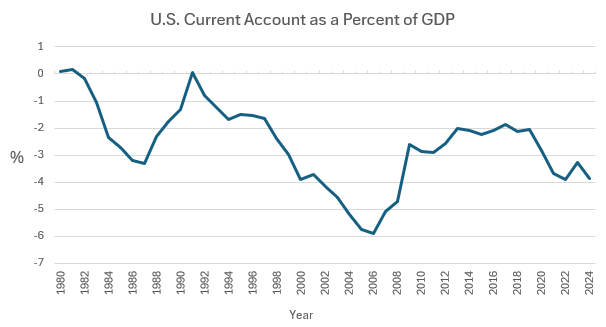
President Trump has declared the U.S. current account deficit an “emergency,” thereby legally justifying his arrogation of Constitutional tariffing powers from Congress. If it is an emergency, it is one well-hidden in the data—which, as seen in the graphic above, show near-continuous deficits over the most recent half a century.
Treasury Secretary Scott Bessent has responded to this inconvenient data by claiming that America has now arrived at a dangerous “tipping point” in its ability to bear deficits. “Tipping” into what, he won’t say. But he justified the president’s massive new global tariff regime by asking what would have been if “someone” had truncated the housing bubble in 2005 or 2006. This argument, if it can be called one, is riddled with holes.
First, the housing-bubble analogy does not work. To the extent that we can today say that home prices were too high in 2005 or 2006, that was a credit-driven domestic phenomenon which could have been addressed (at high cost) through tighter monetary or lending policies. The current account deficit, in contrast, is a macro accounting identity driven by relatively stable capital flows that have persisted decade after decade, without crisis or identifiable U.S. economic underperformance.
Secondly, and following on from my previous point, the current account deficit hit a high of nearly 6 percent of gross domestic product (GDP) two decades ago—back in 2006; since then, it has fallen by over a third. If Bessent is positing some cumulative multi-decade deficit number as a tipping point, the onus is clearly on him to explain the logic and to reveal his evidence.
Thirdly, whereas tariffs alter trade patterns they do not alter the underlying saving-investment gap—which is what drives the deficit. Note that deficits have increased since the significant Trump-Biden tariffs of 2016 to 2024. Tariffs actually harm U.S. exports by increasing input costs, since roughly half of what we import are intermediate goods, and by driving down the demand for foreign currency (which boosts the dollar). Tariffs also invite retaliation—an invitation which China has accepted with gusto, to the massive detriment of the U.S. farm sector and rare-earths dependent auto sector.
The final problem is that the president’s own trade deals will, if actually implemented, massively fuel the deficit. Trump has touted “trillions of dollars” of new foreign inward investment commitments as part of those deals. These trillions, if they were to materialize, would hugely increase the U.S. capital account surplus. But it is an accounting identity that the capital account surplus must match the current account deficit. And so if the capital account surplus is to rise, foreigners will have to sell us more to generate the required dollars. The president is thus worsening the very “emergency” that he claimed as the legal basis for his tariffs.
In short, there is no identifiable economic “emergency.” But if there were one, the president himself would be fueling it.