Argentina’s Struggle for Stability
Updated
Argentina has struggled with political dysfunction and financial crises for decades. How is the country faring under firebrand President Javier Milei?
- Argentina is Latin America’s second-largest country and third-largest economy, but it has long struggled with economic and political dysfunction.
- Despite its wealth of economic resources, Argentina has defaulted on its sovereign debt nine times. It has often leaned on funding from international institutions and more recently from China and the United States.
- Peronism, a populist movement founded in the 1940s, has been Argentina’s dominant political movement, but the administration of radical libertarian President Javier Milei marks a sharp departure from the status quo.
Introduction
Argentina is Latin America’s second-largest country by area and the region’s third-largest economy. Over the past century, it has vacillated between economic growth and dysfunction, going from being one of the richest countries in the world to becoming one mired in a prolonged financial crisis, massive debt, and triple-digit inflation. Meanwhile, the legacy of populism and military rule has left the country’s political culture deeply divided.
Today, Argentina is in a difficult situation. While President Javier Milei has implemented sweeping reforms aimed at tackling the country’s chronic financial problems, Buenos Aires is struggling to make payments on its existing debt and rebuild its depleted foreign exchange reserves. Meanwhile, the government has received a new loan program from the International Monetary Fund (IMF) and has been offered support via a $20 billion U.S. stabilization package. Beyond addressing economic challenges, Milei has also sought to realign Argentina’s foreign policy, seeking closer ties with the United States and the West.
What is Argentina’s political history?
After gaining independence from Spain in 1816, Argentina cycled through democratic and military rule for more than a century. In 1943, army officer Juan Perón took power in a coup, and ruled Argentina on and off for the next three decades. His populist political philosophy, known as Peronism, has long dominated the country’s politics.
Throughout his time in office, Perón pursued many left-leaning policies, nationalizing the central bank and several large corporations, expanding health and welfare benefits, and establishing an alliance with organized labor unions. Historians attribute much of Perón’s success to the charisma of his second wife, Eva, who advocated for greater labor rights and pushed Congress to pass Argentina’s women’s suffrage law. However, some experts say that Peronism’s authoritarianism, nationalism, and military support gave it fascist traits. Perón’s popularity did not prevent continued interventions by the military, which eventually forced him into exile in 1955 and banned the Peronist Party for nearly two decades.
A new military junta, the National Reorganization Process, took power in 1976, seeking to purge the country of suspected left-wing dissidents. Its seven-year campaign became known as “the Dirty War,” during which an estimated ten to thirty thousand people were killed or forcibly disappeared. While military rule ended with the election of President Raúl Ricardo Alfonsín in 1983, Argentina continued to grapple with political instability through the 1990s. Today, Argentina has achieved relative democratic stability, though critics say the country continues to struggle with persistent institutional challenges and high political polarization.
What are the main political parties?
For much of the twentieth century, Argentina’s political scene was dominated by the Justicialist (Peronist) and Radical Civic Union (UCR) parties. But in 2015, the Republican Proposal Party (PRO) party became the first third party to win the presidency since the country’s return to democracy. And in 2023, Javier Milei of the far-right Libertarians, another outsider party, took control.
Justicialist Party. Commonly known as Peronists, the Justicialist Party advocates for greater economic intervention and welfare-state policies, as well as economic independence from wealthier countries. Peronism’s long domination of Argentine politics continued under Néstor Kirchner and Cristina Fernández de Kirchner, spouses who consecutively served as presidents of Argentina between 2003 and 2015; Cristina Fernández de Kirchner later served as vice president under President Alberto Fernández (no relation) from 2019 to 2023.
Radical Civic Union (UCR). Founded in 1891, the UCR is Argentina’s oldest-surviving political party, having spent most of the past century in opposition to the Peronists and various military-led regimes. The party’s ideology has shifted over the years, and it has come to include both more liberal and conservative factions. Generally, the UCR favors reducing the national debt, educational reform, and strengthening human rights, and has historically represented the interests of the urban middle class.
Republican Proposal party (PRO). The center-right PRO, established as an electoral alliance in 2005 and a national party in 2010, generally supports free-market, tough-on-crime, and socially conservative policies.
Libertarian Party. President Milei brought the far-right party into the spotlight with his 2023 electoral victory. Founded in 2018, the party advocates for free markets, dramatically cutting the size of the state, and a strong conservative stance on social issues such as abortion.
There are also dozens of smaller parties that cycle in and out of political coalitions. Others with representation include those in the growing Workers’ Left Front – Unity, a small alliance of Trotskyist parties, and the centrist Civic Coalition ARI.
What are the major social and political fault lines?
Despite its democratic consolidation, Argentina continues to grapple with issues of corruption and low public trust in institutions. The country also struggles with deep polarization, known as la grieta, or the rift. This extreme division between left- and right-wing political factions has often resulted in political deadlock and rapid reversals of government policy.
This divisiveness carries over to the parties themselves. The Justicialists, for instance, have many internal currents that vie for influence. Most prominent among these is Kirchnerism, a further-left populist strain originating from Néstor Kirchner and Cristina Fernández de Kirchner. The Kirchner governments, particularly under Néstor, have been credited with presiding over a period of significant economic growth, but their time in office was marred by allegations of fraud. (Cristina Fernández de Kirchner was later convicted and permanently barred from public office.) President Fernández struggled to manage mounting tensions among rival Peronist factions, and some experts say this internal fragmentation has contributed to the party’s waning popularity.
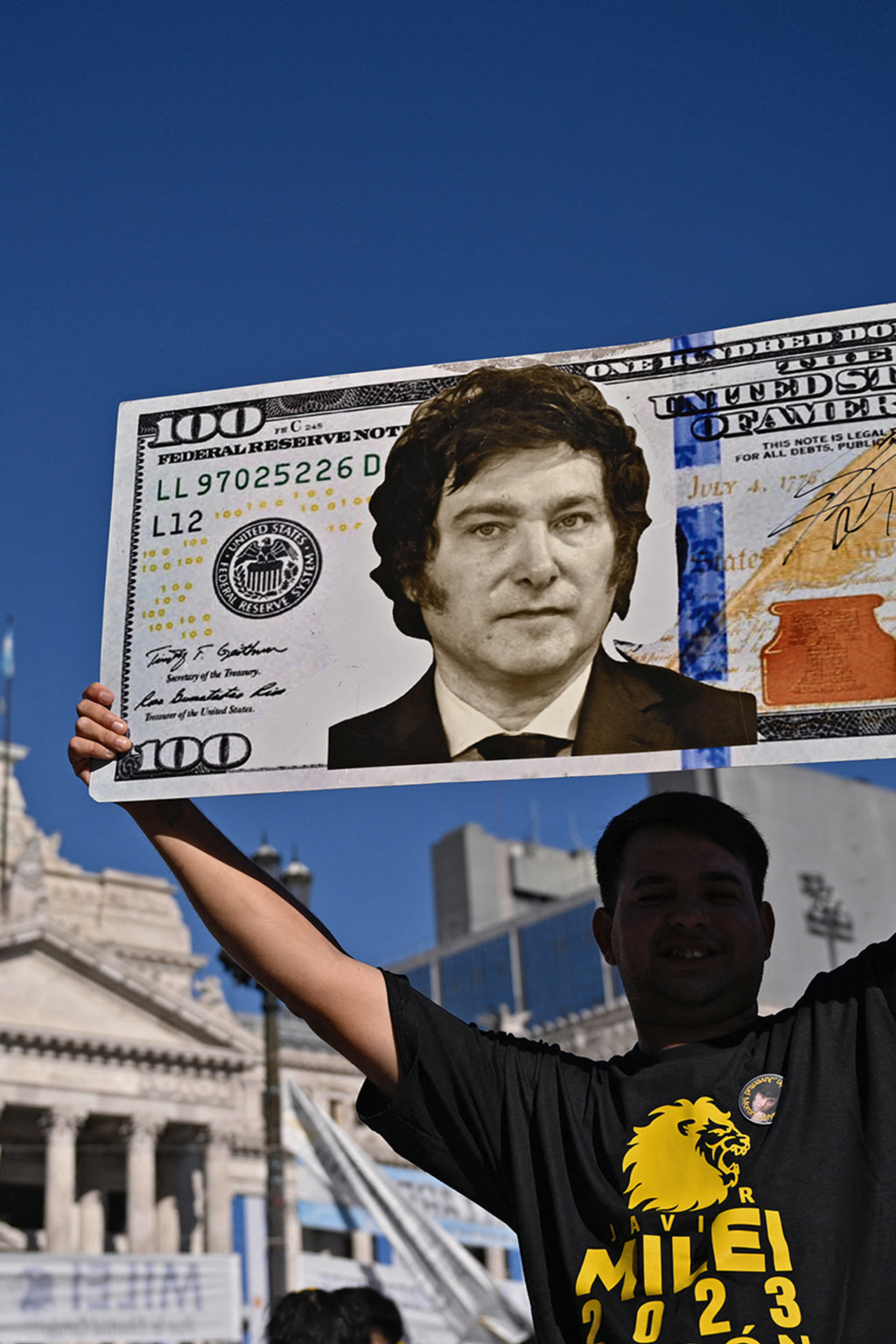
Libertarian Javier Milei’s 2023 victory underscored the depth of the grieta, signaling a rejection of the Peronist establishment and the broader political elite. Milei, known by the nickname “El Loco” (“The Crazy One”), presented himself as an outsider promising drastic economic and political change. Railing against big government, he slashed the number of government ministries by almost half and has curbed the central bank’s functions, including by halting the printing of money to fund government deficits. He opposes abortion and mandatory vaccination, is skeptical of climate change, and supports drug legalization and deregulation of firearm ownership. In August 2025, Milei and his administration came under heightened scrutiny after a corruption scandal implicated his sister and other close associates—this was followed by an unexpected defeat in legislative elections in Buenos Aires, Argentina’s biggest province.
How did Argentina’s economy develop?
Argentina has historically vacillated between periods of economic growth and crisis. Between 1860 and 1930, it became an economic powerhouse; in 1913, Argentina was one of the ten wealthiest countries per capita in the world, ahead of France, Germany, and Italy. But beginning in the 1930s, Argentina’s economy began to deteriorate rapidly, as unsustainable government spending and an overreliance on commodity exports such as beef and wheat fueled frequent boom-bust cycles. The 1970s and 1980s saw stagnating growth, rising debt, falling real incomes, and periods of hyperinflation. Some economists call this the “Argentina paradox”—by far the sharpest decline of a formerly rich country in history.
In the 1990s, the government abandoned its previous state-led development model in favor of a series of market-friendly reforms. These opened the economy through trade liberalization, deregulation, and privatization; officials also pegged the Argentine peso to the U.S. dollar in an attempt to stabilize the economy. However, a devastating economic crisis followed in 2001 when Argentina could not maintain the peg and was unable to pay approximately $95 billion worth of debt, the largest of nine defaults in its history. A 2005 restructuring only received the support of around two-thirds of Argentina’s bondholders, leading to more than a decade of legal wrangling that blocked Argentina from borrowing from international markets.
The upheaval of the 2001 depression saw a revival of left-wing politics under Néstor Kirchner. A global commodities boom allowed the economy to recover and Argentina to repay its nearly $10 billion debt to the IMF. The administration of Cristina Fernández de Kirchner, however, faced criticism for imposing price and export controls, nationalizing Argentina’s largest energy company and the private pension system, and again ballooning the country’s public debt.
Her successor, Mauricio Macri (2015–19), sought to improve a worsening economic situation by cutting export taxes, lifting currency controls, and negotiating a debt settlement with holdout creditors, allowing Argentina to regain access to international markets. The resulting surge in international borrowing supported a brief recovery, but it could not be sustained, and in 2018, a run on the peso forced Macri to sign a $44 billion loan agreement with the IMF, the largest in the bank’s history. A return to Peronist policies under Alberto Fernández (2019–23) saw increased taxes to try to plug the budget hole and another restructuring of Argentina’s bonds in 2020. Headed into the highly anticipated 2023 election, Argentina saw widening fiscal deficits and a pickup in inflation.
What are the current economic challenges?
Argentina has major economic potential. It is the third-largest economy in Latin America, behind Brazil and Mexico, with a gross domestic product (GDP) of roughly $633 billion in 2024. According to World Bank data, more than half of Argentina’s GDP comes from the services sector, including tourism, with manufacturing industries such as automotives, pharmaceuticals, and chemicals making up 15 percent of GDP. Agribusiness, which makes up 6 percent of GDP, still drives much of Argentina’s exports. The country also sits on some of the world’s largest shale oil and gas reserves, though the government is increasingly looking to harness renewable energy. In addition, Argentina comprises roughly a fifth of South America’s so-called Lithium Triangle, which contains about half of the world’s known deposits of lithium, an element essential in the production of batteries.
In January 2025, after making large cuts to public spending, Milei’s government achieved its first budget surplus in over a decade, amounting to 0.3 percent of GDP. However, a hidden “quasi” fiscal deficit at the central bank remains. Inflation, which reached over 140 percent before the 2023 election and accelerated to 211 percent in December 2023, fell to around 33 percent by August 2025.
But Argentina’s economic woes persist. The country’s currency controls, multiple exchange rates, and import barriers have made it harder for international companies to operate in Argentina and created persistent difficulties for domestic firms. Additionally, Argentina is grappling with rising poverty and a burgeoning informal currency market. The rapid reduction in public spending has gutted investment in infrastructure, leading to a down in the construction sector.
After taking office, Milei shelved plans to dollarize the economy and instead prioritized cutting spending and reducing the deficit, earning initial applause from the IMF. However, his administration has been slow to rebuild Argentina’s reserves, and the combination of inflation inertia and a crawling peg—an exchange rate regime that allows a fixed exchange rate to fluctuate between a specified range—led the inflation-adjusted value of the peso to rise. Argentina’s fiscal success was rewarded with a new IMF loan package in April 2025, which provided Buenos Aires with an immediate influx of $12 billion. But these funds didn’t catalyze a turn around in Argentina’s balance of payments, as the country continued to draw on its reserves and developed a current account deficit.
Financial pressure after the Peronists performed strongly in a provincial election in Buenos Aires led to a large drawdown in Argentina’s reserves and pushed Milei to seek direct assistance from the United States. In October 2025, the Donald Trump administration finalized a $20 billion currency swap line with Argentina to stabilize the country’s financial markets.
What role does Argentina play in the region?
Many experts consider Argentina to be a regional power in South America due to the size of its economy and its active involvement in major multilateral groups, including the Community of Latin American and Caribbean States (CELAC), the Organization of American States, and the Southern Common Market (Mercosur) trade bloc.
Much of Argentina’s early history was marked by tensions with its neighbors, especially its historic rival, Brazil. The creation of Mercosur in 1991 represented an effort to cement a rapprochement between Buenos Aires and Brasília. Bilateral ties notably improved under Argentina’s Kirchner administrations, but the Peronists’ support for Venezuela’s Nicolás Maduro regime under President Fernández increasingly put them at odds with Brazil and much of the region.
Argentina’s relations with its neighbors have also been tested by concerns over security. For decades, a small area along the junction of Argentina, Brazil, and Paraguay—known as the Tri-Border Area—has served as a hub for criminal activities such as arms and drug trafficking and smuggling, prompting greater trilateral security cooperation in the region. Relations with Brazil, Chile, and Uruguay have also been strained by disputes over China’s growing role in Latin America, Antarctic and maritime boundaries, and the future of Mercosur. Meanwhile, Argentina still maintains its claim to the nearby Falkland Islands more than four decades after it lost a war with the United Kingdom over their control.
What is Argentina’s relationship with the rest of the world?
Amid persistent economic and political instability, Argentina has sought to play a greater role on the world stage, including in its relations with China, the United States, and Europe.
China. Beijing and Buenos Aires have significantly deepened trade ties over the past two decades, and China is now Argentina’s second-largest trade partner, after Brazil. In 2022, Argentina officially signed on to the Belt and Road Initiative, a massive, China-led global infrastructure project. In recent years, Chinese state-owned companies have concentrated their overseas investment in Argentina’s agriculture, infrastructure, and telecommunications sectors, which has included financing for a nuclear power plant and a space station. Since 2005, China has provided nearly $8 billion in development finance to Argentina.
Meanwhile, Argentina currently has approximately $18 billion in Chinese state loans, mostly relating to energy and infrastructure, and Buenos Aires consistently turns to a bilateral currency swap line with Beijing to counter severe pressure on its currency and finance imports from China. (In 2023, Argentina used the swap line for the first time to repay some of its debt to the IMF.) In April 2025, the country renewed a $5 billion portion of the swap line with China for another year. While Milei initially pledged to downgrade relations with China, some analysts say his administration has since adopted a more pragmatic approach to the country driven by economic necessity.
United States. Relations with the United States have fluctuated according to Argentina’s domestic political situation. During the twentieth century, U.S. policymakers were often displeased with Perón’s leftist policies and neutrality during the Cold War, and eventually cut off U.S. aid to Argentina. Following Argentina’s 1976 coup, the military government became an important ally of Washington’s anti-communist efforts, and recently declassified documents have revealed U.S. financial and intelligence support for the Argentine junta during the Dirty War period.
Relations shifted again during the left-wing Kirchner administrations, which developed close ties with Venezuela and Iran. But center-right Macri strived for closer ties with the United States, and his 2017 visit to the White House was the first by an Argentine leader in nearly a decade. Milei has also positioned himself as strongly pro-West and pro-United States. As president, he immediately rejected Fernández’s push to join BRICS—an economic grouping originally comprising Brazil, Russia, India, China, and South Africa—before it expanded in early 2024. Additionally, since 1998, Argentina has been a major non–NATO ally of the United States, one of only three countries in Latin America to hold this distinction, the others being Brazil and Colombia.
European Union. Argentina and the European Union (EU) primarily manage bilateral relations through a 1990 trade framework with specific agreements on fisheries, nuclear energy, and scientific and technological cooperation. Additionally, the EU holds regular bilateral dialogues with Argentina on issues relating to energy, trade, digitalization, and human rights through the EU-Argentina Joint Committee, the last meeting of which was held in 2022.
On trade, the EU remains a major destination for Argentina’s exports, with trade in goods totaling more than $17 billion in 2024. European companies also invest heavily; in 2023, they held more than $42 billion worth of stocks in Argentina. As a member of Mercosur, Argentina is party to the EU-Mercosur trade agreement, which still awaits final EU approval.
Recommended Resources
The University of Ljubljana’s Rok Spruk details the rise and fall of Argentina’s economy in this 2019 piece for Latin American Economic Review.
The Carnegie Endowment for International Peace’s Christopher S. Chivvis, Beatrix Geaghan-Breiner, and Oliver Stuenkel examine Argentina’s role in the emerging world order.
For Foreign Affairs, María Victoria Murillo explores how Argentina, under President Javier Milei, is still in crisis.
For the Americas Quarterly podcast, Juan Cruz Diaz and Brian Winter break down whether U.S. economic support for Argentina can keep Milei’s plans on track.
This Backgrounder looks at China’s growing influence in Latin American countries, including Argentina.
Colophon
Staff Writers
Additional Reporting
Andy Xu Sofia contributed to this Backgrounder. Will Merrow and Michael Bricknell created the graphics. Header image by Luis Robayo/AFP/Getty Images.
 Backgrounder
 Backgrounder
 Backgrounder
 Backgrounder