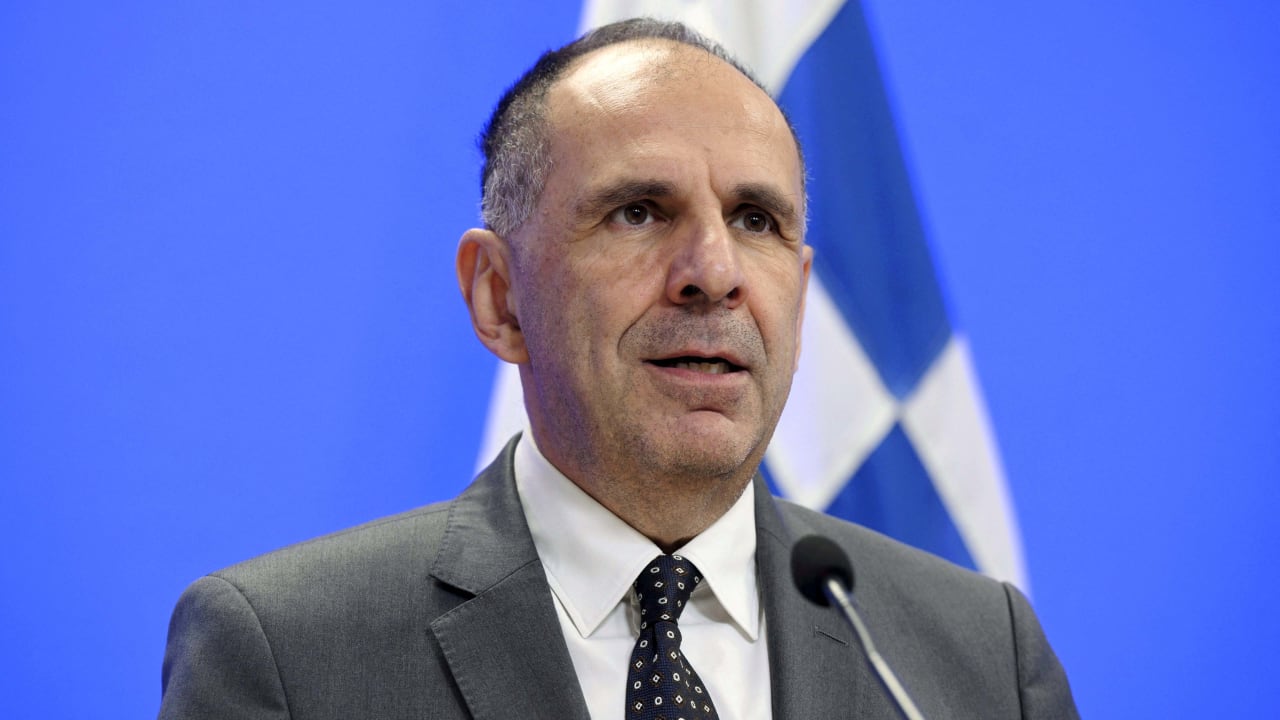
A Conversation With Foreign Minister George Gerapetritis of Greece
Event date
Speaker
- Minister for Foreign Affairs, Greece
Presider
- Anchor, Katy Tur Reports, MSNOW; New York Times Bestselling Author; CFR Member
Foreign Minister Gerapetritis discusses Greece’s approach to evolving U.S. foreign policy, NATO’s role in ensuring stability in the region, and Greece’s broader engagement across the Eastern Mediterranean and the Middle East.
TUR: Welcome, everybody. Thank you for coming. I’m sorry we’re a little bit late. The foreign minister was meeting with the secretary-general. Ran a little bit long. We’ll get an update on that, I’m sure. But we appreciate you being here. Again, this is a meeting—a conversation with Foreign Minister Gerapetritis. Did I say that right?
GERAPETRITIS: Absolutely.
TUR: OK, good. Of Greece. I’m Katy Tur, anchor of Katy Tur Reports on MSNOW. And a reminder that this meeting is on the record. So let us begin, because the world is a crazy place.
GERAPETRITIS: You know how it goes, if it’s on record you hear—you hear only, like, 20 percent of the whole thing. (Laughter.) So you have to decide.
TUR: I want to start with NATO, and Donald Trump’s threat to take Greenland. Do you understand it as over? Or is it still looming?
GERAPETRITIS: I think it’s not over. I think there is a lot to discuss about it. We have a strong belief in NATO. This has been the foundation of the transatlantic relationship. It is part of the international security architecture of the postwar era. We do realize that we need to make some adjustments. I think there is a legitimate ground concerning the Arctic security. So we can hear this. On the other hand, we need to work on further details how to enhance security. And this is something that we have to decide within NATO. We all realize that the Greenland issue is something which is of critical importance for the Europeans because of Denmark, obviously. So this—we do have a very strong belief about it, but definitely there is—there is plenty of room for dialogue with the American administration. And I think that this is going to be a constructive dialogue.
TUR: Did this come out of nowhere for you? Or was there an actual threat to Greenland from China or Russia?
GERAPETRITIS: To be totally honest, we didn’t have a full picture of what is coming on. We did realize that there is—that Greenland is getting increasingly as a venue of higher importance because of the presence of Russia and other actors. But the truth is that this has become a major issue, especially after the American elections. As I mentioned, Katy, we do realize that this is an issue of concern. This is partly legitimate. But the truth is that I think it came as—mostly as a surprise how important this is for the new American administration.
TUR: He seemed to link it to not getting a Nobel Peace Prize. Do you have a reaction to that?
GERAPETRITIS: No, you don’t expect me to comment on this. (Laughter.)
TUR: Not on the record, at least.
GERAPETRITIS: The truth—the truth is that the world is becoming highly unpredictable. You mentioned whether we could foresee this, or whether we could see this happen. The truth is that it’s getting increasingly unpredictable. And it’s not only because of the new American administration. I think the whole idea of the geopolitical new era is getting, indeed, unpredictable. A few years ago, being a foreign minister it was mostly about foresighting, how you can predict the future. Now I think there is a total shift on how we perceive our duty. Now what we’re trying to do is to develop what-if scenarios, because of total unpredictability. So, you know, unpredictability is our everyday life. It’s part of the job. We’re trying to—sometimes to square the circle. But mostly, the idea is that this is happening on a rational basis.
TUR: That unpredictability, is it solely because of Donald Trump? I mean, Sir Richard Shirreff, the former NATO deputy commander for Europe, said that Donald Trump is a bigger threat to the alliance than Vladimir Putin is.
GERAPETRITIS: No, I cannot—I cannot say this. The truth is that for us Europeans, Putin is a credible threat. And, you know, it’s not only because of the Russian aggression of Ukraine, but it’s also because of many other incidents happening in Europe, including hybrid threats. So I do think that for Europe Putin is indeed a threat. Also it is true that the new American administration has changed the pattern of exercising politics. And there is a certain adjustment to this. In a sense, Katy, I feel that the new type of the American administration political behavior also bring brings into light some of the deficiencies of the security architecture, such as, for example, the obvious imbalance concerning the burden sharing on NATO. And we all agreed that we need to actually revisit the basics of burden sharing in order to become mostly on a fair basis. But the truth is that unpredictability is a multipolar issue that cannot attribute it—cannot be attributed to a single factor.
TUR: When you’re talking about shouldering the burden, Donald Trump was very clear what he wanted last time around when he was president, 5 percent. Do you think he’s clear now about what he wants from NATO in order to, in his words, make it stronger?
GERAPETRITIS: I think we have a very clear idea. Greece, as you know, because of the geography and the geopolitical aspect, we do spend a lot on our defense. We are well above 3 percent for the last many years. So it’s not going to be a huge surge for us. But I think for many Europeans this is going to be a relatively difficult task. As I mentioned, Katy, I think it is imperative, in light of the new doctrine that we’re trying to develop in Europe, the doctrine of strategic autonomy, to actually take on our soldiers the basic task of defense. Now we have a 3.5 (percent) and 1.5 (percent), the former being the critical defense infrastructure whereas the latter is mostly the collaterals relating to defense. I think there is a very clear roadmap to this. And I think this is going to be mutually beneficial.
TUR: Let’s talk about Russia. The administration has largely sided with Russia and what they want out of—what Russia wants out of Ukraine. They are talking to try to come to some settlement. Do you believe that if Russia is able to get the Luhansk, the Donbas, what it’s asking for, that that’s where it ends?
GERAPETRITIS: Well, you know, we speak of unpredictability. So you never say never in our job. The truth is that in order to have a sustainable peace, we need to have a fair agreement for all parties. History has proven that on many occasions when we have a humiliating agreement this was essentially the triggering for further uneasiness. So for me, it’s really important that we—in Ukraine we have a fair and honest agreement which reflects the basics of international law, including sovereignty of Ukraine. You cannot impose an agreement that is very unilateral, that is humiliating, and then expect that this agreement is going to last forever.
TUR: Peace with honor is what you’re talking about.
GERAPETRITIS: Indeed.
TUR: Let me ask you about Article Five, because there is some concern that if Vladimir Putin believes he can get what he wants out of Ukraine that he’s going to continue. He’s already crashed drones on NATO territory. NATO has not done anything about that. Do you have confidence that if he were to invade or step into a NATO country, maybe one of the smaller native countries that he wants back, that the alliance is ready to fight back? And that alliance, are you confident will it be backed—and will Article Five be backed by the U.S.?
GERAPETRITIS: I am pretty confident that Article Five will be triggered in such a case, because I think that the ties of—the transatlantic ties are still quite reliable and credible. I know that there has been some serious challenge on the part of President Trump and his administration, but I think when it comes to the actual fundamentals of this relationship, which has been the essence of post-World War II security architecture, I think we also the common—the common belief, the common mindset. And I think this solidarity will be proven. When we’re discussing about the future of NATO, I have the feeling that we’re not discussing about a total rupture, but mostly about the transition.
TUR: To what?
GERAPETRITIS: A transition to a more functional, I think, organization that, as I mentioned for burden sharing, will be the essence. The truth is that us Europeans, we need to take more burden when it comes to the security of Europe, of our neighborhood. And this is, I think, only legitimate to believe. But when there is a moment of crisis, I think that the whole of the Western world will be alike.
TUR: Is that diplomatic-speak for saying that you don’t entirely trust the United States, and that Europe needs to learn how to defend itself? I mean, the French foreign minister is basically saying that. He was hitting back against Mark Rutte, who said that NATO can’t exist without the U.S.
GERAPETRITIS: To be totally honest, this idea of strategic autonomy of Europe is not a new concept. It’s a concept that has been developed in the last, at least, five years. So it’s well before the election of President Trump. So the truth is that we—after the Russian aggression of Ukraine, in Europe we see things very differently. It hasn’t happened in Europe after World War II that we had a war so close to us, within the heart of Europe. So for us, it came as a shock because, you know, the idea of the European Union, especially, was the idea of building peace upon economy. And we didn’t have that type of incident. And, you know, when you have a war which is well within your borders, you just see things differently.
So for us, strategic autonomy, it’s becoming steadily an existential issue. It’s not related to the new American doctrine. And I think for us it’s very vital to actually develop it. Strategic autonomy obviously does not only relate to deterrence. It also relates to finance, to competitiveness, to trade. And I know that you’re going to ask me about the trade agreements of the European Union. But I think it’s a whole system of actually revisiting the fundamentals of Europe.
TUR: I do want to talk about the mother of all deals in a moment. But let’s talk about Greece’s strategic positioning and liquid national gas. You guys want to be the gateway into Europe. Give us an update on the ports, the terminals. Where are you guys at?
GERAPETRITIS: Actually, we’re very well located. You know, it’s not a coincidence that ancient gods preferred Greece out of any other country. And this is, first, because we have a very key central role between three continents. Essentially, we’re at the edge of Europe, but very, very close to Africa, to Middle East, to the whole of world. We do have very strong infrastructures, and especially ports, with the port of Piraeus being probably the strongest port within the Mediterranean. We have developed energy as a key factor for our policy. And now Greece has become an exporter for the first time in our history. We were clear importers for decades, and just last year we became exporters.
We have diversified our energy mix. After the Russian aggression of Ukraine we took a very firm decision to actually develop a new energy strategy, not to over-rely on certain states. So now we are relatively autonomous on our energy production. We have more than 50 percent coming from renewable energy sources. We have two FSRU stations. We have developed synergies with all countries concerning vertical and horizontal corridors. We have in development now two sea interconnectors, with Egypt and with Cyprus. And, of course, we have the Vertical Corridor that we announced a month ago. So, yes, we do have the capacity to support Greece as the energy juncture for Europe, Africa, and these. And, yes, we have the political willingness to develop our energy alliances.
TUR: How is the bilateral relationship with the U.S., considering that lot of the liquid natural gas comes from here?
GERAPETRITIS: This is true. Almost 25 percent of the American LNG goes through Greece. And please don’t forget that we have a very strong merchant fleet. We have the strongest merchant fleet in the world, almost one-third the overall American LNG is carried through Greek vessels. So I think Greece is a very great, a very critical ally for the United States. And it’s a very safe ally, because, you know, Greece has proven in the last at least six, seven years, with a new government, that we are very strong on our beliefs, we consider very highly our traditional allies, and we do not develop any transactional policies. We operate as a matter of principle. And I think this renders us truly honest brokers in this whole energy market.
TUR: I want to get to the Middle East. You were at the U.N. Security Council today meeting with the secretary-general. Can you give us an update on Gaza, specifically?
GERAPETRITIS: Yes, of course. And apologies for being late. We had scheduled twenty minutes with the meeting with the secretary-general, and eventually took it more than an hour because, again, there are so many pending issues that we need to discuss. And, you know, Greece is one way or another involved on all open pending issues, but in particular with Middle East. As you know, we’re entering phase two. Phase two is a very critical phase because it involves the development of the stabilization forces on the ground. It involves the disarmament of Hamas, which is obviously a condition precedent for the development of forces, but also for the security of Israel. It develops also the technocratic Palestinian government. It is very important that there is a very clear roadmap concerning the necessary reforms of the Palestinian Authority and the Palestinian governance. And I think within the next few weeks we’re going to have the stabilization forces on the ground.
As you know, the Security Council has produced a very critical resolution, 2803, which is the legal foundation for the new regime in Gaza. Greece is going to play an active role, both in terms of the humanitarian aspects of the issue as well as the stabilization and the reconstruction. At this very moment we have developed many mechanisms concerning the humanitarian aspects. We host a number of Palestinian children in our hospitals. We provide strong humanitarian aid. Only a month ago we visited Ramallah and we had a very good meeting with the Palestinian Authority and President Abbas. We have very strong traditional ties with the whole of the Arab world. At the same time, we have a strategic relationship with Israel. I have to tell you, to be totally honest, that it’s not over yet. There are a lot of issues that need to be addressed in Gaza and in the West Bank. But I can say that I am moderately optimistic about the eventual outcome in Gaza. We envisage a coexistence, a peaceful coexistence, of Israel with the state of Palestine once this situation is cleared.
TUR: Moderately optimistic is saying a lot for the region and for that area. What’s your most pressing concern?
GERAPETRITIS: You mean about Gaza?
TUR: Yeah, about it—about it becoming less stable.
GERAPETRITIS: For me, the most important—for me, the most pressing need now is the scope of mandate of the ISF, of the International Stabilization Force.
TUR: Who’s going to make up the International Stabilization Force?
GERAPETRITIS: This is going to be under the umbrella of the Security Council resolution. But this is going to be a decision of the Board of Peace. As you probably know, the U.N. Security Council resolution gave the authority for the establishment of the Board of Peace and the ISF. So there is going to be a chain of hierarchy. And the eventual commands will be made by the authorities.
TUR: Expand on that. What is the tension between the Board of Peace and the Security Council?
GERAPETRITIS: Ah. (Pause.) (Laughter.)
AUDIENCE MEMBER: Well done.
GERAPETRITIS: OK, this is not very encouraging, hearing laughters after the questions and expecting a reasonable answer. (Laughter.) The truth is that the scope of the Board of Peace went further than the resolution, in that the Resolution 2803 specifically mandated the Board of Peace for Gaza, and for a limited period of time, for the resolution of the conflict. Whereas the Board of Peace is more open-ended, and essentially it consists of a permanent international organization. So there is not a total convergence. And this is why we said that at this moment we’re not able to join the Board of Peace, although we were invited.
What we explicitly said, and I think that was the reasonable and principled thing to say—and this was the suggestion of my prime minister before the European Council—was that the Europeans should opt in to the Board of Peace merely for Gaza and for the period necessary to resolve the conflict. So Greece is entirely in favor of all initiatives concerning the peaceful resolution of the situation in Gaza. For us, it’s existentialist because it’s very close to our neighborhood, and because there are Christian populations there, and because of our close ties with Israel and the Arab nations.
TUR: Do you anticipate Donald Trump pushing the Europeans out, pushing the U.N. out, and declaring that the Board of Peace is in charge, and only?
GERAPETRITIS: No, I do not—no, no. I don’t believe this. I think the umbrella of the United Nations will be there because, apart from anything else, the legal foundation is Resolution 2803. The truth, again, is that it’s an initiative—the Board of Peace is an initiative which can bring some added value to the regime, because there must be a different model in Gaza. And I think that this conflict is very complicated. It goes back decades. The historical roots of this conflict, it goes well beyond any U.N. resolution. So I think we should just try and be as realistic as possible with the new mechanism concerning the resolution of conflict. So I think that Board of Peace and U.N. can and should be compatible. And the Europeans and Greece will be very constructive in this respect.
TUR: Will Hamas disarm?
GERAPETRITIS: No. This is a question that you shouldn’t address to me. Clearly, I’m not a member of Hamas, and let alone a leader of Hamas. If you ask me whether I’m optimistic about this, I would say that I am not entirely optimistic. And I can give you a reasoning why I’m not very optimistic, because I think Hamas is not only a matter of a bunch of people who compose this terrorist organization. I think Hamas has been developed as an ideology. And in order to eliminate Hamas you have to eliminate the ideology behind Hamas, this terrorist ideology. And in order to do this you need to do much more than just disarmament. You need to provide meaningful education. I’m very concerned that for the last two years, there is an under-education of youngsters in Gaza. And this could be obviously a reason for a new generation of extremism. So obviously disarmament is necessary, but I feel that it’s not adequate.
TUR: Can you give us any detail about the meeting you had with the secretary-general?
GERAPETRITIS: No. (Laughter.) But I can tell you that it was a very honest meeting. We had a tête-à-tête—an extensive tête-à-tête with the secretary-general. And we had also a meeting with our delegations. The open part, I can tell you, was about Cyprus. Now, as you probably know, there is a process of trying to resolve the Cyprus issues. The Cyprus issue is a very painful story. The island of Cyprus is split after the Turkish invasion back in 1974. And it is still the only place on Earth which is under a clear dichotomy. So I think it’s important. It’s a great signal, I think, for the world, if the United Nations could make it to have sustainable resolution of this long-standing dichotomy on the island.
Yet we do understand that, in the same way as in Gaza, in Cyprus the situation is very difficult, in the sense that there is a de facto situation of an occupied territory in the north part. And in spite of trying to actually find a proper solution under the U.N. Security Council resolutions, for more than fifty years this has been absolutely ineffective. So we’re trying to find the driving force to accelerate this process. We also discussed about Syria and Libya, because those are two venues that could become very difficult in a very volatile region. And of course, we discussed general issues of—conceptual issues about the security architecture within the United Nations and the new scenery of multipolarity and multilateralism which seems to develop. Obviously the secretary-general is also very concerned with what is happening, but I think we should address those issues with calmness and we should try to be as constructive as possible.
I do believe, as I mentioned, that we are in a transitional period. And we need to address the root causes of malfunctions, even within the United Nations. We are fully supportive of UN80, the agenda concerning reformation of the decision making within the United Nations. I think that there is a very wide agenda. For me, it is important to keep on the constructive dialogue concerning the international multilateralism. I do not want to believe that this is actually a dead story. I think multilateralism has a lot to give us, mostly because, you know, Katy, the vast majority of problems nowadays, they are transnational, be that armed conflicts—there is not a single conflict where there is not an external actor—or climate crisis, or food insecurity, or international terrorism. So I don’t think that there is any nation, no matter how powerful it is, that could produce a positive result unless there is a very wide consensus on this.
TUR: So, on that note, Europe is looking outside of the United States on a number of different issues, including on trade. Tariffs have clearly pushed Europe to reconsider their trade relationship. You just signed—or, the EU just signed—the mother of all trade deals, is what it’s being called, with India. Does that set you on a path to try to free yourself from the need for trade deals with the United States?
GERAPETRITIS: OK. This is clearly a provocative question, but I will try to be rational with this. (Laughter.)
TUR: You did get an American journalist.
GERAPETRITIS: No, no, it is your job to be provocative. I really appreciate that. And, you know that I’m not a politician. I’m an academic. So for, like, twenty years, I based my thinking on rationalism. And now I have to become a politician, which is not an—you know—
TUR: Is fundamentally irrational?
GERAPETRITIS: No, but it’s not a privileged territory of rationalism, I would say. Now, coming to international trade, in Europe the truth is that we do not like tariffs because we firmly believe in free trade. And this is a matter of ideology. And we do have now the—you know, the experience to talk about free trade, because the postwar era in Europe was essentially based on free trade. The idea of European communities, later European Union, is exactly the idea that economy could support a non-war situation in Europe. So for us, this is about the essence of our way of thinking, of our mindset. And this is why we are trying to actually mitigate the impact of tariffs. And we are in constant discussion with—also with the United States concerning this issue of tariffs.
Now in the last few weeks we had two amazing treaties concerning free trade. The first concerning Mercosur and the second with India. Although there are some setbacks with Mercosur, I think it’s an equally important free trade agreement. Now, with India, you know, it’s of utmost importance for us. Both agreements have been negotiated for more than twenty, twenty-five years. And, you know, it could be the driving force of the new era of international trade, but they’re both very long-awaited agreements. So very happy about them. It’s a market of about two billion consumers, the free trade agreement with India. For us in Greece, it’s important because it opens a market of 1.4 billion, and especially when it comes to some really important products, Greek products, and especially agricultural products.
But, you know, it’s really important to try and diversify the trade. What has been proven is that over reliance in any respect could be detrimental—be that energy, or food security, or water supply, or whatever. So this is a fundamental perception of Europe and of European Union, that we want free trade and we want to raze all possible obstacles in international trade.
TUR: All right. So we’re going to open it up now to—you lucked out because I was going to ask a tough follow up. (Laughter.)
GERAPETRITIS: Are there any other questions about this—you almost—(laughter)—
TUR: No, but I’m going to open it up to that to the members for Q&A.
(Gives queuing instructions.)
James.
Q: Hi. Thank you very much, Mr. Minister, for being here.
Just a quick question on the fiscal and economic outlook of Europe. Are you concerned generally with France and Germany’s current position, the rise of far-right parties, and the future stability of the euro? And if so, what do you think the impact would be on Greece’s general economic outlook?
GERAPETRITIS: I will start with the good news concerning my country. As you probably know, we are doing a very good job when it comes to economy. We are champions when it comes to growth, to reduction of unemployment, to reduction of debt towards GDP, we have some very good macro indicators. And this is why we’ve been rated very highly. So economic stability is very good in Greece. And this goes side by side with political stability.
You know how it goes in Europe, and I will try to just place your question into the broader political scenario in Europe. In Europe we do have a lot of governments which are coalition governments. And this is a political problem, if combined with rise of extremism also in in Europe—in some parts of Europe. So the problem is that many countries do have problems of political stability and political pressure. And that could create some problems. And we see, for example, even in strong countries, like France or Italy or Belgium, having problems of political stability.
Now, the truth is that we do have a lot of concerns. Even in Greece we have a lot of concerns. For example, we had some strong riots concerning the agreement, the Mercosur agreement, in the same way that there are some strong riots in France as well. And that especially happened with farmers in Greece. And this is a very critical issue because of its link to the issue of food security. I think, at the moment, the situation seems to be relatively stable in Europe, both in France and in Germany. But it takes a lot of energy to actually maintain this position. Sometimes the truth is that we do have contradicting interests in Europe. This is something that probably is unknown in the United States because of the situation. And I’m not saying this in an ironic way.
But, you know, like in Europe, we—there are twenty-seven EU member states. There are some serious discrepancies between south and north, between east and west. And we try to converge as possible, but the truth is that we’re relatively far from economic convergence. And this might jeopardize the social cohesion, but at the end of the day we make it to survive. And I think that the European project has not expired, in spite of problems.
TUR: Kilaparti?
Q: I thought you were going around the table. Mr. Minister, thank you again for your comments.
And I have two questions. One is—
AUDIENCE MEMBER: Mic, please?
Q: I did press the button. Can you hear me?
TUR: Bring it up—bring it up to your mouth.
Q: OK, very good.
My question is with reference to your meeting with the secretary-general and the Board of Peace proposal that the Security Council agreed to. Is there any chance, given what happened in Davos, that there would be a Board of Peace under the U.N. administration? That’s the first question. And then—
GERAPETRITIS: The truth is that under the resolution of the Security Council there was not in the first place the idea that the United Nations would have the lead in this project. The leads would be assigned to the Board of Peace, led by President Trump and including also Tony Blair. So what the Security Council did was to provide the authorization in order to establish the board of peace. The question is whether there is full compatibility between the resolution and the actual establishment of the Board of Peace. I think there could be. It is reasonable to expect that there could be alignment. And this is why our proposal, I mean, the Greek proposal to the Europeans, is that we opt in for Gaza, exactly in order to make the bridge with the Security Council resolution.
You’re entitled to a follow up.
Q: It is really hard for me to believe how you could reconcile the Board of Peace, as proposed by President Trump, with what is recommended by the Security Council.
GERAPETRITIS: There are not so many divergences, you know. I’m not speaking about the inside decision making and how the Board of Peace is structured. What I’m saying is that the fundamental difference relates to the scope. And this is for us very critical, because we think that the Board of Peace should focus on Gaza and Gaza only, and should not be open-ended, and conceivably embrace any kind of conflict. So I do not really think that there is a huge jump that we need to take in order to make it aligned.
Q: The follow-up question, not particularly about the Board of Peace but about the U.N. reform initiative: Given everything that is going on in the world, do you think there is a possibility that we would make any major progress on that front?
GERAPETRITIS: About the United Nations? Now I will give you my take of it, which is mostly academic. I think we should insist on multilateralism. Sometimes we say that the modern world is very multipolar, and this is why we need to develop a different attitude. But even before World War II in Europe the world was very multipolar. And the lack of multilateralism essentially resulted in a war, in a global war. So I comment on international multilateralism. For me, it’s absolutely essential. If you ask me whether adjustments are required in order to have a more effective mechanism, the answer is in the affirmative. By all means, we need to revisit the international multilateralism. But we cannot abandon it. To be honest, I cannot accept the idea that might makes right. This is not my attitude. And this is not the—I think, the attitude of the Western way of thinking. What I insist on is not that we abandon realism. What I sustain is that we need to have a value realism.
It would be—you know, it would be of the outer space if I came to you and say that everything is right, and we have an outstanding relationship now, and everything is calm and there is a fruitful future. We do realize that we live in a very turbulent period. And for the first time, we do have problems as Europeans vis-à-vis the United States. What I’m saying, though, is that we need to build on reality, but at the same time having as a basis the fundamental values—the fundamental values which resulted in the Western way of thinking. And by this I mean the idea of the rule of law, of democracy, of human rights. Yes, we need to take into account that there is a rapidly changing world. And we need to take into account that at this very moment the mighty states may be more effective in some respects. But this cannot happen without values. And I think values need to be produced at a higher level. And this can only be the international multilateralism in the United Nations. So, yes, I’m hopeful about the United Nations.
TUR: Do you think Donald Trump wants to replace the United Nations with the Board of Peace?
GERAPETRITIS: I cannot enter into President Trump’s mind. (Laughter.) You know that this would be a very hard task, to say the least. But the truth is that at the moment I feel that we’re very far away from the idea of a replacement of the United Nations. What I think is what is created is a series of incremental type of ad hoc mechanisms to deal with global affairs and global problems. And this is not something that is necessarily a bad thing. You know, we have to be very frank and open. On some respects, the United Nations and the European Union, we failed to produce some tangible results. And probably we need to think out of the box. The truth is that we can combine the idea of a structured, orderly United Nations with some more incremental vehicles. But, again, for me, the important thing is that we stick by our values.
TUR: I’m going to go back and forth. So, remember, speak into the microphone, say your name, and state your affiliation. Mark (sp), to you.
Q: You just spoke of a values-based realism. I guess my question is, what do you believe those values should be, without returning to neoliberal orthodoxy?
GERAPETRITIS: I think that at the moment we need to actually address global issues in a different manner. You know, it’s—for me, the differences now—the priorities now are completely different. Just to give you some indications, you’re all very learned about what is happening in the world. For me, for example, the most scary situation is not that we have record of armed conflicts around the world. But the most scary thing is the situation with the water supply around the world, which at the very low because of climate crisis. The increase in global inequalities, and the lack of effective education around the world. So I think we should just reshape our fundamental ideas about core needs of the world and just put them up front.
You know, the traditional, orthodox human rights is a theory that cannot be overseen. Ecumenical rights are there and will be there. And we need to respect them because of their inherent nature relating to human nature. But I think there are some other existential needs that we need to address. So if we can all agree that there are some basic, fundamental needs that we need to address on a global layer, I think this understanding could be our basic value. You know, in the past we’ve made a lot of efforts in order to try and establish some global governance tools. For example, the Paris agreements concerning climate. And most of them were ineffective. I think now we should build on a different perception about contemporary values, and we need to understand how these operate. So, for me, it’s a matter of how we conceive our priorities. Our political priorities, but also humanitarian priorities. And those are the values that need to be combined with reality.
TUR: Bo, I’ll take it to you.
Q: Hi, Mr. Minister. I’m Bo. I’m from Episcopal Relief and Development.
And I have a question based on—I think Greece is rather unique among European countries, that there is still a very recent diaspora in the United States that originates from Greece. And I was just curious about that, how that impacts your job. You know, like, what are the advantages of having a very engaged Greek population, and what are some of the challenges of that?
GERAPETRITIS: Our diaspora in the United States is truly amazing. We have—we cannot actually calculate them because they go back four or five generations. And it’s difficult to actually keep the ties. We have the honor here to have our ambassador of the United Nations and our general consul in New York. And they would know more about it. But I have to tell you that having such an active diaspora is a privilege, but it’s also something that sometimes makes our job very difficult. Why? Because we need to have a different mix of policy in order to keep them engaged in our domestic political agenda, whereas at the same time to use this diaspora as soft diplomacy tool. You know, it’s—you know, at the same time, it’s a blessing and sometimes an anathema to try and keep them on board.
Only yesterday, the cabinet of ministries back in Athens approved a new draft legislation for the mail ballot. And this is a major breakthrough for us because you can imagine that in Greece, we are about eleven million people, out of which voting rights we have about 999.5 million. And we expect that potentially we can have a plus-50 percent of electorate in Greece, we have used sanguinis, which means that everybody who is born and they have an ancestor—a Greek ancestor, they’re entitled to the Greek nationality. And this is going to be—the mail ballot is going to be a further impetus in order to enroll. So we expect a surge in the participation of our diaspora in national election.
And this could be a complete change in the way we perceive political affairs in Greece. But, I have to tell you, that for us it’s a tremendous asset. Wherever I travel I see a very vivid diaspora. It’s probably because they don’t see what is happening in Europe and they’re not disappointed because of this. But the truth is that, especially in the United States, the Greek diaspora is absolutely amazing. They’re very influential. And we rely heavily on them. We consider them to be the bridge between Greece and the United States. And we have a strategic plan how to actually embrace them.
TUR: Well, you can count my family among the diaspora. (Laughter.)
GERAPETRITIS: Ah, we have—we have a Greek. Not the Greek passport, though.
TUR: No. Do you have one to spare?
GERAPETRITIS: Yes, I can tell you, by mail ballot. (Laughter.)
TUR: That is going to do it for us today. Thank you for joining this meeting. And thank you to foreign minister.
GERAPETRITIS: It was wonderful to have you. Thank you so much. It was a wonderful discussion.
TUR: Thank you very much. (Applause.)
(END)
This is an uncorrected transcript.