A Conversation With Former National Security Advisors
Event date
Speakers
- Former National Security Advisor (2010–13); Member, Board of Directors, Council on Foreign Relations
- Former National Security Advisor (2005–09); CFR Member
- Former National Security Advisor (2013–17); CFR Member
Presider
- Michael FromanCFR ExpertPresident, Council on Foreign Relations
Former national security advisors discuss the recent changes to the National Security Council and the foreign policy challenges facing the United States.
FROMAN: Well, good afternoon, everybody. It’s great to have you all here. In addition to this very full room, we have about 500 people who are registered to be online, including several dozen press. And so we’re delighted to have you here.
Just want to say I’m particularly delighted to have my in-laws here, Ed and Judy Goodman. (Applause.) I’m very grateful to them for producing my wife—(laugher)—who’s also here, a fellow CFR member.
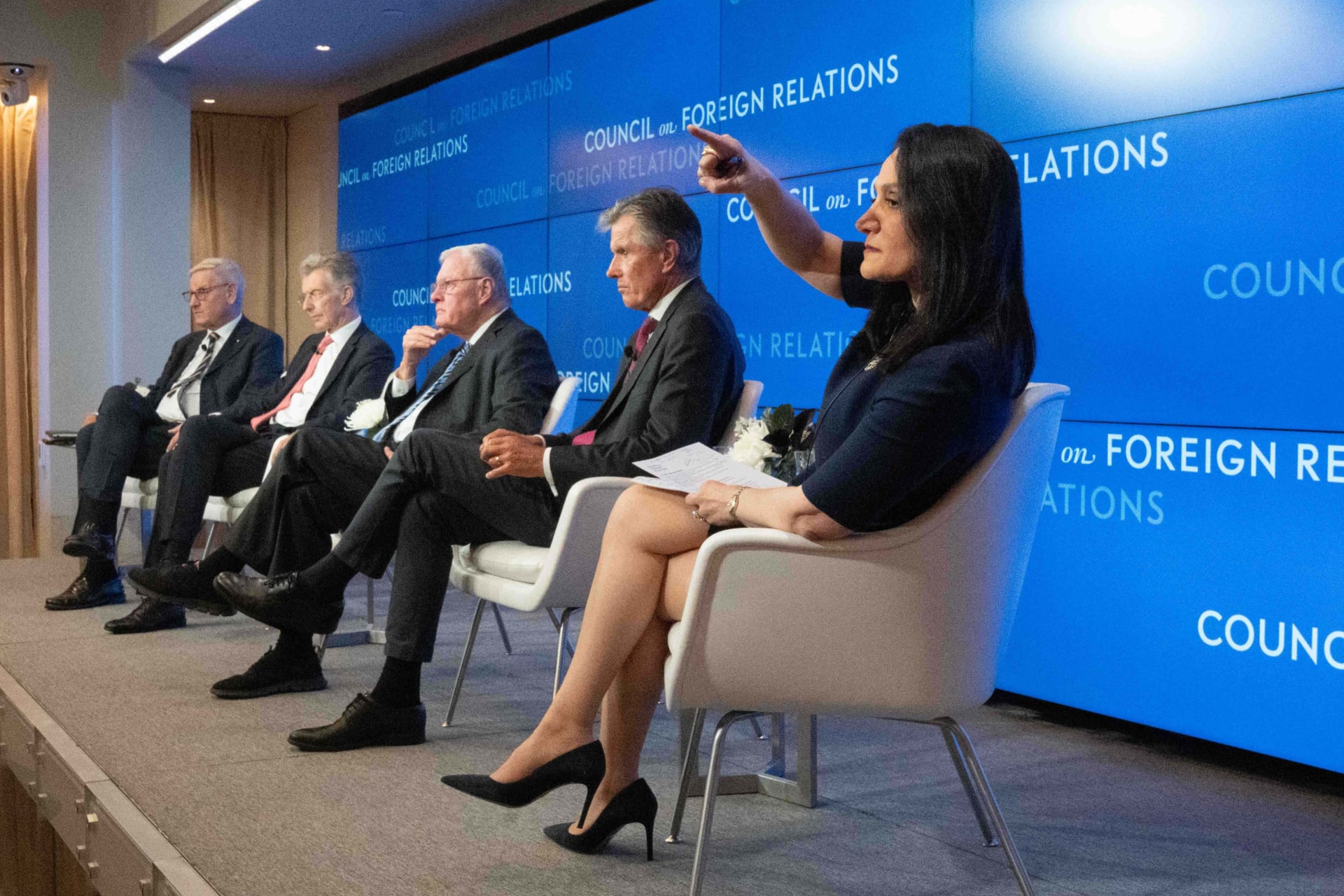
And delighted to welcome today’s meeting with three former national security advisors, Susan Rice, Steve Hadley, and Tom Donilon. You all have their bios. We won’t spend time on that. We’ll talk for about thirty minutes and then open it up for questions.
So you’ve all been in this incredibly important position of national security advisor. Every administration, the NSC has evolved somewhat. Over time it seemed to have grown. In some administrations it seemed to get quite operational. In others it added new topics to national security, whether it was counterterrorism or cyber, homeland security. This administration has taken a particular approach to decision making on national security issues. Every administration reflects the personality of the president. How do you assess the current structure, role, and process of the National Security Council?
Let me—(laughter)—starting off with a bang—you know, start off with a bang. I told you, they’re all easy questions. Susan, would you like to start this one off?
RICE: Sure. Thank you, Mike. Hi, everybody. It’s good to be with you.
I think—well, as I’m sure we’d all agree, to a substantial extent the NSC itself, its structure, its function, does need to reflect the style and the orientation of any given president. However, since the National Security Act of 1947, there has been some degree of consistency, some degree of structure and process and rigor, which I think has traditionally served our nation well. In recent years, we’ve seen a system where intelligence and information informs ideas, options, deliberations, decisions, and their implementation. We’ve seen a system that’s largely been bottom-up, with working groups at the deputy assistant secretary or assistant secretary level, leading to deputies level meetings with the deputy secretaries, leading to principals committee meetings. And the opportunity for the president to sit at the head of the table and to interrogate options and recommendations.
In this administration, in addition to the radical shrinkage of the National Security Council and its staff, and the seeming litmus tests that have been put in place for people based on ideology or background or support for the president, it seems—and I underscore seems, because I’m not in there and I don’t think any of us can be absolutely certain without being on the inside exactly how things are being done. But it seems that, rather than there being a process where issues and options are pressure tested, where alternatives are debated and endorsed or discarded, where recommendations are made based on analysis, it seems that the process is very much top-down, with the president saying what he wants to do and everybody scrambling to get it done.
And that may not be a bad approach in every instance, but it does, in my view, increase the likelihood that we have blind spots, that there are alternatives that haven’t been considered, the ramifications of particular decisions may not be fully surfaced, that dissenting views or differing opinions are not encouraged or welcomed. And I think that can be quite problematic, if not dangerous in some circumstances. And if you look at one example that inadvertently burst into the public domain, the Signalgate experience, what troubled me most about that was—in addition to the carelessness of it and in addition to the fact that clearly classified information was being shared on a non-government, non-secure system—was a seeming superficiality of the deliberative process.
Instead of sitting down in the Situation Room with a series of meetings where the discussion could turn on the advisability of taking military action against Yemen, in that context, that seemed to be debated in very short form and, you know, message texts and memes on an app, rather than, you know, sitting down and actually considering the pros and cons, the risks and the benefits, and how we would convey that to our allies, what messages we’re sending to our adversaries. I mean, all of that stuff that we would normally do seems to have been short circuited. And so if that’s any indication—and maybe it’s not, but it’s one public indication that we have of how discussions and deliberations are happening—it leaves me concerned, to say the least.
FROMAN: Steve, this president takes pride in making decisions by his instinct. And his instincts are not always wrong. Indeed, he gets to some good conclusions after a fairly short reaction. What concerns do you have about process?
HADLEY: Well, I think I’d emphasize something that Susan said. There’s a reason the national security advisor does not testify before Congress, is not Senate confirmed. There’s a reason why Congress does not prescribe the structure of the National Security Council staff, so they can be tailored to the way the president gets information, and the way the president makes decisions. That’s in the design. The size of staff. Under the Nixon administration, under the Reagan administration, the policy staff was probably fifty-or-so people. Under other administrations, it has been a couple hundred. So, again, there’s a lot of variety.
We now have a dual-hatted secretary of state, national security advisor. We had that under Henry Kissinger for a while in the Nixon-Ford administration. It can work. When the president is very active in making policy, having proximity to the president is a good thing, not a bad thing. And it is useful for the current incumbent of those two positions to have that kind of access. What it requires, of course, is a strong deputy who can run the staff, and also has the confidence of the president so that the Secretary of State/National Security Advisor Rubio can go overseas, because there are times when the Secretary of State only will do. You can have special envoys, but there are times when the secretary of state needs to show up overseas. You can do that if you have a structure where there’s someone at home minding the store while the dual-hatted secretary of state goes overseas.
So you can make this structure work. And I think they’ve tried to tailor it to the way the president takes information and makes decisions. I would say one other thing. You know, I was a—I’m a big process guy. And I like these interagency process going up. But my experience is that the major initiatives of any administration often come top down, through the president’s vision. The president is actually the person at the top of the stack who has the broadest vision. And many times, the initiatives come from the president or require the president if they’re going to become a reality. So the fact—you know, again—once again, the president really is the chief strategist of their administration. That’s not new.
FROMAN: Tom, let me take it in a slightly different direction. Over the last couple of years we started seeing this axis of the aggrieved, or the autocracies—China, Russia, North Korea, Iran—come together. A couple weeks ago we saw in China a conference where Modi, Putin, Xi are holding hands. Clearly there’s some big shifts going on of alignments around the rest of the world. And President Xi seems quite out there in terms of laying out his vision of where the future of world order should go. How do we respond? Do we have an alternative vision that we’re putting out there? And how do we make sure we’re not ceding the ground to others as these alignments sort of move away from us?
DONILON: Yeah, the short answer is to recognize the challenge. But I want to say one thing about the National Security Council before we leave that topic. Because I do agree that, you know, it’s been essential since 1947 as the method by which policy gets developed and options get delivered up to the president, right? But there’s two other aspects to it which are just as important, I think. It also is a principal mechanism by which implementation is overseen. So you can have a decision made by the president, right, who has, as Steve said, you know, kind of the widest kind of vision, right, as to what’s going on in the world, makes a decision. But you have to have the decision implemented second. And then you also have to have accountability. So there are other functions here, I think, in the National Security Council which are really important and not to lose sight of.
Second thing I would say, just very quickly, is the topics matter. Kind of the directors that you put in place in the National Security Council will, and should, reflect the priorities facing the country and the priorities facing the president. And we have a number of things, particularly in the technological area, which I think require kind of focus at the White House. The last thing I’ll say on—and go to Steve’s point on process—which is that, you know, Eisenhower, I think, said something on the lines of, you know, a good process won’t guarantee or great outcome or a perfect outcome, but a bad process will almost always guarantee you, you know, a mistake. (Laughter.) And process is important, right?
And if you look back at—you know, my view is kind of as a—if you take an amateur historian’s look back at what kind of major foreign policy mistakes in the history of the United States in the last half a century or so, and you will find, I think, at the root of each of them a process failure—whether it be the Bay of Pigs, you know, or Vietnam, or Iraq, I think, had process failures as well—aside from policy.
FROMAN: We can talk about that—
DONILON: Huh?
FROMAN: We can talk about that—
DONILON: Oh, right. You know, I’m sure—I’m sure we could. But the—but, nonetheless, it’s a point I wanted to make, which is that the process matters because, as Susan said, you know, the inputs matter, right? And then in the implementation and the accountability matter.
On kind of the global scene, you know, it’s—Mike, I think it’s the—you know, it’s the—it’s the third great change in kind of the global order since World War II. Doesn’t have a name yet. You know, we had the Cold War, the post-Cold War period, right. You know, but this period now doesn’t have a name at this point, but it does have some characteristics, as you laid out, right? And there is significant—you know, and it happened fairly quickly—significant fragmentation, significant diminution in the cooperation and coordination between and among the important powers in the world, the building out of geopolitical and economic blocs, which is taking place as you referenced.
China, again, I think on display at the Shanghai Cooperation Organization meetings, and the, you know, the meetings on the margins of the eightieth anniversary of World War II ending—which China laying out kind of an alternative worldview and an alternative center of power and alternative center of gravity, if you will. With a set of initiatives, by the way, that they’ve been kind of grinding on for a number of years now—these initiatives around development initiative, and they announced security initiatives, they have a civilizational initiative. And they announced at this last session here a governance initiative, right? Again, trying to kind of grinding away at putting together kind of an alternative center of gravity for international governance. And it presents a—it presents a challenge, right?
And there are other characteristics, by the way, to this, which I think have developed too. You know, the United States has entered into a very different kind of approach to economic management globally. And that is closer—that is in the process of causing a rewiring of globalization. Not, by the way, the end of globalization, right? You know, that’s not—that’s not—the data doesn’t support that, right? The data does support, though, more trading within blocs. And the data does support the trading decisions, right, the economic relationships are being driven more by security and resilience, right, and not as much by markets and efficiency. So it’s going to be more expensive—going to be a more expensive world. And these breakdowns, I think, result in other kind of knock-on effects, including things like the breakdown in nonproliferation regimes. I think we’ll see a substantial increase in defense spending as a result.
Now, what to do about it, right, is to kind of confront the challenge and understand it, and bring all the multidimensional assets of the United States at it, which are manifold. We can talk about that. But it’s a—it’s a significant—it’s the most significant challenge the United States has faced, I think, you know, with respect to the quality and heft on the other side that we face, kind of, in our modern—in our modern history. The last thing I’ll say about it, technology is at the center of this, at the end of the day. You know, if you look at what might make a difference, right, as to how the world turns out in terms of economic growth and leadership, what happens in artificial intelligence is at the center of that. And we’re in a competition. Who wins that competition? What does winning mean? What are the—what attributes does winning that competition bring to economic growth and also military capabilities? And is it going to be kind of—you know, kind of a dynamic technology which adds to economic growth and productivity?
So that, I think, is—that’s the big—that’s the big bet. That’s kind of the big, kind of, undetermined, I think, aspect to this—to this new world that we’re in, that doesn’t have a name yet. Maybe some—if you can get a good name, you’d probably sell a lot of books. (Laughter.) But that’s kind of where—
FROMAN: I’ve tried the concept of polyamory—(laughter)—but nobody else seems to like it. So, Steve—
DONILON: Yeah, just keep on trying.
FROMAN: I keep on trying. (Laughter.) Steve.
HADLEY: The global order that was established after World War II is very much in our interests. And it was established in our interest because we were the global leader at that time, and have been through most of that period. That is now really at issue. Everybody talks about how our economy’s integrated with China’s. Well, I’m no economist, but the reading I’ve done suggests that Chinese trade with the United States, exports to the United States, are down 25 percent. China’s overall exports are up. Why is that? Because the exports they used to make to Europe—to the United States, are now going to the Global South, to Africa, to Latin America. They are becoming a leader in the Global South in a way that we used to be, and I think are not now, in terms of trade. And these initiatives Tom talked about are geared towards rallying the rest of the world, if you will, behind China’s concept of an emerging and a different world order. And we’re not playing. We’re not showing up. We don’t have an alternative vision. That is a real risk for the United States.
FROMAN: Susan.
RICE: I would just add to what Steve said. It’s more than we’re not showing up. We’re accelerating this trend towards China and Russia and their axis, consolidating power and influence around the world. And what was so striking about what happened at the Shanghai Cooperation Organization was, among other things, India being pushed into—or, moving into, literally, you know, a grasping of hands with Russia and China, with whom, you know, not long ago they were—at least with China—firing shots. Why did that happen, after we have had successive Democratic and Republican administrations going back thirty years that have worked assiduously to try to strengthen the U.S.-India relationship, to try to create some distance between India and Russia, India and China?
And, you know, within a matter of weeks—I was going to say months, but it’s really been weeks, we’ve thrown that away, by virtue of a tariff policy ostensibly aimed at India’s relationship with Russia over Ukraine, but in reality it seems to be more about personal pique and the fact that when the president claimed credit for diffusing the conflict between India and Pakistan, India didn’t rush to embrace that narrative—for reasons that many of us understand. And as a consequence, we now have seen India in—you know, as a proud and strong nation, saying, you know, we’re going to go in a different direction. That’s a huge loss.
And when you combine that with the effects of our tariff policies and our mixed signals on our support for NATO and Ukraine, you know, the sort of very strange do-si-do that we seem to be doing with China, that I predict will culminate in a very warm summit between Xi and Trump in the fall, we are taking steps that are accelerating what might have been a trend that was underway in any case, but is now more defined and, I think, harder to undo. And, you know, walking away from our global leadership role, ending USAID, ending, you know, the work of VOA—all of the things that we’ve done to retreat, we have left the field open to China and Russia. And they are very enthusiastically filling the board.
FROMAN: Let me ask you a bit more about that. You had the rare position of not only being national security advisor but also a leading advisor on domestic policy to the president. And there are reports of a draft defense strategy document that suggests that the U.S. strategy should be much more focused on the homeland, the border, perhaps the Western Hemisphere, opening the door to a spheres of influence kind of approach. Leaving Eurasia to Russia and the Europeans to work out, and perhaps even leaving Asia to China to work out. Is China or should China be the pacing threat still for the United States in our defense policy, our national security policy? Or does this spheres of influence approach and a focus on the Western Hemisphere, from Panama to Greenland, make sense?
RICE: I think China remains our pacing threat. We ignore that at our peril. And I think we are witnessing what I’ve called, you know, a version of superpower suicide. We’re going from being a global superpower to a regional great power. We’re going back to nineteenth century, you know, great power spheres of influence. And it’s remarkable that this is becoming not only the de facto approach we’re taking, which I’ve talked about for some months, but it looks like it may be now codified in the draft of the National Defense Strategy. You know, which puts a different light, by the way, on discussions about Greenland and Canada and Panama as, you know, properly belonging to the United States.
I think—one thing I will say, and others may differ, is, you know, one consistency about the Trump administration, President Trump, is he often says very clearly what he needs and what he intends to do. And this focus on not just the homeland and use of the military domestically, the border of course, but the hemisphere, is, I think, indicative of an approach that they have signaled coming, and now they may be codifying. And I think it’s, personally, the wrong approach. I think we continue to need to be concerned about the competition with China. We need to be concerned about Russia, which remains revanchist and now is probing in Romania and Poland. You know, we can’t lose sight of what’s going on in North Korea and elsewhere. I mean, the rest of the world hasn’t gone on holiday because the United States has decided that we’re principally focused on the hemisphere.
FROMAN: Steve.
HADLEY: Maybe, maybe not. I mean, I’m not aware of what’s in that defense strategy document. But if you look at what the administration is doing, despite the notion that this was going to be a more isolationist administration, they’re actively engaged very much on a global basis. I mean, there have been multiple presidents who’ve wanted to pivot away from the Middle East, including some of the rhetoric from the early Trump campaign. We’re deeply engaged in Middle East. We are, for better or worse, deeply engaged with Europe and in dealing with the issue of Ukraine. We’re probably going to have a Trump-Xi summit to talk about the China relationship.
So, yes, there’s a lot of focus on the hemisphere. That’s not all bad. I think one of the problems of some prior administrations is we’ve been diverted from our own hemisphere because of engagements elsewhere. So I think the jury is open, is still out on this question of what is the overall concept of this administration’s foreign policy. It seems, to me, to be pretty engaged. This is a president also who’s taken pride of trying to end conflicts. You know, involved in Azerbaijan and Armenia, for example. So I think—I think the notion that we’re isolationists, nicking back down to the hemisphere, I don’t think it’s consistent with the facts about how the administration has performed.
FROMAN: Let’s go to Russia and Ukraine, if we can. We had the Anchorage summit. Rather than a ceasefire, we’ve seen an increase in Russian attacks on Ukraine, and, as Susan said, forays potentially into Poland and Romania as well. The president seems to be losing his patience with President Putin. Over the weekend he tweeted—or, excuse me, Truth Socialed—that NATO would go along with them he’d be happy to impose more tariffs on China for buying Russian oil, if they would agree to stop buying Russian oil from India, et cetera. Tom, where do you see this going? Do you see an increase in sanctions coming down the pike? Or what has to happen at this point for there actually to be an incentive for Putin to reach a ceasefire?
DONILON: I think a lot of things have to happen. Just one second on China—on the China-Western Hemisphere point that was just being made. China is clearly, I think, the pacing challenge for the United States across a whole range of competitive dimensions, including, as I mentioned earlier, in technology. But the Western Hemisphere can be—I think, should be better viewed as an asset in that competition. And I think we can do a lot better in building out our relationships in the hemisphere again, to have it be kind of a—to have it be an asset.
You know, Rush Doshi and Kurt Campbell had a piece in your publication, Mike, in Foreign Affairs, on scaling, and the importance of scaling in the world today, the building out of alliances and partnerships, friendshoring, particularly in economics and technology. I think that’s a—that’s how I would—I would view it. We’ll come back to China, I assume, and talk about strategy there. That’s how I would think about that. You know, with respect to Russia, I think it’s been kind of—the last month has been super clarifying. You know, one is that, you know, President Putin has rejected the peace initiatives, right, of the United States and the—and Europe generally. You know, two, there has been a significant escalation inside Ukraine, in terms of attacks on Ukraine, but also a significant escalation the so-called, kind of, gray zone war that’s been going on now for some period of time in Europe. And it hasn’t escalated.
Of course, the most visible escalation of it was, obviously, the nineteen drones that went over Polish territory. And I guess I think we had an incident last night over—or, yesterday over Romania. Think it’s kind of the acceleration is testing, if you will, outside the confines of Ukraine. You know, Putin has not backed off his maximalist goals with respect to Ukraine. I think that’s become clear. I think it’s become clear that Putin is not prepared to back off the maximalist goals in order to get a better relationship with the United States, at least at this—at least at this point. I think he believes he has an advantage in a war of attrition going forward, which is what this—which is what’s—obviously, what this war is.
So, you know, the gray zone thing, just for a second, is, you know, the list now—if you go back and do some kind of looking at this, right, the last couple of years—on sabotage, right, and pressure at the borders, right, and cyber, and election interference, and disinformation, right, you know, even electronic interference, obviously, with the—with the flight of the president of the European—of the European Commission, right? This whole range of things, right? This is, obviously a war in Ukraine, but it’s also an actively hostile Putin with respect to Europe and the United States, I think at this point. So I think it’s been super clarifying, Mike, with respect to kind of where Putin stands.
Now, what does that mean? I think it means a whole range of things and steps that we should be taking, right, in two or three categories. One, Ukraine, right, to demonstrate long-term commitment to Ukraine and its defense, both in terms of, obviously, financial and military aspects, right, in terms of intelligence, in terms of committing if, in fact, we can get to a ceasefire, to having, you know, kind support for that—support for that. I think additional capability to strike within Russia, frankly. You know, this has always been, I think, a deep problem. I think we can go into why that happened, I think in terms of the analysis of what escalation might be. But this inability to kind of strike military targets inside an opponent, right, that gets a safe zone, if you will, is—obviously becomes—given the scale the of the attacks now coming into Ukraine, is really problematic and needs to be addressed. The big—and then, of course, there’s a whole range of economic sanctions.
And I do think, you know, Secretary Bessent evidently had a discussion on Friday with the G-7 about a whole range of sanctions steps that could be taken, that should be taken by the United States and the G-7, the Europeans generally. So, yes, I do think, because of the clarity that’s come here, right, that we should—we should be doing more to support Ukraine, and we should be taking additional steps with respect to sanctions on Russia. Because, in order, at the end of the day, to actually have a negotiation, you have to have leverage. And it has been a mistake not to increase leverage going in, as opposed to taking leverage off the table. I think that’s kind of the dynamic we’ve been in. And I think if you don’t have anything—if you don’t put pressure on them, and you don’t have anything to give at the negotiating table, you put yourself in a less good—in a less good position. So the answer to your question, I think, is yes. (Laughter.)
FROMAN: That would have been a much shorter answer, actually. (Laughter.)
HADLEY: I’ve been skeptical for a long time that there’s a negotiated solution here. I think the way this war ends is that Putin decides at some point to back it down, to sort of institutionalize the status quo. He’s not going to do that until two things happen. One, he pays a bigger economic price for continuing this war, which is sanctions. But, two, we support Ukraine militarily so that Ukraine is able to stop the incremental gains of territory by Russia, and enforce a stable line of separation between the forces. And, you know, that’s what’s really got to happen. And we’ve got to do it in such a way that we help Ukraine develop its own indigenous defense capability so that it is not dependent on continued large-scale European and U.S. support, but is able to defend itself and to enforce, as I say, if you will, a ceasefire-type line against the Russian invasion.
DONILON: But that’s a long term—that’s a long term commitment, right? And I think that’s right, by the way. But we have to demonstrate that, in order to get Putin to realize what he faces.
HADLEY: We haven’t started down that path. And that’s the path we ought to be on.
DONILON: Yeah, I agree with that.
FROMAN: Susan, last word before we open it up for questions.
RICE: OK. I agree with both of you. It’s been a clarifying several weeks. One of the other things that’s clarified in my mind is that basically no matter what Putin does, it doesn’t seem that President Trump is ready to wield an economic stick against Russia. The threats, it’s every two weeks, it’s two more weeks. We’ll see what happens. I’m really angry. But nothing happens. And the tweet over the weekend I think was another way of evading the necessity of the U.S. leading on economic pressure by trying to put it on the Europeans. Yes, the Europeans should be doing more things, but it should not be that, you know, our expression of frustration or anger or concern about where the Russians are taking this is dependent on something that, frankly, Trump’s buddies, Orban and Erdogan, could do in an instant, if that were really what the—what we were trying to accomplish.
So that’s very clarifying. It is concerning, to say the least, that it seems like, you know, no amount of Russian transgression is enough to trigger a serious response with sanctions or tariffs, reminding everybody that Russia is one of the very few countries in the world against which we have no tariffs added in the Trump administration. And, you know, for all the talk of, you know, what China is doing in its partnership and support for Russia, you know, we’ve directed all of our economic ire against India, and not China, with respect to Russia. So that’s one important thing, I think, that needs to be said. And I agree with Steve that, you know, we’ve got to ratchet up the costs on Russia. By both strengthening our support for Ukraine, which is, you know, insufficient at the moment, getting those assets unfrozen and able to be part of the fight, so to speak, and, you know, providing the sort of economic leverage that must be utilized in this case.
FROMAN: All right. With that we’re going to open it up for questions, both in the room and with our online members. If you’re called on, please stand, identify yourself, very brief question, and with a question mark at the end. (Laughter.) Yes, right here.
Q: Thank you so much. I’m Barbara Slavin from the Stimson Center. Nice to see all of you.
The Middle East. How would you characterize this administration’s handling of the Gaza war? What would you like to see the Trump administration do? I think you’ve all dealt with Bibi Netanyahu in your time in office. Thank you.
FROMAN: Who’s up first? (Laughter.)
HADLEY: Well, look, it’s a transformed Middle East. And it’s been transformed largely by the activities of the Israelis, responding, of course, to the terrible attack that came from Hamas out of Gaza, which gave us the Gaza War, a very successful, and much more economical in terms of life and suffering, handling of Hezbollah in southern Lebanon, giving the Lebanese actually an opportunity to reclaim their sovereignty and take away the leverage that Hezbollah has through its military operations in southern Lebanon. Setting back Iran, not only by setting back Hamas and Hezbollah, but by the strike in Iran itself which really belied what was conventional wisdom, that you couldn’t use military force against Iran to get away with it. And Israel has done exactly that.
Israel has emerged as the major military power in the region. And there is an opportunity—added to that the fall of Assad in Syria—to really transform the Middle East. But it will require active diplomacy. And so far, I think we have not seen that from the Israelis. We have not seen that from Netanyahu. And I think there’s a role for the United States to push that in the issue of Gaza, in the issue of southern Lebanon, the issue of how to use the setback of Iran to reconfigure the Middle East and to help Israel establish a much more productive relationship with its Arab neighbors.
DONILON: You know, Barbara, I think—I think that, as I said earlier, that I think we have—some people say it wasn’t clarifying with Russia. We should have seen it all along. But there has been some—I think, some clarity also on the Israelis’ approach in the Middle East, and kind of the overall situation, right? Which is that, I think, if you—if you were—before the session, I was counting up the number of countries that the Israelis have struck in the last—in the last year, which is seven or eight countries, right? And what’s clarifying there is that this is a very clear strategy to basically diminish, as much as possible, the power, right, and the threat of the entire range of Iranian proxies. And that’s what’s underway, I think, by the Israelis right now.
I think we see that with respect, obviously, to Gaza as well. That the priority right now is to eliminate the leadership, right, and to diminish it as a threat anywhere in the region, right? Attacking Hamas leadership in Gaza, but also we actually saw in Qatar outside as well. So and I think this is a—this is now a—this is the long-term strategy, I think, for the Israeli government right now, which is to eliminate what they consider to be the big threat, right, Iran, in all its elements in the region. And that’s what they’ve taken—that’s what they’ve taken to doing. And they’ve had some success along those lines, obviously, including with respect directly on Iran, as Steve said, right? Where Iran basically right now is defenseless against an external attack by the Israelis or the United States, as we saw. I think that’s the dynamic we face right now.
Now, what does that miss? It misses a longer-term plan for Gaza at this point, right? That that still is the—that’s the missing piece. And given the scale of the military operations being prepared for Gaza City, I think that implies a long-term security presence by the Israelis inside Gaza. Still not having any sort of kind of political-military joint plan for its future. I think that’s a snapshot of where things stand at this point.
RICE: You asked about Gaza. I think the fundamental problem is that we’re now at a point, you know, nearly two years since the horrific events of October 7 in the Hamas terrorist attack, where the pulverization of Gaza persists with no strategic endpoint, no clear objective, and, you know, enormous, unconscionable human suffering in the meantime. And I think the United States is past the point—and I have criticism of the prior administration and the current administration on this—we’re past the point where we are trying to effectively exert any influence on how that conflict ends.
You know, I don’t know what Secretary Rubio said or did today or yesterday in Israel. But what we are seeing is now not only a clear-cut determination by the Netanyahu government to take the war in Gaza to an end state that has never been defined. It’s just interminable, it seems. But we’re also seeing some extremely aggressive moves in the West Bank. And is Rubio going there to say, no, don’t do that? Or is he going there to say, you know, we may not like it, but go ahead and do it, or more encouragement than that? We don’t seem to be interested in trying to encourage the Israeli leadership to have a strategic vision for what they’re trying to accomplish that is in both Israel’s interest and ours.
And in the meantime, you know, the bombing in Qatar was, I think, quite a different use of force than the ones we’ve seen elsewhere in the region, that have been clearly targeted at an objective that one could clearly understand and endorse, in many instances. This is putting Israel more at odds with the countries in the region that successive administrations have worked to build bridges to, and between Israel and the gulf countries. It is also, you know, just leading to the alienation of Israel from many of its European partners, and the global community more broadly. And we’re now at a point where, you know, I think even the best friends of Israel are having a hard time trying to define how this current approach ends in a fashion that redounds to the long-term benefits of Israel and its security.
FROMAN: Steve.
HADLEY: The attack on Qatar is very interesting. All based on press reports. The head of the IDF, the Israeli Defense Force, said about two weeks ago that Israel would go after Hamas leadership wherever they might be found. And the press reports that Qatar then came to the United States and came to certain of Israelis saying, does that mean us? Shin Bet and the Trump administration assured Qatar that they would not be attacked. And Israel attacked them. So I would hope one of the messages—and the risk of that, if you take this notion seriously, there are Hamas folks in Egypt, for example, in Oman.
The violence over the last two years has been contained. It has not reached, for example, Saudi, UAE, or the gulf countries. They’ve been relatively insulated. The risk here now is of spread. And one of the things I hope that Secretary Rubio is saying to Israelis is that’s a mistake. That’s a mistake. Spreading it more broadly in the region, striking other countries, is really not on. That’s what President Trump has said. That’s the message I hope we—
FROMAN: We’ve sort of lost track in this conversation of the hostages. If Hamas were to release the hostages, would it change anything?
RICE: I hope so.
HADLEY: Yeah.
RICE: But, you know, the way to get the hostages released was arguably not bombing the Hamas negotiating team in Qatar.
FROMAN: Let me go—I see a hand way in the back.
Q: Hi. Rishi Iyengar from Foreign Policy magazine.
I wanted to ask about the U.N. Of course, the U.N. General Assembly high level week is next week. I’m curious to all of your thoughts about the U.S. kind of seeming pullback from the U.N. and multilateral institutions in general, and how you think that’ll impact, sort of, the U.S. place in the world and relations with others?
FROMAN: Ambassador Rice. (Laughter.)
RICE: I think the General Assembly next week will be, in many respects, a nothingburger, apart from the push for Palestinian statehood which will gain some attention and traction. I think we’re—it goes back to something I said earlier. I think we are, on so many dimensions, in a posture where we are not playing on the fields that we have traditionally played on as a global superpower. We are not—we’re not competing. We’re not advancing our interests. We are not playing the leadership role that the United States traditionally has under Democratic and Republican administrations.
I mean, lots of people have, you know, not-so-flattering things to say about the United Nations. And I’ve, at times, been one of them. But it doesn’t mean that it is not in our interest to be actively and effectively engaged. But instead, you know, we’re refusing to pay for United Nations peacekeeping operations. We’re, you know, vastly cutting back our support for lifesaving, you know, agencies, from the World Food Program to UNICEF. And we’re—instead of being a place where ideas and issues can be debated, consistent with our obligations under the U.N. Charter, we’re denying visas to the entire Palestinian delegation. That just strikes me as an ineffectual way to try to exert our values, our interests, and our leadership internationally.
DONILON: You know, it’s an important question. You would hope there’d be kind of a rethink on this approach, right, because it is—it is isolating. It does take us out of important bodies where we should have an interest, and we have a national interest, like standard-setting bodies around the world in various places, entities that kind of do work that would otherwise we would have to—will end up having to do. I think Susan makes a very important point on the on the lifesaving activities of the United Nations.
That is exerting, obviously, a tremendous cost in terms of human life, right, and wellbeing. And you saw the Lancet—the recent Lancet study, right, which kind of scaled up and quantified the cost in terms of human lives and health. But it also has a tremendous, I think, cost to the U.S.—to the U.S. influence in the world, frankly. And it’s a—it’s a real—I think it’s a real loss for U.S. soft power, but also a loss and in terms of U.S. leadership in parts of the world where we are in significant competition with the Chinese.
RICE: Not to mention the global health security implications.
DONILON: Exactly.
FROMAN: Let’s take an online question.
OPERATOR: We will take the next question from Kent Davis-Packard.
Q: Hello. I’m Kent Davis-Packard, founder and president of Women Forward International, and also a fellow National Cathedral School alumna with Ambassador Rice.
My question is actually for Ambassador Rice. I’m wondering—there’s a lot of talk, you mentioned it, about China’s threat, and the fact that we’re not doing half as much as we should be right now. I know there are a number of offices working on this issue, countering the cyberthreat. Might you summarize for us what is missing? Is it the fact that we’re not unified in our efforts and we just can’t implement the right type of defense against China’s threat? Or might you speak to that? Thank you very much.
RICE: Well, were you purple or gold?
Q: I can’t remember. It’s terrible. (Laughs.)
RICE: Oh my gosh. Inside baseball, sorry.
Q: Yeah. (Laughs.)
RICE: I think there are many aspects, obviously, to what the United States can and should do to strengthen our hand in our competition with China. First and foremost is the integrity and the reliability of our alliance system around the world—in Europe, in Asia, and building connectivity between them. I’m afraid that in many respects that is not a sufficient priority at the moment. On the economic front, it’s, you know, taking steps to enhance our competitiveness and our reliance on like-minded friends and partners around the world. But having predictability and consistency on the economic front. It’s also about strengthening rather than undermining our currency and the full faith and credit in the United States. You know, at a time when the integrity of the Federal Reserve is under attack and our ability to rely on critical economic data is now being called into question, we are undermining our global leadership on our preeminence as the world’s leading economy and holder of the reserve currency.
I can go on into all the military aspects. Tom has talked about technology and the importance of us competing effectively in the technologies of the future. They’re all of these pieces that go into our strength. Our university systems, our values, our ability to be a place where the rule of law is respected and where diverse views and freedom of speech and talent of all sorts is welcomed and developed. All of these are part of our competitive strength. And they’re all things that I fear are increasingly being undermined. So there is a link, very much so, between how we are postured and how we are handling such things as immigration, as the sanctity and integrity of our institutions, including our universities, our law firms. All of these things are part of what make us who we are, and attract the talent and the support internationally that we’ve relied on to be a fundamental asset in our leadership, and thus in our competition with China.
DONILON: You know, as Susan says, it’s—if I had to make one kind of, kind of broad statement, it’s that the approach thus far with respect to China has been too unidimensional. Trade is important, right? You know, an economic relationship is very important.
FROMAN: Trade is very important.
DONILON: Trade is very important, right? (Laughter.) Yeah.
FROMAN: Just for the record. (Laughter.)
DONILON: OK. Yeah. I’ve heard that before from Mike. (Laughter.) But there are other important things, or additional important things, right? And I really do want to stress that I think what this requires is a close look at the sources of American power, right, over the last sixty or seventy years, right? Where did it come from? What are our examples, right, for how we’ve gained edge? And at the center of that has been science and technology and investments in basic research.
You know, most of the major kind of national champion companies we have today would not be the companies they are today absent kind of federal investment, beginning, you know, obviously, in the 1940s, right, but all the way through—all the way through today. They wouldn’t be the companies they are today absent the fundamental research, right, that was promoted by the federal—by the federal government. Whether it be DOE, or NIH, or the National Science Foundation, right? You can go back and actually there’s a—there’s a great chart that I really like, which is—it’s a chart of the iPhone. with kind of thought bubbles around it, with lines going to where the government initial R&D investments were for each major part of the iPhone, right? You know, that’s just one example, right?
And so in this—you know, it obviously came out of World War II, but it also was reinvigorated, obviously, during the so-called Sputnik moment, right? The Sputnik moment after 1957. And that launched a whole range of things, from NASA to the Defense Education Act, right, you know, to developments in all manner of military aspects. We should be having a Sputnik moment today, frankly, given the challenge that’s presented to us by China—a much more formidable challenge economically and technologically than the Soviet Union ever was, right? And we don’t have that moment today, frankly—the kind of broad look at what the United States needs to compete and taking actions to do that.
And the second thing I’d just mentioned is that we also, I think, need a complete look at our dependencies, frankly, and how we can meet those dependencies—particularly in the military side—meet those dependencies, do away with those dependencies, working with allies and partners around the world. So there’s just a whole range of things that we can do. We’re too unidimensional. Needs to be kind of a multidimensional, kind of all hands on deck kind of Sputnik moment, kind of, I think, effort here in order to meet the challenge.
FROMAN: Steve.
HADLEY: There’s some good news that comes out of what Tom just said, and some of the other comments up here. We can win this competition with China. And we should be confident that we can. But it requires us to make the right investments here at home, that Tom talked about. It requires us to work with friends and allies, because by ourselves we do not have the mass to counter China. But with friends and allies we do. And the last thing we need to do, something that comes out of a story that Graham Allison and Bob Blackwill tell about a meeting with Lee Kuan Yew—who is the founder and leader of Singapore, and a real expert on China. And he said to Lee Kuan Yew, do you think China wants to displace the United States at the head of the international system? And Lee Kuan Yew said, sure, why not?
And they said, well, do you think he’ll succeed? Lee Kuan Yew apparently thought about it for a while and said, no, I think they probably won’t. Why not? He said, because China will draw on 1.4 billion people. And you will draw from the rest of the world. And that’s one of the things. If we’re true to that vision, investing here at home, working with friends and allies, and drawing from the rest of the world, we could handle the China challenge, I think. We should be confident about that and confident in our values.
FROMAN: Right here at the end of the first row.
Q: Hey, how are you? I’m Corey Trusty. I’m the Space Force military fellow, up in New York.
My question for you is, just kind of given all the things that you’ve been talking about today—our domestic policy, our foreign policy, kind of get rid of some of these organizations that we have that give us the ability to have soft power—how do you think that’s going to affect, like, kind of, the hard power things, the way we’re able to power project and globalization, especially for our military forces?
RICE: I’ve talked a lot about this one.
DONILON: Well, I think—well, I think it’s critical, right? You know, as Steve said, we’re in a multidimensional competition with China. And it will require us, right, to succeed, to have scale. And the scale requires working with other countries, right? And that—you know, that’s the way in which we can actually face off against China with respect to hard power as well as soft power. Soft power is, obviously, critical though, in order for us to accomplish that. I think that’s the linkage that you’re—that you’re talking about. And I think it’s absolutely true, frankly, that, you know, we have to try to build up the willingness for partners to work with us over the long term, make the kinds of investments that they we might—we’d like them to make, in order for us to kind of meet this vision that we can share with partners around the world of having, you know, a successful competition with China.
And being, by the way, more stable, secure, in a deterrent posture that makes sense, right, which makes us more stable and secure. All that will require this. You know, for the United States to, frankly, build out—I was talking about it earlier—its economic base, right, but its kind of just raw, hard power military deterrence, right, will require us to work with other—to work with other countries closely. And that’s directly related to, I think, the effectiveness of our soft power. If you look at kind of the—you know, kind of the mass on either side, right? If you’re doing kind of a graph of the mass on either side and the industrial capability, right, the United States by itself is not as large and doesn’t have the same kind of manufacturing capability as China does today. China now has the largest manufacturing capability, as a percentage of global manufacturing capability, as any country since World War II, since the United States, right? For us to succeed there—and we can succeed, as Steve said—it has to be done in partnership and alliances. And I think that does require effective diplomacy and soft power.
FROMAN: Just right—I’m sorry—right here, yes.
Q: Good afternoon. My name is Macani Toungara. I’m with Dell and I was NCS gold.
RICE: What?
Q: NCS gold. (Laughter.)
FROMAN: What a small world. Look, you have Esther. (Laughter.)
Q: My question is about the consolidation of American data into centralized information systems on the part of this administration. We’ve seen a lot of traditional barriers to information silos be consolidated very rapidly. Are there any barriers to the creation of a Chinese-style social credit system in the United States at this point, if all that data is centralized and controlled by the executive?
FROMAN: Are you recommending that, or? (Laughter.)
RICE: No, she’s asking—
Q: I’m asking if there are any barriers to that coming, given this consolidation of data systems today.
FROMAN: Anyone want to take that on?
HADLEY: Well, there’s a technological dimension to it. Is it possible? And then there’s a dimension of would American leaders, political leaders, endorse it, and would the American people tolerate it? I think the answer is no and no.
RICE: I hope you’re right. (Laughter.) But what we have seen, based on some reporting, is that one of the principal missions of DOGE, as it went around various agencies—from Social Security to the IRS to the Labor Department—was to extract a great deal of personal information on Americans. And then the question becomes, you know, what keeps an administration from consolidating that data, which has never been done before. As you know, that we’ve had very deliberate and effective systems for siloing that data so that it can’t be shared, even among agencies. That seems to be in question now, as there’s a great deal of opacity around what’s happened to that data. And I think it’s a worthy question. I think we don’t know what we don’t know, which is why I worry that your hope or expectation may be not as sound as we’d all like it to be. Because I don’t think people really know exactly what has happened thus far. I certainly don’t.
But I’m discomforted by what I understand to have been sort of the hoovering up of data and the consolidation of it within whatever is still DOGE. And then you get to the question of how can it be utilized? What laws and barriers are there to stop it? And that’s not clear. And then, what’s to keep it from being utilized to the benefit of individual private entities as well, which, as we all know, in the context of AI, you know, data is gold. And nobody has yet had the ability to access this kind of mass quantity of data, particularly if it were to be consolidated. So I think these are questions that we ought to be wrestling with.
DONILON: And it will increase, by the way. I think that this—Susan’s points are all—I think I agree with fully. But there’s also an entirely new dimension to this, which is the use by all of us, right, of AI agents, right? Where we are—it’s already happening—providing massive amounts of personal information in conversations with machines, right, you know? And the question presented is—and some of—and, by the way, and some of our most personal concerns, right, this is happening. You know, what’s the way forward, right, to protect that? And I do think that’s going to become a very big issue for the AI companies going forward, which is kind of the protection—the privacy protections.
Because I think—and it may—that may come sooner rather than later, I think, as it becomes clear that the information is being consolidated and used kind of to increase the quality of the of the AI. And a leak on something like that, or, you know, kind of the disclosure of the most personal information—that people are treating—are treating, you know, AI robotics as—you know, agents—as fellow human beings, and sharing things with them. So I think this is becoming—that this is going to become a much bigger issue on, of course, a range of dimensions beyond just the government datasets.
HADLEY: Yeah, it is interesting that we seem to be more sensitive about what we share with the federal government, when we’re sharing huge amounts with the private sector. And Tom’s right to raise the question, I think, with respect to AI, which is heavily a private sector, at this point, driven operation. So there’s a huge question that’s much, really, broader than the one you raised. My own sense is that DOGE has run out of gas. And what’s happened is that the departments and agencies have now taken control of a lot of these issues. So I worry less about the DOGE than—
RICE: Do we know what happened to don’t know the stuff they had?
HADLEY: I don’t know.
FROMAN: I have been privileged to work with or for all three of these panelists. And we are so grateful for their lifetime of public service, and grateful for them sharing their insights with us today. So please join me in thanking them. (Applause.)
(END)
This is an uncorrected transcript.