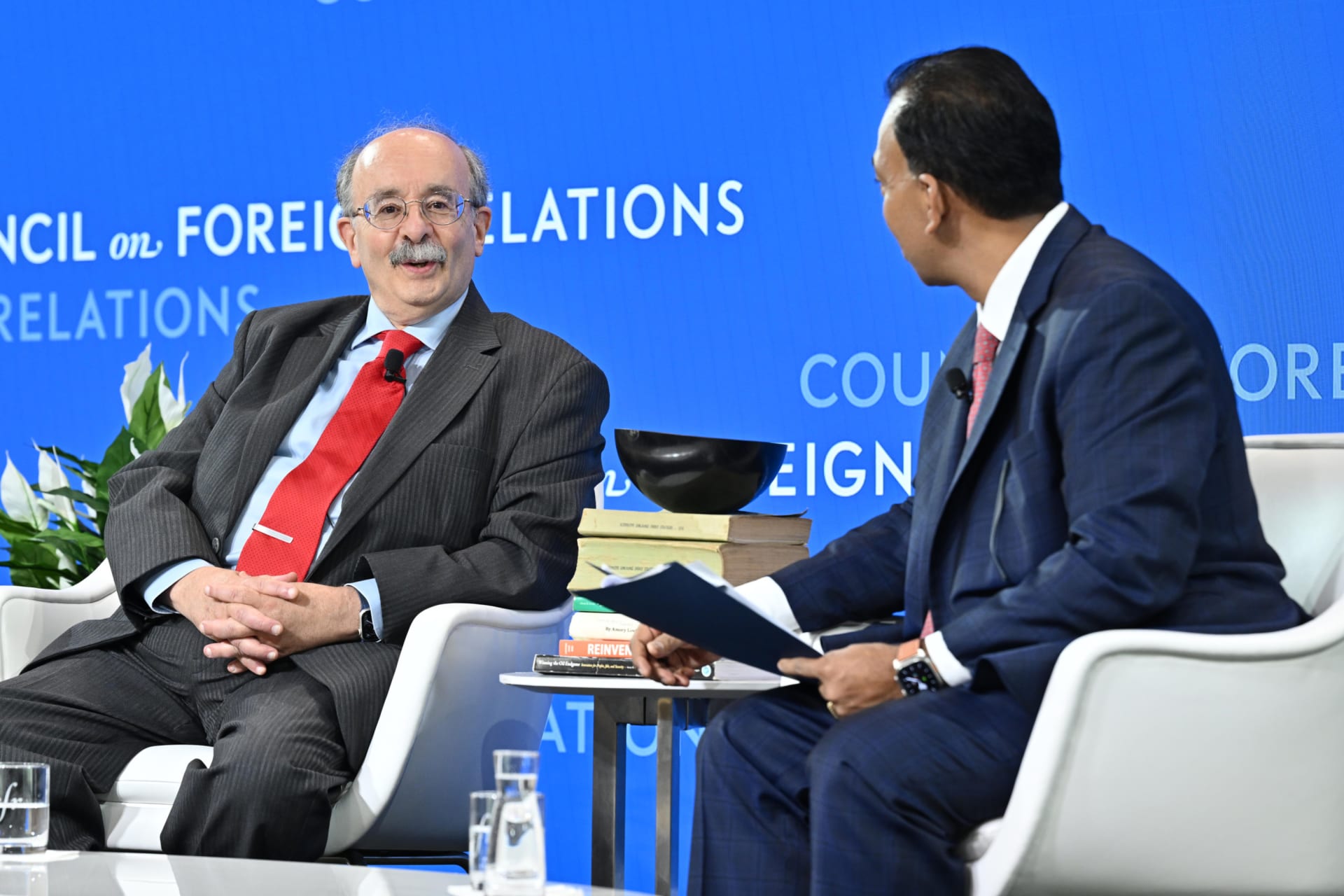
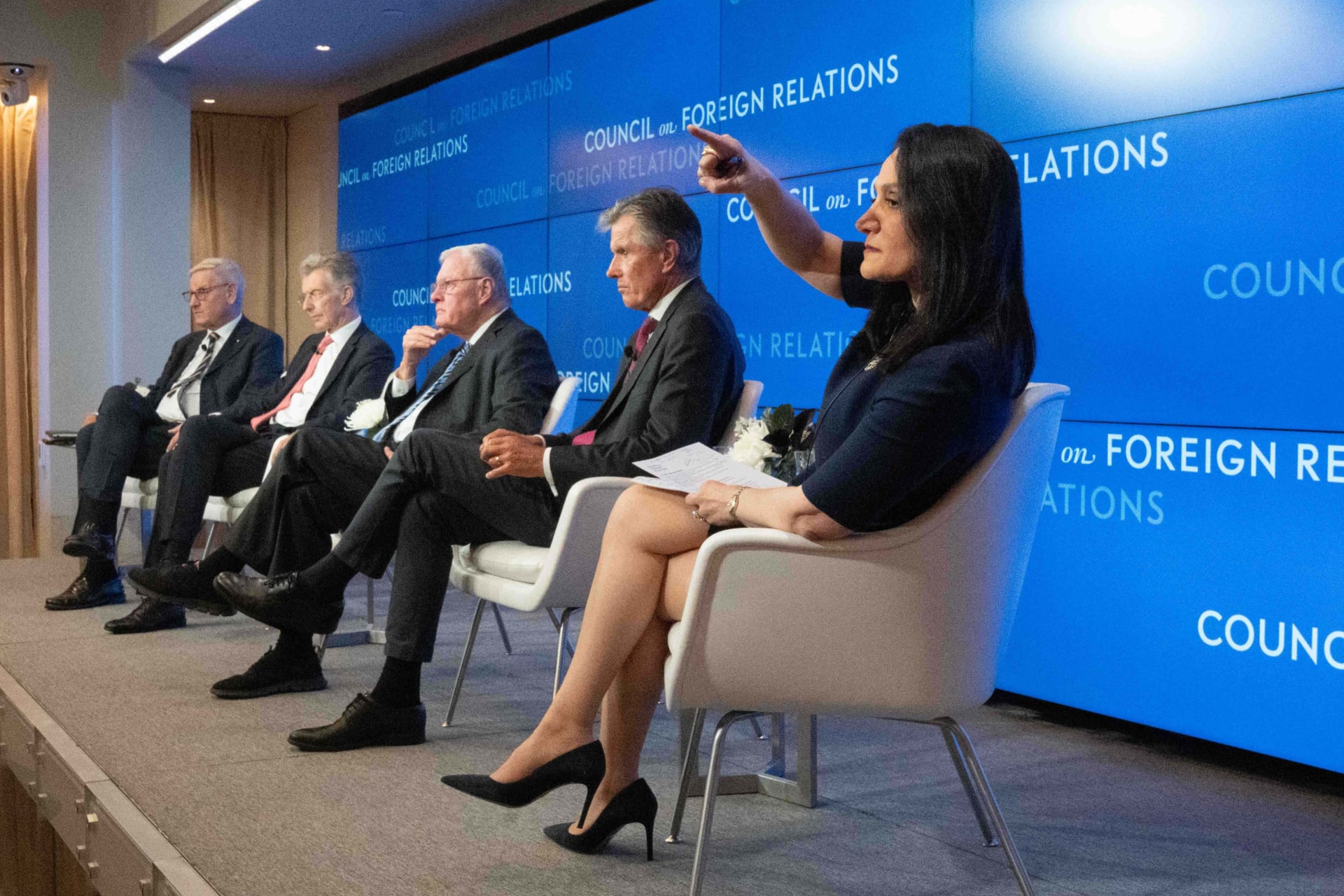
A Conversation With General Charles Q. Brown, Jr.
Event date
Speaker
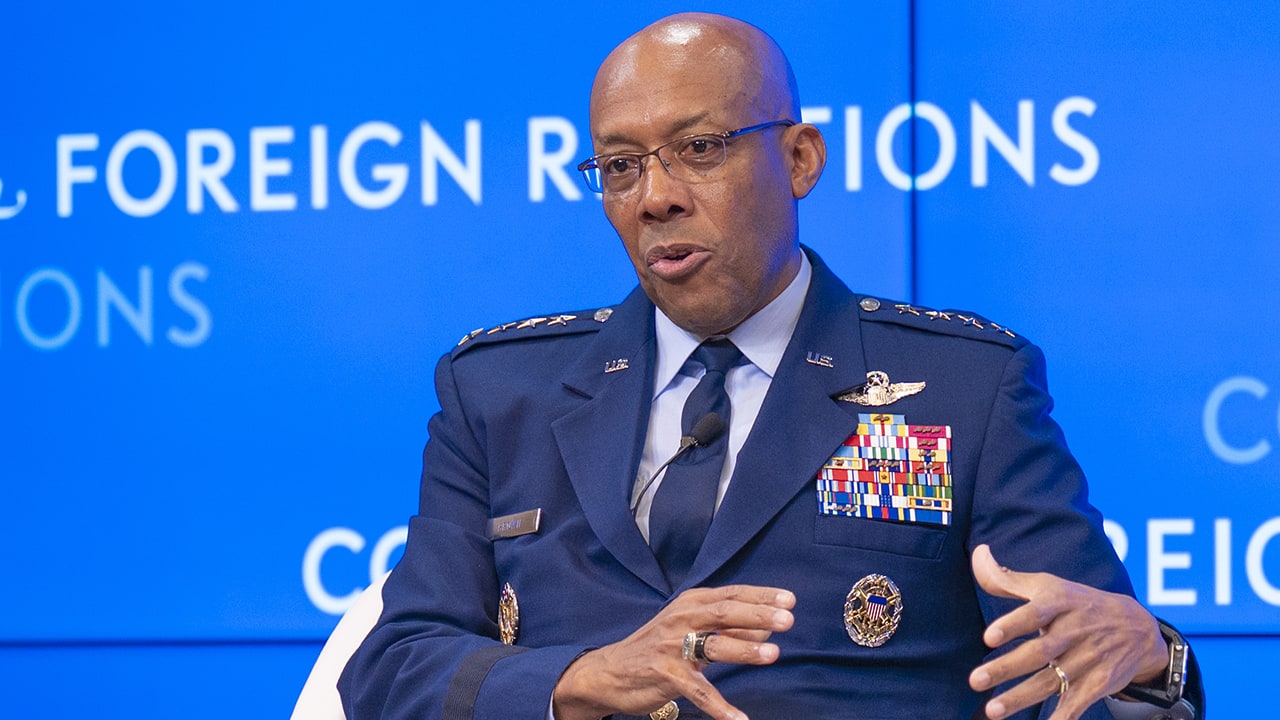
 General, U.S. Air Force (Retired), 21st Chairman of the Joint Chiefs of Staff; CFR Member
Presider
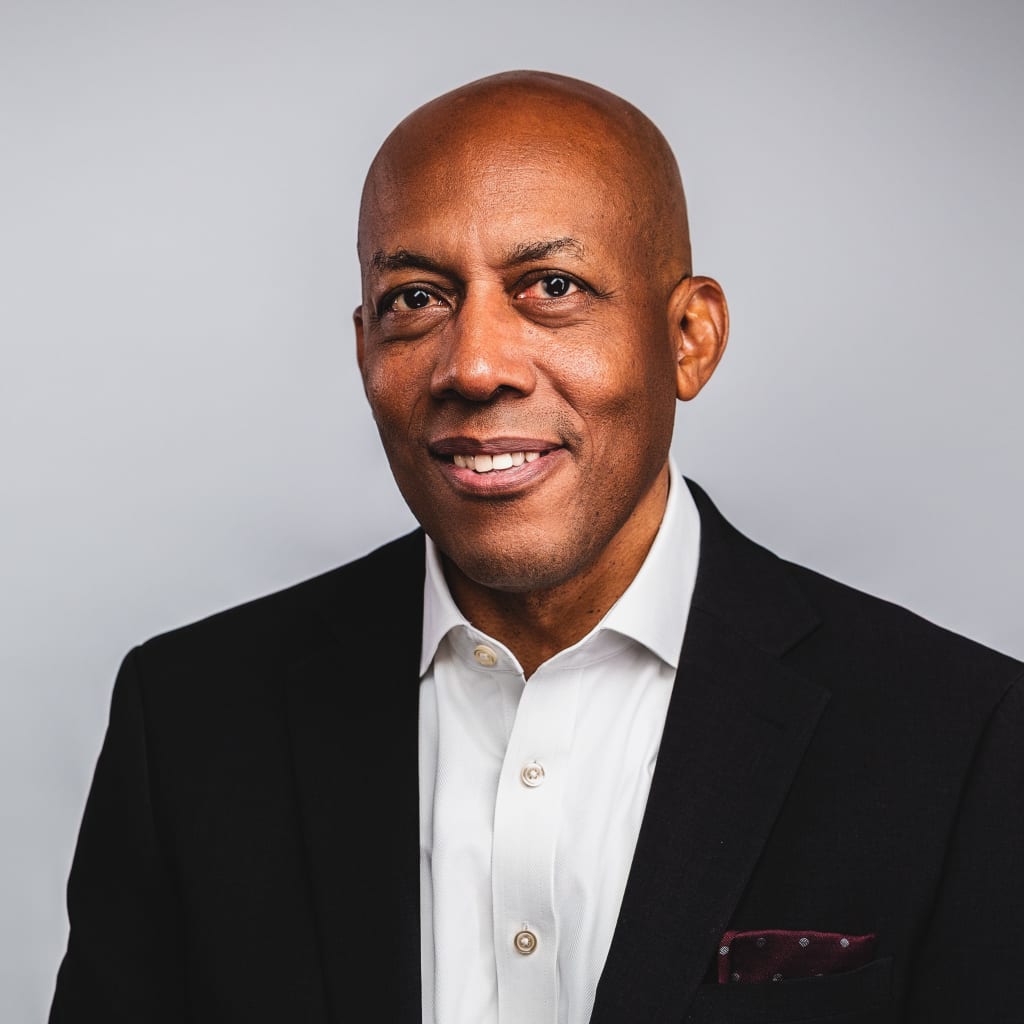
 Michael FromanCFR ExpertPresident, Council on Foreign Relations; CFR Member
General Charles Q. Brown, Jr. discusses the most pressing geopolitical challenges facing the United States and the world today and reflects on the lessons learned throughout his distinguished career.
FROMAN: Good evening, everybody. Welcome to this Thirtieth Conference of the Stephen M. Kellen Term Member Program, one of my favorite events of the year in part because, as you probably all know, I started as a term member and it had a big impact on my life. And so I’m delighted to see so many of you.
I have never seen this room so filled. And just so the general knows, we also have three overflow rooms and people on Zoom. So something like 500 term members have registered between tonight and tomorrow. That’s out of a total of about 850, 900 members. So 50 percent—more than 50 percent of our term membership is participating in this, and it’s just—it’s unbelievable. Thank you for being here. So thank you. (Applause.)
Stephen Kellen was a longtime Council member who really believed in the importance of identifying, developing, promoting the next generation of foreign policy experts, and as you all know that’s a key objective of the Council and we do it through our internship program, our research assistants, our junior staff and, very importantly, through this Term Member Program. And I want to thank the Kellen family for the generosity of Anna-Marie and Stephen Kellen Foundation and particularly to Andrew Gundlach, who’s Mr. Kellen’s grandson who’s been a very active supporter of the Council—a very active member in the Council here in New York.
You know, I want to say just a word about one of the main functions of the Council and that is to give our members an opportunity to engage directly, ask hard questions of influential policymakers, leaders, experts. Whether or not they agree with the perspectives that they’ve heard on stage, we think it’s important to present a broad range of perspectives and there aren’t that many places in the country where—still where you can have the kind of civil discourse of having people on stage with very strong points of view—I think we heard some in the previous session—and have a real dialogue between members and folks with a wide range of perspectives.
So I hope you’ll all respect that. It’s really important that we maintain that kind of opportunity, that kind of community of people. It helps us attract some of the best and most interesting speakers in the world because they know when they come here they’re going to be treated respectfully and that they’re going to get good, hard, substantive questions from our membership and that’s what makes the Council special. It’s what really makes it—what makes a—to be a Council member is somebody who is very much part of that dynamic.
I hope you’ll also take time while you’re here to get to know each other. This networking opportunity is a key function of the Council. I did say the first time I came to the Term Member Conference a couple years ago I saw everybody just networking like crazy and my staff had to pull me aside and said, they’re not just networking. They’re actually trying to meet each other and—(laughter). Anyway, so there have been a lot of marriages and children born out of the Term Member Program. (Laughter.) I’m not trying to encourage anything here but for whatever purpose we can help support you that’s great.
Look, I would be remiss if I didn’t mention that the upcoming deadline for term membership applications is January 10. You are our strongest ambassadors so please encourage friends and colleagues, family members who you think would be good term members to apply. Nancy Bodurtha and Vera Ranola will be happy to help you with any questions or ideas that you have in that regard.
You all have the biography of our speaker, but let me just say what a great personal pleasure it is to have General C.Q. Brown, former chairman of the Joint Chiefs of Staff, with us tonight. As chairman he was the highest ranking military officer in the most important military in the world and the principal advisor—military advisor to the president, the secretaries of defense, the National Security Council. And before that, of course, he was also chief of the Air Force. We’re going to talk a little bit about his experience at the Air Force and as chairman.
And with that, please welcome General Brown to the stage. (Applause.)
I think I should say it’s a great pleasure to have you here. It’s also a great pleasure to have Sharene here and so thank you, Sharene Brown, for joining us and for lending us your husband this evening.
You have spent your entire adult life in the military. How does it feel to be a civilian picking out your own clothes in the morning? (Laughter.)
BROWN: Actually, it’s pretty interesting because when I go out now people ask, did your wife pick that stuff out for you and I go, no, I actually dressed myself. (Laughter.) I’ve been reading GQ since I was in high school—(laughter)—and I still have a subscription, and so I like, you know, to be able to get nice clothes and dress. (Laughter.) And I have two uniforms. I’ve got this—and I live down in Florida so it’s this or shorts and a polo, and it’s kind of nice to have a little bit of flexibility.
As I tell folks, I don’t do anything before 9:00 except to work out and have coffee by the pool.
FROMAN: You’ve earned it. Your father retired as a colonel in the Army. Your grandfather also served in the Army in World War II. The military has become a bit of a family business in this country.
How do you think about the challenge of recruiting the best, the most qualified people we need for our armed forces, and make sure that it’s sort of understood more broadly in our society?
BROWN: I think it’s how we engage not only as military members but, you know, us and our families and not just the fact at how we operate on our bases but how we get out in communities and people get a chance to know us.
I’ve always believed that young people only aspire to be what they see or know about. You don’t decide to grow up to be something you don’t know anything about and typically that’s why there’s a—for the military, maybe other career fields, there’s kind of a family line where people do this because they see their parents do it or they have a relative in their family that does it.
You know, fewer and fewer people serve now just based on—if you go back to when I came into the Air Force, we were probably twice the size that we are today. And you know, I came in—started ROTC in 1980, so just six years after the end of the Vietnam War, so you had a lot of people who had some kind of connection to the military. And so I think the key part is really being able to talk about what the opportunities are. I can guarantee you, if you come in, even if you only come in for four years because that was my original plan, you will leave a better person.
You’ll have some opportunities, you’ll get some experience, and then you can take that and go on and do some other things or you can stay and, you know, I just think the more we can engage and provide those opportunities not just only to the young person but also talking to their influencers.
So it’s, you know, their parents, their guidance counselors, coaches, Scout leaders, church leaders, people that they engage with, because what you’re really looking to do is match their talent to a career field that matches up with them so they can reach their full potential.
FROMAN: Let’s do a little tour around the world, if we could. Among your other positions you were the commander of CENTCOM and during your time as chair of Joint Chiefs the security situation in the Middle East has been fundamentally transformed.
We just had a panel about Gaza. But to look more broadly at the region we’ve seen the proxies of Hezbollah, Hamas, Houthis severely degraded if not destroyed. We’ve seen Syria collapse. We’ve seen Iran significantly weakened and in fact their nuclear program either destroyed or set back severely.
Did you ever expect to see so much change in a security environment over such a short period of time? What does it mean for the role of the U.S.—U.S. military—in the security of the region, going forward?
Well, I should say one more change was the amazing cooperation between U.S., U.K., Israel, UAE, Saudi, Jordan when it came to defending against Iran’s missiles.
BROWN: Yeah. Well, not only as a deputy commander but I’d served at the United States Central Command headquarters three times. I was there first ’97 to ’99 as a major deputy director of operations as a one-star deputy commander, then air component deputy and air component commander. So a total of, like, five assignments.
And so you’re right, this past couple of years have probably been the most dynamic I’ve seen in the Middle East. But I also see maybe the most opportunity because so many things change that have been kind of a norm in some aspects. But it all started—I mean, started, you know, even previous to the past couple of years with Hamas going into Israel.
I could look at the Abraham Accords and I went to—as the Air Force chief I went to a Dubai air chief conference and on one side was the Emirati air chief and the other side sitting next to me was the Israeli air chief. You wouldn’t have seen that, you know, several years prior.
And then you look at what happened after Hamas went into Israel. That upset parts of the apple cart but then it got even more dynamic with the proxies of Iran, with the Houthis, the Shi’a militia groups that were attacking our forces February 4 through 7 thereabouts. We did a pretty big strike with the B-1s that actually got their attention and settled them down a bit. That was that.
FROMAN: Sounds like understatement. Got their attention and—
BROWN: Yeah. Well, it did get their attention that we were serious about things. But the other aspects of what also changed is the strike that the Israelis did in April on the consulate outside of Damascus which generated the attack mid-April from Iran, and this is one of the first times you really had state on state between Israel and Iran and it happened again in the September-October time frame.
Well, that changed the dynamic. At the same time Hamas is going down Hezbollah being really neutered and then Iran it can’t—you know, it doesn’t have air defense to defend themselves. Their nuclear program is in a different place today than it was for what the Israelis did over twelve days and what we did in support of that.
And so and then, you know, like you said in the previous panel in the conversation on Gaza, and so you got a twenty-point plan in the first point. So you have an opportunity here but it still can be very fragile.
And I think the last thing I’d say on this is when I was at CENTCOM—if any of you have a military background, when we do plannings we always have it what is the end state as if you’re going to get to some type of utopia, and I said, well, in CENTCOM we only have pass through states because you’re going to pass through an area, hey, where it’s going to be stable for a little bit and then something dynamic is going to change it.
So you can’t sit back and rest on your laurels and get, you know, it’s all done. So even with this twenty-point peace plan you can get to some level of peace. But, you know, it’s the Middle East.
FROMAN: On that point, do you think the U.S. could ever actually pivot away from the Middle East?
BROWN: You know, I don’t think you ever—could ever really just pivot. I mean, that’s a—even pivoting to the Pacific is—I think it’s a weight of effort how much priority you put on one part of the world versus another. This is the value of allies and partners.
You kind of mentioned the work we were doing with some of the other countries. You know, the U.S. leadership is very much valued but the U.S. doesn’t have to do all of it, and the more allies and partners can actually contribute I think that is beneficial.
So I believe that we also have a role in the Middle East but that role can shift to a lower weight of effort and as we prioritize in other areas of the world.
FROMAN: Let’s go to the Pacific then. You led the air component of INDOPACOM. We had a CFR trip out, spent time with Admiral Paparo and his team out there where they talked a lot about China being the pacing threat for the United States, going forward.
Is deterrence and the defeat of China if they were to take action on Taiwan—is that the number-one threat facing the United States that we should be organized around, and how confident are you, one, that we can achieve that objective and, two, that we can tolerate whatever the costs, casualties, and otherwise that it would take to prosecute the defense of Taiwan?
BROWN: You know, I’ll leave it to the policymakers to determine what’s number one. I mean, we’re waiting for a National Defense Strategy. It will help national security. The National Defense Strategy will kind of lay it out.
Regardless, though, I think the PRC has a perspective of the world that doesn’t necessarily align with ours and if we want to maintain our place in the world we’ve got to pay attention. No matter what happens with Taiwan we’re going to have to deal with the PRC over the long term and that is something that we can’t just think about only about Taiwan.
We’ve got to think about everything else associated with this. So it’s not just from a military standpoint. It’s, you know, economically, diplomatically, in all kinds of forms, you know, commercially things that we got to pay attention to because we’re in competition right now, pretty heavy competition, and I think it’s important for us to pay attention to that aspect.
If we go into a conflict and, you know, when I was the Air Force chief I wrote “Accelerate, Change, or Lose.” One of the things I highlighted in there is we could lose—have casualties very similar to what we had during World War II and our nation hasn’t had that experience in the conflicts we had in the Middle East.
It’d be—you know, it’d be, you know, the equivalent of another world war where the nation—the entire nation goes to war, and what you really want to do is actually—you know, our goal is not to go to war. So, really, the goal is to deter and so how are you doing or how are we doing with our allies and partners the things to not have a conflict.
FROMAN: Well, let’s build on that. This administration has had a somewhat different approach to managing allies and partners than has been generally the case over the last couple decades.
How confident do you feel from military to military? Those alliances and partnerships are still strong and when it comes to, for example, deterring China do you feel like the Indo-Pacific alliances and partnerships are where they need to be and if not what do we need?
BROWN: Yeah. So the thing I found throughout my career, particularly as a senior officer, is no matter what’s happening politically, diplomatically, the military-to-military relationships are pretty strong because we all have a common value. The things we’re trying to achieve is defend our national security of our various nations and so we look at things in the same way and, you know, when we have conversations it’ll be, well, there’s some things that happen above us. We still know we have a job to do and we’re able to kind of talk through those things.
You know, my last meeting with NATO was on the 16th of January and so the conversation was they knew they needed to do more. But they also knew they needed U.S. leadership. I also found as working in the Indo-Pacific because, you know, we only have a handful of alliances in the Indo-Pacific, different from what we have in Europe, but what I was seeing was the confluence of European nations interested in what’s happening in the Indo-Pacific and Indo-Pacific nations interested in what’s happening in Europe, partly due to Ukraine.
But just the fact that we were bringing together—some of the Indo-Pacific nations would come to our NATO military conferences to have conversations about what’s going on in their part of the world. At the same time, we’re seeing more European nations deploy forces into the Indo-Pacific for various reasons.
And so the takeaway, you know, from that is what happens in one part of the world is not staying in that part of the world and it really impacts, particularly as we are more globalized, you know, not just from a security perspective but also from an economic perspective and your economic security is also part of your national security. It plays a key role in it, and this is where I see more and more nations paying attention.
Now, you mentioned based on the current dynamics. The thing we have to think about is countries will hedge in a certain direction based on how confident they are that whether it’s the United States or some other nation is going to come to their aid or work with them very closely, and the thing I found in the Indo-Pacific was for many of the nations they would say they didn’t want to—you know, they don’t want to choose. If you called them right now and said U.S. and PRC they’re not going to say.
But you want to do all the things that when the chips fall they lean our direction. What I found they really do like our military security but sometimes they’re economically intertwined with the PRC and we are as well in some cases, and that creates a bit more of a dynamic challenge and it has a huge impact if there’s a conflict, you know, there in the Indo-Pacific not just to, you know, the economics in the Indo-Pacific but more globally.
That’s the part why I think deterrence plays a real key role in this because if you have a big upsetting factor to more than just a military operation.
FROMAN: “Accelerate, Change, or Lose,” that was the paper you wrote when you were chief of the Air Force. You continued to hit those themes when you were chair. You’ve been a consistent voice for innovation in the armed forces, encouraging the services and combatant commanders to innovate.
Tell us about what your view of both AI, autonomy is, going forward, in warfighting and how do you balance the potential of these emerging technologies against sort of the fundamental skills that we might need in wars? We’re seeing—in Ukraine we’re finding a, you know, earlier twentieth century trench warfare battle at the same time. How do you balance what you need to train people for to be prepared for whatever the contingencies?
BROWN: Well, I think there’s some basic things you got to be able to do and have a good understanding because otherwise you’re not sure if the technology is actually doing the things you want it to do. When I first started flying F-16s, we didn’t have GPS.
FROMAN: No GPS?
BROWN: We did not have GPS. (Laughter.) So you actually had to have a map, time, distance and a heading. Pick a heading. Look out the window. You see a bridge. OK, that’s the bridge. (Laughter.) You go for two minutes and then you make the next turn at the next, you know, turn point on the ground.
So you had to know how to do those things, and then you got GPS and then you don’t have to do anything. I mean, just think about it. You couldn’t give directions to your house if you had to. You don’t have to.
And so when we were growing up it was, you know, go to the third light, you turn by the—you know, at every point, you know—
FROMAN: You carried printed maps in your car, right?
BROWN: We carried printed maps—we carried printed maps in our car.
And so the thing here is you still got to have a good sense of some basics and critical skills and when I think about AI, you know, the response you get from artificial intelligence is only as good as the prompt you use, OK, and so if you don’t ask good questions you’re not going to get good answers.
And so you still got to have some basic skills associated with this and how you apply it. I would say the same thing with levels of autonomy so that you’re doing things aligned with the objectives of what you’re trying to achieve with these emerging technologies.
The other thing I also think about associated with the emerging technology is the fact of how our adversaries might use these capabilities. If we think about our own values and how—the law of armed conflict, that’s the way that we operate but our adversaries may not have the same value system and they may use technology in a way that we would not use it.
We cannot use, as we say in the military, hope as a course of action that they won’t use that technology in a way that we wouldn’t. We got to think about how we would respond when they do.
FROMAN: Does that lead to a race to the bottom or how do you—how do you balance the ethical issues?
BROWN: No, I just think what you do is you have to think about how you would do things asymmetrically that plays to our strengths and plays to our values, which means this is the heart of innovation. It’s not just the innovation from a technology standpoint, it’s also innovation how you would use that technology. It’s also innovation associated with the processes and approaches we take.
You know, I often say you can’t keep doing the same thing and expect a different result. You just can’t talk about innovation and then nothing happens. You have to figure out how you’re going to bring it into the system and how you train the, you know, service members or whatever workforce that’s using this technology.
Train them differently from today—the way you train them today how you would train them tomorrow. Make this an application that helps them do their job better whether it’s a fight in combat, manufacture something, make decisions ,all those kinds of things that we got to think about.
Innovation is a complete aspect of not just the technology but it’s also, you know, how you train the doctor on how you’re going to use this, what facilities you’re going to use it in, those kinds of things.
It’s pretty dynamic but we tend to gravitate to the technology, but there’s a whole—that, to me, is the tip of the iceberg. The things that we have to think about associated with it as well is just the policies of the technology, how we would approach, because the technology sometimes moves faster than our own policy and that’s something we got to think about as well.
FROMAN: I mean, it strikes me that one of the biggest challenges to succeeding in that innovation is our defense procurement system itself. There’s no lack of blue ribbon commissions that have said, we got to fix this. They’ve admired the problem. It’s part Congress. It’s part the services. It’s part the big prime companies.
Why is it so hard to get this fixed? What would be your top one, two, or three recommendations, reforms, that you think could unleash the kind of innovation you’d like to see when it comes to getting new technology into the hands of the warfighters?
BROWN: Well, it’s something I’ve been thinking about a lot and it’s—there’s an aspect of having a little bit more flexibility, some consistency, and some streamlining. The flexibility, the way our budget system works today, is we get very specific on various line items with thousands of budget lines.
So what you can’t do is have the flexibility to move money back and forth to a more successful program versus a program that’s not doing as well. Because of that, you know, that was all done, you know, for various reasons. You know, some of it is trust and oversight, but you got to be able to streamline some of that and create, I would say, more portfolios so that you can go for this portfolio the best product or weapon system is going to move forward and get more of the funding and then the next—the one that’s not doing as well can compete. If they can do better and they do then they can come along.
But one part of it is just getting, you know, the flexibility to be able to do this. But it’s so cumbersome not only in the building but also with Congress.
The other part is consistency. One part of the consistency is, having talked to our industry partners and having worked as a programmer where you do the budgeting process—I was an O6, a colonel—what we tend to do is we go, here’s what we want this year. We’re going to get this many. Next year we change the number. The number goes up and down, which makes it very difficult for an industry to know what is it you really want and then what are you going to resource.
So from a resource standpoint, getting a budget on time would be a really good idea to make this happen.
FROMAN: Well, that’s not a problem.
BROWN: Well, it’s—I spent fifteen years as a general officer. We had one budget on time. Five years in continuing resolutions and you’re seeing it right now with the government shutdown. What that really means you can’t do any new starts. You have to spend at the same level as last year.
So if you had a new program you were going to start you can’t start it until you get a budget, and if the budget comes three, six months late, or not at all that year, you know, you lose that consistency and so industry then doesn’t have a good demand signal to know supply chains, workforce, facilities.
You know, they’re not going to go invest on a whim because we’ll change again. We’ve burned them. They’re going to sit back and wait. That slows things down.
And then the streamlining is—you know, our budget guidance in the federal acquisition regulations totals about 10,000 pages.
FROMAN: So it’s a book.
BROWN: Yeah. And so I think part of that is, you know, there are some efforts there to streamline that. There’s also efforts to actually do the portfolio piece that I talked about in the budget line consolidation.
But we really got to take a look at not only the guidance we have but then how do you train the force to change the culture to take, I would say, a little bit more risk because right now it’s more risk averse because you don’t want to go against any of the guidance. When you got 10,000 pages you can step on a landmine anywhere and so you’re, you know, reluctant to kind of move forward. So if we can do those three things I think that will help.
The last thing we got to do is just pick a couple areas that between the department, Congress, and industry say this is important for the nation. We are going to work together to commit to this to make it happen and we all got to do it for the common good of the nation, not, you know, picking a different size and that’s part of the problem, too—you know, picking a different size and a little bit of finger pointing.
But at some point you got to pick something because what’ll happen is we’ll have a crisis and then we’ll be picking, OK, and we want to actually do some of this work before we get to a crisis because that to me also helps with deterrence.
When our adversaries see that we can generate combat capability, manufacture—it doesn’t have to be manufacturing combat capability. The fact that we can manufacture and turn on a dime that’ll send a message.
FROMAN: These are our term members. They’re in their thirties, relatively early still in their careers. You’ve had a remarkable career rising to the very top, and I have to say in the interest of full disclosure General Brown invited me to be an observer at this all-day exercise with all of his combatant commanders and service chiefs and their deputies in a tabletop exercise.
I got to see him as a leader with all of his team. It was rather extraordinary. What do you attribute the leadership skills that you’ve gained to? What were the most important factors that contributed to that? What’s the best advice you got along the way?
BROWN: Well, maybe the first one maybe not so much tied to that tabletop exercise was something I got from my dad that he got from a POW from Vietnam at a prayer breakfast and it was—I was in pilot training and really trying to determine what, you know, airplane I wanted to fly. And this gentleman told my dad, essentially always ask for what you want. The worst they can do is tell you no but they can’t tell you yes if you don’t ask.
I’ve used that throughout my career. I’ve applied for things I probably wasn’t quite qualified for. I actually did it when I was in college. I applied for a job in college. My GPA wasn’t quite there but I ended up getting the job. My brother got the job after me. (Laughter.) I have no idea what his GPA was but the aspect of—I’ve used that time and time again to make it known what I want to be able to do and it’s helped me.
As I do that, though, you got to make sure you’re kind of qualified for what you’re asking for or least close to the mark because I think that’s important, and I encourage people when they come talk to me to do the same thing but I also talk to them about their plan B.
And so I’ll—you know, you may need a bigger plan B but if you want to do plan A you got to make it known because that—you can’t get that opportunity and it’ll pass you by and you go, well, you know, what will happen is someone will not even know you wanted to do that, and so that’s important.
I think the other part that really helped me was when I went to weapons school and the Air Force weapons school—well, have you seen the movie Top Gun? Top Gun is the Navy’s version of the Air Force weapons school. I say that because the Air Force weapons school started in 1949. Top Gun started in, like, 1969.
But it was probably the toughest thing I’ve done in my career early on and I reflect back it was probably the toughest course. I went through six months—you know, actually four months for me. Went to six months but it was a graduate level course. I learned everything about the F-16, and you go through these extensive briefs and debriefs where you really get wire brushed and it really builds confidence.
You figure out how to solve very complex problems. You don’t always know the answer but you know that there’s a way to actually break it down and I think in between that and my engineering degree that helped me build confidence to speak up because I’m more of an introvert. So I tended to listen, not say anything.
But as I got in a situation I knew I had to speak up and particularly, you know, as a chairman when we get to the tabletop exercise when you’ve got eleven four-stars that are combatant commanders, five four-stars, six four-stars, the vice chairman, plus the Joint Chiefs and you’re the person at the head of the table, OK, you got to speak up.
You got to be confident in what you’re doing but you also got to be able to listen, and those folks are watching you and if you don’t speak up or you don’t show confidence they’ll roll you over, and that to me was one of the most important things I felt.
Now, I’ll also tell you I always walk into anything I do with a little bit of apprehension. Yeah, I’d go into these meetings I’d be nervous because someone, you know, I knew was not going to like what I was going to say or the approach I was going to take. But, again, you got to be OK with that.
And I think the last thing I’d say associated with this is the thing I think about leadership it’s not a popularity contest. You will be dinner table conversation at somebody’s house every night if you’re in a position of leadership. There will be things where people will go, oh, General Brown, he did so great today and then someone else will be at home going, that son of a—(laughter).
I mean, and you got to be OK with that and you really got to be thinking—I’ve always felt if I can look myself in the mirror based on the decisions I made I can sleep well at night.
FROMAN: A great moment to open up for questions. So, in the words of the general, speak up.
Let’s see. So, middle. Yeah. There you go.
Q: General Brown, thank you for your leadership and for your service.
I have a question about the law of armed conflict, which you mentioned earlier, and more generally compliance with domestic and international law. What do you estimate is the risk at present of illegal orders being made and there being compliance with those orders, not necessarily internationally but domestically here in the United States?
BROWN: Yeah, let me—this is something that actually is a topic that I’ve been asked about. I’m at Duke University at a(n) event here just recently where we talked about this, and you have to think about the way the orders are put together because there are a lot of lawyers, probably more lawyers than you can swing a stick at, but every lawyer has a different opinion on how they might interpret the guidance or what they’re trying to achieve as they look at both domestic and international law.
So there is a risk of violating the law but also the norms of the law of how we’ve interpreted it in the past and therein lies part of the challenge associated with it as you look forward. And as you look at maybe different interpretations associated with it, it sets a new norm not only for, you know, us but also for allies and partners as they look at it as well.
And so it is complicated and it’s complicated for the military members. But once the—you know, the leadership, our policymakers go through the process and look at the decision and they determine that it’s legal, you may not like what it is what the—you know, what the output is from the order but you got to figure out how to execute.
Now, part of this—the job I had as the chairman is senior advisor to the president, secretary of defense and National Security Council. So I do—you know, I had an opportunity to provide advice in various areas. It doesn’t mean that advice always gets taken and that’s part of our role to be able to speak up in private but execute publicly once and as soon as it’s made.
FROMAN: Yes, right here.
Q: Hi. Charlotte Clymer. I’m a term member and a writer and a very proud Army veteran.
Mr. Chairman, thanks for your time tonight and for your long career of public service. I know there are a hundred things that are important you could speak to tonight so I promise I don’t ask this question lightly. There are 5,000 openly trans service members who have either been kicked out or are being—or are pending being kicked out, depending on how the Supreme Court rules on this trans military ban. During your long tenure in senior military leadership, did you see any assessment or evidence that the service of openly trans service members affects military readiness and unit cohesion?
BROWN: Well, one of the things I’d highlight to you is the—not necessarily, but I’ll also tell you the thing that we have to also pay attention to is not only the rights of the trans members but also the rights of everybody else as well.
And so when I—the day I went to go testify to be the chairman of the Joint Chiefs, there was a situation with a trans member during basic military training. And just the dynamic between, you know, the lodging, restroom facilities, and people either not knowing and some people felt comfortable or uncomfortable.
So the aspect we got to protect the rights of the—of all members looking at both sides. I don’t know that it impacts, you know, readiness.
And I did a commercial for the Air Force—a recruiting commercial. It was based on an interview I did when I was a captain about African Americans flying fighters, because there was only about 2 percent, and that response led eventually to the commercial I did as the chief of staff of the Air Force. I said that when I put my helmet on, put the visor down, put the canopy down, you don’t know who I am. You don’t know if I’m Black, African American, White, straight. Great. You just know I’m an American airman kicking your butt.
It’s the same thing. If we get in a conflict, you just want to trust the people to your left and your right that they will do their job. That, to me, is probably the most important thing. And you know, when folks come into our military, you know, my goal was to make sure that everyone could reach their full potential.
Q: Thank you, sir.
FROMAN: Way in the back, standing up. Microphone?
Thank you, everybody, for asking brief questions. It’s been terrific so far. (Laughter.) And it’s with a question mark at the end and—(laughter)—a lift in your voice.
Q: Good evening. Carrie Lee. I’m a senior fellow at the German Marshall Fund, former chair of the Department of National Security and Strategy at the U.S. Army War College.
My question is actually about your departure, which was rather abrupt from the chairmanship. Also included Chief of Naval Operations Lisa Franchetti, vice chief of staff of the Air Force and the top lawyers for the military. We’ve seen the secretary of defense and the president invite top service members in their speech to 800 generals to leave the ranks if they disagree with the administration’s political policies.
My question is there are many of us in this room who are mid-career, probably those online who are more senior in their career, who are still in the military—reservists, civil servants. What advice do you have for those who are still in the DOD who are deeply concerned about what looks like politicization of the senior officer ranks?
BROWN: Well, I will share with you what I told the Joint Staff today. Actually, I’ll go back to right after the election.
My name was in the press about being fired. We were at a Joint Staff offsite and I told the Joint Staff, do not worry about me. You’re got to make the main thing the main thing. Our job is to defend our nation and stay focused on that main task.
The day I got fired I had a VTC. I was out at the border with the VTC—video teleconference with the Joint Staff—and I told them the same because the rumors were flying that week and I had a feeling that day was going to be the day.
I still believe that those that are still serving, then you can look at the quorum of the general officers that were in the room in Quantico, the fact that, you know, we still have a role of staying nonpartisan in how we approach things but it makes it difficult when we’re put in some of those situations.
But I also say service is not always going to be easy. Life’s not going to be fair. But we got to think about how we carry ourselves. That was my goal as the chairman of the Joint Chiefs, how I carried myself to the very end and how I carry myself today.
You’ve got to be professional. Trust is the foundation of our profession as military members. And we’ve got to show that, you know, we don’t make the policies, but we do have to execute the policies, whether—no matter what administration it is, if it’s legal. And so from that perspective, you know, for those that are still serving, I appreciate what you’re doing. Keep what you’re doing because it’s really important for our nation. We can’t walk away from this.
I realize that for some people it’ll be more difficult than others. Some people will hopefully let go, and I actually have a chance to talk—I’ve talked or connected with most of the folks that are being let go to talk to them and go, hey, I left with zero regrets. I’m very proud of everything I’ve done. I wouldn’t change anything about how I’ve done things. I don’t care for the way it ended, but I get more time with my family now. But I’m still serving, and I will continue to serve and do things in support of our national security.
Thanks for the question.
FROMAN: The gentleman here, third row.
Q: Good evening, sir. Jeff Zeberlein. I’m in the Navy, lieutenant commander.
Just going back to the innovation piece we started with, as you think about the future of warfare, particularly autonomy in warfare, CCA’s man-on-man teaming, what makes you optimistic about that future about how that is going to help American power and what’s also, conversely, the potential, some of the worst case outcomes or what worries you about that future that we need to guard against?
BROWN: What makes me optimistic is the—just the capability itself and being able to bring automation to make it easier on the human and operations and decrease the risk to those that we send into harm’s way.
I mean, that’s what makes me optimistic and being able to—then at the same time be able to use the best of our nation. So it’s not just what we do in the military because a lot of the work that’s happening on automation in some of this technology does not happen within the Department of Defense.
It happens throughout our nation. And how do you bring all that together for the benefit of the nation, not just from a national defense standpoint but also from a security—economic security standpoint?
So those are the things that make me, you know, optimistic and the ability to work together I started to see that having spent several trips out to Silicon Valley talking to some of the smaller companies. You know, they’re really interested and want to do stuff but the department has to make it easier for them to get there, which goes back to the earlier question about, OK, so the process that we have that we got to change.
To me, that is also innovation. You can’t do one part of innovation. You got to do all the innovation to make innovation come forward.
What concerns me? We’re not going fast enough. You can have a lot of innovation sitting on a shelf but when the stuff hits the fan, you know, if we’re not ready to move that stuff’s capability faster, I mean, that’s one part of it.
I think the other thing that worries me is the risk of what I’d said earlier is how our adversaries may use this capability in a way that we—you know, an evil genius kind of way that we don’t think about that catches us by surprise or it challenges our values that we don’t—we’re slow to figure out how to react to it from a policymaker standpoint, which is why it’s so important that we work with our policymakers to make sure they understand the value of the technology, what the technologies can do, what it can’t do, so they don’t—it’s easy to make a policy if we’re not going to do anything. There’s a risk to action, but there’s also a risk to inaction. And so the more we can actually help educate our policymakers on the value of some of this technology, that can also help, you know, things go faster. Because I also think there’s these kind of delusions of killer robots. Yes, that could maybe happen. But the key point is, how do we actually think about it ahead of time, to put in the safeguards to be able to do things we wanted to do effectively?
FROMAN: Yes.
Q: Hello, General Brown. My name is Hall Wang. I’m a startup founder.
And, like you, I’m an ROTC alumnus. I went to a rival school, Duke University. I want to ask you about acquisitions. The secretary of the Army, Dan Driscoll, has pretty much—(inaudible)—saying that the prime contractors are handcuffing American military power. The example he cites is the lack of right to repair, and also the other more—things you pointed to about the slow acquisitions process. Do you think Secretary Driscoll is accurate? Or is he going too soon, too fast, to break things the Silicon Valley way? And do you wish there was more aggressive support from the fellow secretaries of the services? I want to highlight, I may have worked for Boeing many years ago, but I’m no longer married to my former employer. (Laughter.)
BROWN: Yeah. You know, it’s easy to poke at the primes. It’s easy to poke at the department. Easy to poke at Congress. I think the whole system needs to be really taken a look at. It’s not—the primes are actually responding to the incentives that they’ve been provided by the department. Once the department changes—you know, the department can lead the way in some of this to change and drop, you know, some of the restrictions to make things go faster. And we’ve been doing acquisition reform for a long time. We don’t reform anything. It goes back to what Ambassador Froman said. A lot of studies, lot of discussion. When I was a lieutenant colonel, one of our senior officers said, anything we don’t want to do, we study. (Laughter.) Another commission, another study, write another paper.
We got to make—we got to make a decision and do something. You know, I would ask the staff, we always talk about, you know, you know, we could do this. We could do that. Let’s talk about what we could do. Let’s talk about what we’re going to do. Part of this is what we’ve got to—you know, I think it’s not just that the primes, but it’s the department sets the tempo for some of this to break this down. We got to work with Congress, because Congress has the purse strings. And when you have multiple hoops you got to jump through, you can blame a bunch of different people. The primes are responding to what they—what they know, because of the way we’ve set up the process. Change the process, and I think we could actually go much faster.
Or you may not be able to overhaul everything overnight, but find some areas, I think, some lanes—you know, like the express lane at Disneyland. I mean, not everybody’s—you know, pay a little extra money, but you can go faster, not have to wait in line as long. There’s some things that we can do differently. I appreciate what Secretary Driscoll’s doing to energize this, but you can’t—it’s more than talk. We got to put things in place to make it go and change policy and process to make these things happen, and train the right people so they have the right mindset—that are like founders on the inside—that can do these things and don’t feel like they’re handcuffed because of the guidance that they’ve had and how they’ve been trained.
FROMAN: Just to be clear, it sounds like there’s kind of a Gordian knot here between Congress, the Pentagon, primes, others. Sounds like you’re saying it’s the—it’s the department. The department’s got to take it actually to get it going. Is it the acquisition people in the department? Or is it the services? Who needs to take the first big step to untie this knot?
BROWN: I’d take any one of the three to take a first step. (Laughter.) I think the department—as, you know, if Secretary Driscoll has laid out, the department lays out some areas where they can, you know, do things. Where there’s an aspect the deputy secretary has laid out, you know, a focus on missile production, by identifying some priorities. This is something that, you know, as a chairman, I’d asked the question talking to industry. It’s interesting what our priorities are. Because you have multiple voices speaking. Every service has an idea what they think. Every senior officer may have a different opinion. But what are the most important things we got to go after from a capability standpoint?
I think the other part that was changed was our requirements process, because we tend to write very specific requirements versus solving problems. And it would frustrate me, as the Air Force chief and as, you know, commander of Pacific Air Forces. You couldn’t get things done until you had a validated requirement. I go, well, I got a validated problem. I’d rather be able to give, you know, founders a problem and go solve this. You will probably figure out a better way than me writing a requirement that is going to be very specific, and I’ll get exactly what I want, that is probably ten years late, technology-wise. You go, we’ll build it for you. It’s going to be really expensive.
And so part of this is we’ve got to break—you know, the department has a role in this, but I think they all do. But we can start the process. And, you know, but unfortunately, you know, too often in the department sometimes it takes an act from Congress to actually get us to go do things. So that’s why I think it’s—we all have to work together on this. And we’ve got to find, you know, I would say—and one area that I’ve looked at is Patriot, for example. Very important weapon system. You get three primes that work on it and about eight smaller companies that all have a role. Find a weapon system that we all agree on, and go, we’re just going to put our energy by this and figure out how to do this faster, and make that the model for many other things we’re going to go do.
FROMAN: Yes.
Q: Thank you. As the daughter of a thirty-six-year Air Force veteran, I really appreciate your service and your being here today.
I wanted to ask about hybrid warfare, especially given that European Commission president Ursula von der Leyen recently alleged that Russia is perpetrating hybrid warfare against the bloc, through the use of drone attacks, cyberattacks, and foreign malign influence. And wanted to get your perspective on what is the necessary coordination between different departments, between the Department of Defense, Department of Homeland Security, other critical agencies, to ensure that the United States is prepared to defend against hybrid warfare.
BROWN: Yeah. I would actually commend you to watch the 60 Minutes speech that General Haugh did a couple weeks ago that talked about the Chinese and cyberattacks. So when I think about hybrid warfare, it’s not just, you know, the Department of Defense and other parts of our government. But also impacts our municipalities, our industries. And we are, I would say, in some aspect of hybrid conflict today, based on that competition. These are the things that we got to pay attention to going forward. And how do we highlight these to make them known? And sometimes it could be a state actor or sometimes it could be a criminal element that a state actor turns a blind eye to.
So the key part, I think, that we have to be really paying attention to is how do we have a good reporting system to identify that something’s happening early in the process, so we can mitigate it and work more closely together as a nation, with, you know, government agencies, but also working with industry, working with municipalities, so they understand what’s at risk and how they defend themselves and put themselves in the best posture to not be vulnerable. Because if you make yourself a hard target, then, you know, what’ll happen is they’ll go find someplace else that’s a much easier target. And those are things that we’ve got to think about as a nation. Not only working together, but also identifying how we do it collectively.
FROMAN: Back there. Yeah.
Q: Thanks so much, Chairman Brown. Thank you so much for your service and for being here with us tonight. My name is Teresa Lou. I’m a second-year term member here at the Council.
My question pertains to the Indo-Pacific. So the United States has traditionally been very good and excelling in responding to crises, but confronting adversaries like China, but also not exclusively to China, I think, increasingly requires preparation for conflict during peacetime. But in a country like the United States, where we prioritize open debate and other priorities around the world, that is a much taller order to convince the American public to do than our adversaries, like China, where it’s much easier to impose prioritization and urgency from the top. So I would love to get your thoughts on how U.S. leaders can help share their views or help inform the American public about this, and what happens if that consensus is not built.
BROWN: Well, I think the most important thing is to highlight what’s at risk, and also what we’re seeing. And what I found, you know, when I was the commander Pacific Air Forces, you know, that was in 2018 to 2020. And when I first got there, I did not have a good sense that, you know, many of the nations in the Indo-Pacific were all seeing the same thing, or had the same sense of urgency. And I would say, even for me, because I’d spent so much time in the Middle East, but then once I got out to Pacific Air Forces, and with the 2018 National Defense Strategy, you know, light bulbs for me were personally coming on. And I saw that happening with many of the allies and partners in the region as well, because we started sharing information of what was happening to them in relation to their security. And you started to see Indo-Pacific strategies from various nations, kind of, come together.
The thing that I think we, as leaders, need to do, and as term members, is talk about the geostrategic environment and the things that are going on to raise people’s awareness to what’s at risk and the things that are happening. Going to the previous question of, you know, all these things—you know, cyberattacks, those kinds of things that, you know, have an impact. And the more we raise people’s awareness, at least they’ll be, you know, better aligned to maybe get to a consensus. The one thing with this nation, though, is when a crisis does come, we do respond. May take us a little while, but we’ll get it together and respond. My goal, when I wrote Accelerate Change or Lose was to actually raise awareness before we got to that point so we are better positioned when a crisis does happen. And that’s the part of—we’ve got to have the conversation of what’s going on to raise awareness so we can be better prepared as a nation, not just for the policymakers but also just the general public, of what will be required and why deterrence is so important, so you don’t get into a situation where you have crisis we have to deal with.
FROMAN: Yes, this gentleman.
Q: Good evening, gentlemen. I’m Major Jeff Yao. I teach economics at West Point.
Sir, you mentioned economic security. This administration has taken steps towards economic protectionism—reshoring or friendshoring critical supply chains, and, of course, in placing or threatening tariffs. At the intersection of economics and security, do you see this as an erosion of the credibility of commercial peace theory that economic interdependence makes armed conflict too costly? Or do you believe that protectionist measures will weaken our alliances and expose us to greater risk that outweighs the benefits of increased supply chain security?
BROWN: So my degree is in civil engineering and not economic peace theory. (Laughter.) As an economics professor, you probably could come teach me a couple of things. I do think it’s—you know, the things that are going on make us have to think about how we look at not only the economic aspect of economic security, but also how it impacts national security, and how countries take a look at the United States and allies of partners around the world. Because I don’t think anything happens in a vacuum. And as we go through these pieces to reshore, bring stuff to industry, we got to also—as we’re doing that, you got to actually have the workforce, got to have the facilities, got to have the training. So it’s one thing to actually start that process, but we got to follow through to the other pieces of it. Because you can try to bring all that back here, and if it doesn’t deliver you don’t have the capability over there either. And so those are the things you’ve got to, I think, think through, of how do we—that part of the economic plan, now how do you bring the aspect back here? Which will drive some change in how we educate, how we train the workforce for tomorrow.
FROMAN: Yes, please.
Q: Hi, everyone. My name is Sheila and I’m a first-year term member.
I want to thank you for your time today. It’s not often to have—I can have an opportunity to talk to someone directly in the military. I mean, I’m deaf. And admittedly, there’s a lot of colleagues of mine who are willing to serve our country and want to join in the military, but obviously policy at this point doesn’t allow us. And I heard what you were talking about earlier, with problems in recruiting. So I’m wondering if one of the ways to solve that is to include more people who are deaf or have other disabilities. But I am curious, what is your thoughts about this? And in the future, how can we approach it—approach the right people in the right way to recommend maybe saying, hey, deaf people can join the military?
BROWN: Yeah. I think there’s areas that—you know, I do think about the aspect of, whether it’s serving uniform or serving as a civilian within aspects of our national security apparatus. And there are opportunities there. I also think as we move forward, we do have to take a look at opportunities across the board. And we tend to have one—I wouldn’t say one—but we’re very specific about certain areas of what’s required. And I’ve seen it loosen up over the years. And as our medical technology improves, there are probably greater opportunities. I’ll give you—I’ll just give you one example for my own personal experience. When I was going into pilot training, you had to have 20/20 vision to become a pilot. It was just a way to actually, you know, cull down the number of people that wanted to become pilots.
About a year and a half after—about a year after I finished pilot training, I was having a hard time reading the heads up display at night. I barely passed my exam the previous physical. I turned myself in. So I’ve been wearing glasses for most of my career, or contacts for most of my career. And because of that, if it happened—if I’d done pilot training a couple years later, or actually come into the Air Force couple years later, I couldn’t become a pilot because of my eyesight. I think about that from an aspect of we’ve got to have a bit of flexibility in some of the approaches we take because not everything—every job requires certain skill sets. And people with disabilities are not necessarily disabilities, they have different abilities, is the way I think about it.
We have a son on the autism spectrum. He’s very different from our younger son. He’s got different abilities. He can do some things that our younger son can’t, and vice versa. But I think it’s important we continue to take a look at those. And it will take time, but I you know—you know, I do believe there are opportunities for all people to serve. And, again, it doesn’t actually have to be in uniform, but I think there’s ways you can still contribute to our national security. Thanks for the question.
FROMAN: Well, of all of the various achievements General Brown, and all of the list of things in his resume, I failed to mention that he’s a proud member of the Council on Foreign Relations—(laughter)—which is clearly the pinnacle of his career. (Laughter.) We are so fortunate to have you part of this community. We’re so fortunate to have your lifetime of service. Thank you very much for being with us. (Applause.)
(END)
This is an uncorrected transcript.