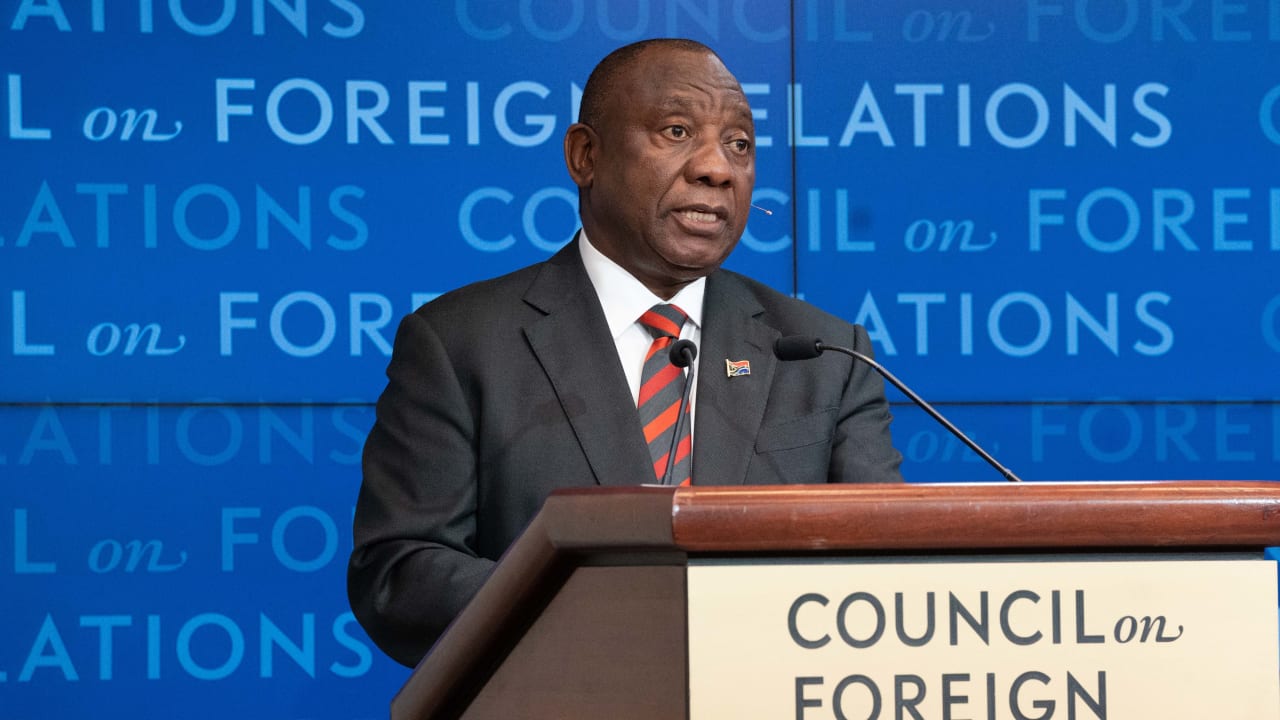
A Conversation With President Cyril Ramaphosa of South Africa
Event date
Speaker
- President, Republic of South Africa
Presider
- Political Analyst, MSNBC; Director of the Mandela Center for Social Change, City College, NY; Former Editor, Time Magazine; Former Undersecretary for Public Diplomacy and Public Affairs, U.S. Department of State; CFR Member
President Cyril Ramaphosa discusses South Africa’s domestic agenda, bilateral trade relations with the United States, the future of BRICS, and the country’s role in the region.
STENGEL: Good afternoon, everyone. And welcome to our conversation with Cyril Ramaphosa, the president of South Africa. I’m Richard Stengel. I’m a former undersecretary of state for public diplomacy in the Obama administration. And more importantly, I collaborated with Nelson Mandela on his autobiography, Long Walk to Freedom, which is how I met this young man thirty-two years ago. (Laughter.) And I’m going to embarrass Cyril a little bit, because not only is he president of South Africa, he is truly one of the founders of modern South Africa.
He was the secretary general of the National Union of Mine Workers. He was Mandela’s closest aide for figuring out the negotiations to get to an election, prevent a civil war, and then he negotiated the constitution. And he really is a giant of modern South Africa. And it’s kind of elegant and poetic that you eventually became president. And I’m not telling a secret when I say also that he wanted you to become president. And I always knew when Madiba, as we called him, was talking to Cyril, because he was listening. He wasn’t talking. Everybody else, he was talking and not listening. (Laughter.) And it was just—it was great to see that relationship, and then—and what a titanic effort that all was, and how successful it was. And it owes so much to you.
RAMAPHOSA: Well, it’s owed to many people. And even Nelson Mandela would say it was a collective effort by many, many, many people. And I would say the entirety of the South African population at the time really participated in producing the democracy that we have today. But, of course, you had to have leaders like Nelson Mandela, Oliver Tambo, Albertina Sisulu, and Walter Sisulu, and many others.
STENGEL: And they had to have you. (Laughter.) And when I would say to Madiba, well, that was a collective effort, wasn’t it? He’d go, no, that was me. (Laughter.) So let’s turn to modern South Africa. You know, I don’t know if folks here know that Cyril just spoke at the General Assembly, I mean, not even forty-five minutes ago. And just—not that I want you to redo your speech, but if you—it would be nice, I think, for people to hear a little bit about what you spoke about and also I thought it was powerful what you said about the African continent and South Africa’s role in the African continent.
RAMAPHOSA: Well, essentially, we came here to celebrate the eightieth anniversary of the founding of the United Nations, an organization which when it was founded held a great deal of hope, I would say, for humanity to ensure that we do not, again, experience the horrors of the Second World War and many other wars that had preceded that.
The hope that many people had was very high but over time I did say in my speech that the role of the United Nations has diminished and particularly that body called the Security Council, which was especially set up to ensure the security of the world, that we do not have wars raging all over the world.
It has not been successful. We bemoan the fact that many parts of the world, Africa as a whole, Latin America, are not represented. Africa is 1.4 billion people. We do not have a voice in the Security Council. We do have voices in the General Assembly but whatever decisions or resolutions that are taken there are vetoed by five powers and we want to sit at the same table like we do sit with them in the G-20.
South Africa has now been given the honor to be president of the G-20 and we will be holding the leaders summit in November of this year. And I had hoped that your president would attend. He kept on enticing me with a promise that he will attend but he doesn’t seem to be living up to it.
So that opportunity for us is a great one, not only for South Africa but for the African continent because it gives us a voice. We have chosen—every country that chairs or is president of the G-20 is given the right to identify themes that they would like the world body or, like, the G-20 to discuss. We chose a theme of solidarity, sustainability, and equality.
We thought that was important because we felt that as the world addresses the many challenges that we all have, we do need to act in solidarity because solidarity has been the greatest hallmark of human development over generations. People have tended to act together, they’ve tended to talk to each other, to collaborate, and through solidarity stronger nations help weaker nations. Like in families, the stronger member of the family will help the weaker one to advance and to develop, and we’ve also argued that the richer ones should help the poorer ones in all endeavors, be it health, education, security, or whatever.
We also chose the theme of sustainability, believing that everything that we do as the world population should be sustainable from dealing with climate, dealing with health issues, education, and so forth.
And we also said that we need equality. There needs to be equality not only amongst, say, if you like, men and women, which is something that the world is now beginning to embrace, which did not exist in the past where women were always relegated to the back, and in dealing with it in South Africa it means a great deal for us because we were a land that did not know equality. Other citizens were promoted higher than others and even women—Black and White women—were not equal to the men. And so equality means a great deal to us as a nation. It touches the core of our humanity, of our existence, and identity.
So those are the three themes that we’ve chosen, that let us treat each other as nations also in an equal way with due respect for each other and listening to one another, and none believing that they’re better or greater than the other. And through solidarity, we support each other.
I spoke about that and said that we are making progress. We’re making tremendous progress over the year. We’ve held—we are going to hold 130 meetings of different varieties. Initially, the U.S. started boycotting some of the meetings and raising the complaint about the rejection of the DEI—I don’t know what you call it; diversity, equality, and—
STENGEL: Oh, DEI.
RAMAPHOSA: DEI. And with time, as the meetings have been going on, they have been gravitating more and more to the various meetings. Ministers hold meetings around what they do, be it tourism, be it water, be it education and childhood development and—early childhood development and so on. So they’re coming back, and we are really grateful to that—for that. And we are hoping that they will also attend the further meetings. Tomorrow I will be addressing the foreign ministers meetings, and I’m hoping that the U.S. will be well represented.
So we’ve been making tremendous progress with not only G-20 countries, but many more that we have also invited, because each host is entitled to invite others to participate. So we’re seeing, you know, a coalescence of thought, of effort amongst many nations that are part of the G-20 process. And in November we hope to adopt a declaration that will deal with a variety of issues, issues such as how we finance climate change. Much as President Trump denying that there is, you know, climate change and damage, many people around the world do believe that there is climate change and we need to address it. We will also be addressing the issue of the debt burden that many countries have, particularly countries in the Global South, in Africa especially, that have huge debt burdens and are having to pay much more than countries in the—in the North. So those are some of the issues that we will be addressing.
And in many ways it’s an exciting moment, and that is partly what I was sharing. But we are also sharing our disappointment with our inability as the world to stop a variety of conflicts around the world. The conflicts on our own continent—Democratic Republic of the Congo, Sudan—Sudan is possibly the worst because unprecedented deaths and displacements of people is taking place, and the world is hardly ever aware of what is taking place in the Sudan. And of course, the war that rages on between Russia and Ukraine is a major concern. And also, in the Middle East, that too is a concern. And we raised that because we do believe that the world needs to pay attention to a number of these issues.
And we didn’t talk much in my speech about the developments in my own country, in South Africa. We have gone through, I would say, maybe three eras when we developed greatly, during President Mandela’s time and President Mbeki’s time; and then we faced decline during the presidency that followed thereafter, where we had what we call state capture—the capture of state institutions, and corruption was rife, and we’re now dealing with all that. But in the course of all that mess that happened, a number of key companies, if you like, that are involved in the services—for instance, in electricity and water and logistics—were also captured and collapsed. And we’re in the process of raising them from the floor. And we’re making progress. We are, however, pleased that a number of companies around the world still retain an interest in investing in South Africa.
We’ve got 600 U.S. companies that have retained their interest in South Africa, and many more still want to come in and invest. And recently we’ve had a wave of investments flowing in from Google, Amazon, and all those big tech companies. They’ve established their data services centers. And they see South Africa as an entry gate into the rest of the continent, correctly so, because we are the most industrialized nation on the African continent. And through utilizing the Africa Continental Free Trade Area, which is like a free trade agreement amongst all the countries on the continent, we will be the most industrialized to be able to drive the commerce and trade that should ensue.
And to that end, we want the Africa Growth Opportunity Act to continue, AGOA, and also the tariffs that President Trump is seeking to levy on us and has already started to be reduced. And that AGOA treaty should continue. And we are now involved in negotiations with the United States trade representative to see the extent to which we can reduce that. And we’ve also been insisting that the trade between South Africa and the U.S. is mutually beneficial. It’s not a one-way trade process. U.S. workers are also employed by companies that trade with South Africa. And similarly, we are also having workers who are employed by U.S. companies. So the two hands, in African tradition, would continue washing each other. And that is what we hope will continue to happen. Sorry for boring you. (Laughter.)
STENGEL: So, Mr. President, let’s continue about the domestic situation in South Africa. And you are now the head of a government of national unity. For the first time since the founding of modern South Africa, the ANC didn’t win an outright majority. I’m curious whether that—what are the pros and cons of heading a government of national unity in dealing with those issues of corruption, of the tariffs, state capture, load shedding? All of those things are very, very difficult issues. Is it making it harder or easier?
RAMAPHOSA: Well, many things in South Africa are a big challenge. But there are also many things that are really exciting because they give rise to great opportunities—great opportunities to pick ourselves up from where we are, to a much better plane. The ANC, the party I lead, lost its majority. And largely for two reasons. Because our former president broke away and formed his own party and he has a great following in one of the provinces, so that reduced our majority. And he had his own gripes. And it was largely also the, you know, person who led the government during the state capture era. And when he exited and formed his own party, many people voted for him. And he won a sizable vote.
The second reason was the performance of our economy. Our economy has not been performing at a high level. In fact, we’ve been having 1 percent or 1 ½ percent growth. And the rate of unemployment is quite high. And revenue collections of our fiscals have been sort of tapering down. And not enough financial capability to finance the developmental needs of our country. And inevitably, our people do become despondent. And many people did not come out to vote. I don’t know what your experience is here in the U.S. So all those things contributed to our loss of the majority vote.
We were then compelled to seek partners that we could work with. And we remembered very well what Nelson Mandela led us in and taught us, that it is possible to work with your opponents and even your enemies to advance the interests of the country. So when we lost power, we were the first, as the ANC, to say: We have lost power. And we respect the will of the people. And in doing so, we are going to be open to working with other parties, even those that were our opponents. We humbled ourselves to our people. And in the end, we formed, if you like, a coalition with nine other parties. So we’ve got a ten-party unity government, with one of the major opposition parties having joined the Democratic Alliance and a number of other smaller parties.
So when we formed the government of national unity we remembered what Nelson Mandela also formed when he got in—when he became president. We had government of national unity then, where we worked with our erstwhile enemies—a party that had instituted Apartheid and led to the killing of many people, exile of many, and the imprisonment of Mandela. He decided that we should work with them to build the nation and to bind the nation together. That’s what we did. And so far, it has been holding.
And inevitably, when you work with people who have either different ideologies or political objectives, you are going to butt heads. And we’ve seen that happening. But we were rather pleased that we were able to put a government together within thirty days after the election. Other countries have taken more time. I think European countries take up to nine months, one year, and all that. We did it because the will amongst all the ten parties was strong that we should put the interests of the country and our people first. So we are in a unity government. And it is working.
It has its own challenges. And we agreed to have what we call—an agreement we call a statement of intent on the issues that we are going to focus on. Which are to grow the economy and create jobs, that collectively all ten parties would work in a Cabinet, which I lead, to reduce poverty, to increase employment. And we also agreed that we would focus on increasing the capability of the state, because during the state capture era many institutions of government were weakened. And we all agreed that we would work together to increase state capability and also to address the issue of the cost of living of South Africans.
So we are working together. And we are cooperating well. And it’s always, for me, a pleasure to even see ministers from opposition parties either going around the world and flying the South African flag, proving that, yes, we can continue to forge the unity that Nelson Mandela wanted to see in us. We do face enormous challenges. And some of the challenges are the legacy of our past. Legacy of colonialism, which led to the dispossession of the assets of the majority of South Africans, who were rendered poor. And inequality then started becoming the order of the day. And Apartheid, which was a system that, through law, convention, and practice, ensured that Black people were given inferior education, no access to good jobs, no access to property.
The new government has been doing everything it can. For instance, we’re the only country on the continent that has 94 percent electricity penetration. When we got into power, it was 53 percent. Access to water has gone up exponentially. People now have taps near where they live, which was not the case. Education. We now have full access to education, although we still need to improve it because we are a land where there was unequal education, where the government spent much more money on White children than on Black children. And if you go to our 25,000 schools, you’ll find that the majority of the schools that we have are schools that were never given attention by the previous government. And now the new government now has to either revamp those schools and improve delivery of education.
So we have many challenges. But we are addressing them. Corruption is a major problem which we are focusing attention on. And we are ensuring that in government and in the private sector corruption is dealt with. The spate of corruption has been multidimensional in our country. We even had major companies, international companies, participating in corruption and corrupting some of our state-owned enterprises, like the electricity generation company. And some of them were U.S. companies, European companies, companies that one would have thought would aid and abet our march towards a corruption-free dispensation. But they participated. So quite often the blame is only put on the public sector, and yet it’s been also pervasive in private sector. So all these are areas we’ve identified for attention and we are doing everything that we can to address those.
And we’ve got a growing youth population. Young people are surging forward. They’re getting more educated, some of them here in the United States and coming back home with great qualifications, and I’m proud that in my cabinet I have young ministers and some of them are sitting here.
They’re bright, they’re hard workers, and they’re focusing on developing the country. That’s who we are.
STENGEL: Excellent.
So now we’re going to open questions both in the room and virtual. I think we usually do two questions in the audience and one virtual, and that young lady had—oh, I’m—hi. OK. Yes?
Q: My name is Lucy Komisar. I’m a journalist.
I was in South Africa at the time of the changeover. I know a lot about the work that you did as the head of COSATU, the labor movement, to fight the repressive White apartheid regime. What did you learn then in the strategy, you and your fellow fighters against repression learned, that now helps you understand what you are doing now and what you should be doing now to fight the repressive Israeli apartheid regime?
RAMAPHOSA: It was Nelson Mandela who, as a gigantic leader taught us a great deal of lesson(s) and one of those that he articulated so well, which still rings very clear when we have to deal with an issue—a difficult issue like what is happening between Israel and Palestine—was that we as South Africans would never say we are free until the Palestinians are free.
And he didn’t say that because he was a good friend of Yasser Arafat. He was saying that because we saw in that part of the world a system that was similar to ours—apartheid—and it appalled him. It pained him to even come to that conclusion.
What we learned in our own struggle is that we’ve got to wage struggle not only for ourselves, largely, because we were supported by the whole world. The world rose up against apartheid and declared apartheid a crime against humanity, and we were humbled by that and we felt that the world having helped us to get to where we were.
And let me say we always knew that we would defeat apartheid. Nelson Mandela also knew. But we knew that it would take us longer without the help of many people around the world. And in the end, the support we got in the U.S. when sanctions were applied and the U.S., not only various nongovernmental organizations but even at government level, decided that they could no longer countenance a system like apartheid.
The apartheid rulers knew that the game was up and it is what really—that’s when the penny dropped for them and they changed around.
Now, what did we learn? We learned that pressure is important to be put. The articulation of an injustice has got to be verbalized more loudly and support needs to be given. This is what has propelled us to give support to the cause of the Palestinians. We have been very harshly criticized for the step that we took to take the case to the United—to the International Court of Justice.
Other people have taken resolutions to the United Nations, but they were never really criticized. But when we decided that we would take the legal route, the only route that our adherence to the rule of law has taught us works, we were heavily criticized by many nations around the world and in some cases were even being punished for having taken that step.
But we are rather pleased today that many countries are seeing the usefulness, if I can use that term, of what we did and are now coming behind us to support what we did because not so much that we wanted to punish Israel but because we wanted the genocide to end—what is happening there to end.
We thought and are convinced that the only way we can do it is to do it legally. We cannot go and wage arms, war against Israel. It’s not possible. But we can speak in the U.N. and we can use U.N.-allied organizations or institutions to put the case across, which is exactly what we have done.
Working together with others is what has taught us to do what we do and the lessons that we have gained. Nelson Mandela was very strong in working together with others and amassing and mobilizing many forces and many entities to end systems that he believed were unjust.
So that is what we have learned over the years.
STENGEL: I think we have a virtual question. Is that right, Liz?
OPERATOR: We will take the first question from Lesley Warner.
Q: Good evening, Mr. President. Thank you so much for sharing your insights with us.
Sitting in the United States we tend to think that everything other world leaders do is about us even when that’s not the case. Over the course of the past year your government has taken actions to downgrade Taiwan’s diplomatic status in South Africa. Can you tell us whether your government’s relationship with the United States contributed at all to that decision and what this move might signal about your government’s relationship to China? In addition, it’s been reported that Taiwan is reducing exports of semiconductor chips to South Africa. What impact do you anticipate that decision will have on your economy?
RAMAPHOSA: When we became a free nation we then had the opportunity to establish relations with many countries around the world. One of those was China and, indeed, many other nations had boycotted South Africa and they decided that they would form relations with us.
In our case we were very clear that the People’s Republic of China—the mainland China—was the real representative of the people of China and so, therefore, we recognized China and we adopted a “One China” policy like many other nations in the world.
And the apartheid regime had a relationship with Taiwan and did not have a relationship with the bigger mainland and we decided that we would downgrade that relationship to a trade representative type of relationship.
So the United States in whatever disposition that it has had with South Africa did not influence our policy towards Taiwan at all and it has been an act of our own volition, and as it is now we have been in discussion with Taiwan that, in our view and we’ve been requested not only by China but by other nations, that their trade representative office should move from the capital city to near Johannesburg or in Johannesburg, which is the real trade and financial center of our country, and we’ve seen that as being nothing really terribly wrong.
They have agreed to move, and their reduction of exports to South Africa obviously will impact on us but we will always find a way of dealing with them or with that issue.
So in our view, the step that we have taken has been taken by many other countries in the world with regard to Taiwan and our view is that it should not be over politicized. What needs to be politicized is the fact that we recognize China and we have a one-state—a One China policy, which many other countries also recognize. The United States also recognizes—or, has a one China policy, as I understand. So I don’t see that as a major problem.
STENGEL: Question from in here. Yes, ma’am.
Q: Mr. President, so it’s such a privilege to be able to ask you my random question for today. (Laughs.) But I just wanted to ask—oh, sorry. My name is Swathi Manchikanti.
And I wanted to ask—you know, you mentioned AGOA as a key strategy for improving trade relations with the U.S. Other national representatives have also spoken about other relationships that they’re trying to strengthen with other nations to kind of balance what’s happening with the U.S. government right now. And I’m curious if you are also pursuing alternative options for South Africa as well.
RAMAPHOSA: Yes. South Africa, I guess what President Trump did was a wake-up call for us. Not so much because we were not trading with other countries, but a wake-up call in saying that we need to upgrade our relations—our trade relations with many other countries in the world. So we’ve now embarked on an outreach program which is led by our minister of trade and industry and competition, Minister Tau. And we’re going around the world and improving our trade relations with many other countries. And we’re finding many countries receptive. And some of them are saying, we’ve been waiting for you. What took you so long? (Laughs.) So we are now establishing a number of—or, setting up a number of trade relations, free trade areas, or free trade agreements with many parts of the world—the Middle East, in Asia, and Latin America as well.
And that does not mean that we don’t want our relationship for trade to be strengthened with the United States. The United States is our second-largest trading partner, outside of China and outside of Europe. Of course, Europe is a number of other countries. So China then the United States are our biggest trading partners. So we want to retain that. But we also want to diversify, because we’ve seen that there’s a great danger for us just retaining just good trade relations with a few countries. And yet, the goods that we manufacture and can export can go to many places in the world.
We are a repository of critical natural resources that we want the world to buy from us, but also buy from us from a value-added point of view. And we’re find in great reception for this notion of adding value so that we move away from exporting rock, stones, and dust—just in raw minerals—but in exporting finished goods. And a number of countries are gaining interest in us. There are a number of things that we have to do. We have to upgrade our energy generation, which has been challenged, as Richard was saying earlier, with load shedding or outages. So we are upgrading that. And we are dealing with a number of reforms—reforms in the electricity sector and reforms in the logistics sector, improving our ports, and improving our railways and our roads. So we have embarked on a major infrastructure development program second to none in the past thirty years. And we’re hoping that all that will open the levers of our economy so that we can grow at a higher level.
STENGEL: Great. Gentlemen back there with glasses.
Q: Thank you, Mr. President, for being here. My name is James Clinton Francis, and I’m a new term member at the Council.
Forty-six percent of power distribution networks are owned by municipalities in South Africa. But in 2024, only thirty-four out of 257 municipalities received successful audits. What is the government doing to improve the fiscal governance capacity of these municipalities so that the nation’s electricity grid is strengthened? And how is the government planning to smooth the cost burden for working-class households in electricity costs?
RAMAPHOSA: Yes. Municipalities play a key role in the distribution of electricity. With the reforms that we have embarked upon, a number of municipalities are now going to start the generation processes as well. So we are—the reforms that we’ve instituted—if you like, liberalizing the electricity generation sector, where we no longer want to rely on a monopoly government-owned entity. We wanted to compete with other energy generators like is happening in many other parts of the world.
And on the distribution side, many of our municipalities do distribute, and they have been facing a lot of challenges themselves, firstly with outages and secondly with lack of real good payment where they are raising good revenue. And municipalities have also had huge problems in owing Eskom, which is the state-owned energy generating company, and as a result the municipalities themselves have faced enormous challenges of capacity, of revenue collection. And as a result, a number of them have had poor audits by the auditor general because the auditor general audits all of them. We are seeing an improvement, but we need to see more.
That is why one of the areas of reforms is a focus on local government. Local government has been the weakest link in the government architecture, which we are now attending to and addressing.
And you raised the question of the costs for households. We’ve instituted a system of supporting indigent families. As poverty has risen we have found that there are many families that are indigent that need support, and we’ve been subsidizing their electricity costs as well as water. So we’ve spent a considerable amount of money supporting them, and municipalities are building registers to know which household need support. And those that need it, they are then given a special rate for water and electricity. And that is part of our process of lessening the cost of living for our people.
And we want to improve the government of our local government by improving the services that they should give, particularly when it comes to water, electricity, and just the cleanliness of our towns—garbage collection and all that. There have been weaknesses there, but we are beginning to improve because we are focusing on that. And we’re focusing on that from the presidency level, my office instituting a number of initiatives and interventions to support our local government entities. And we’ve done so for two of our major towns, Johannesburg and Durban. Durban is the tourism mecca of South Africa and Johannesburg is the financial center. So we’re working with those two, and we’re going to be working with many more. So local government is my area of great focus, and we want to improve that.
STENGEL: OK. That gentleman right there. You’ve been waiting. Sorry about that. And this is the last question.
Q: Mr. President, Petr Sidorov, economist at Deutsche Bank.
I’d like to congratulate you, definitely, over the past few years on the reform efforts. And I think South Africa has really managed to kind of get back in kind of the positive mood of international investors and companies. And so my question would be, if you can look forward to the next three years, kind of what—how are you thinking about making sure you leave ANC in good hands by the end of your term and that—
RAMAPHOSA: Sorry, what was the question?
Q: Sorry, that over the next three years of your term you leave ANC and South Africa in good hands, and that kind of you avoid the risk that reform efforts slow down or, worse, potentially backslide.
RAMAPHOSA: Thank you for the compliment. I wish you were a voter. (Laughter.)
We are moving with the reforms and I’d like us to move faster. And we are moving fast. And sometimes when you try to turn the Titanic, it takes a while. But we’ve become focused and we’re getting there. And the other good thing with South Africa, of course, is this consultative culture, which I’m sometimes criticized for, because we don’t have the dictatorial tendencies of executive powers, and all that. Our constitution—we often say it’s the best constitution in the world. And we learned a great deal from the U.S. Constitution. What we didn’t learn was to have executive powers like what President Trump has—(laughter)—because when we try to exercise executive powers we are often taken to court, because we’ve given so much powers to our courts.
So our reforms are gaining traction. And over the next three years, even when I leave office, I do believe that whoever will succeed me will continue with those reforms, because that’s the only way out for South Africa—out of a low-growth economic sort of trajectory. We’ve got to institute those reforms. And many countries that have instituted the type of reforms we are instituting have seen higher levels of growth. So that is the lesson that I am beaming out to my colleagues in government, and in the party, and so on. That that is the only way in which we can grow our economy and deliver a better life to South Africans.
So I see that continuing and see that gaining more traction and more durability. And the good thing is that—and I was getting to this point—the culture that we have in South Africa is being able to work with other key stakeholders in the country, in the economy, as in labor, as in business, as in nongovernmental organizations—you name them, from religious organizations to traditional leaders, who are kings and chiefs and what have you, supporting organizations. We have a system of putting them all under one roof. We’ve been able to institute the reforms now on issues that many countries would never really do, such as how do we fight crime and corruption? We cooperate with the private sector because they have certain capabilities that they also contribute that can make us work a lot better.
We’ve embarked on another process now that, after thirty years of sort of freedom, we—Richard, will be interested in this—we’ve decided that we should have a dialogue—a dialogue amongst all South Africans to talk about the future of our country for the next thirty years. So I called a dialogue. It’s going to easily involve up to ten million people, meeting at the local government level, at ward level—county level, you would call it—and talking about the challenges the country faces and what future we want, the type of South Africa we want. And all that will then be put together. We’ve done this in the past. You may want to know that when we drafted our constitution, Richard, I think it was after you collaborated with Madiba to write the Long Road to Freedom (sic; Long Walk to Freedom).
When we drafted our final constitution—because we had an interim constitution, which enabled us, one, to end Apartheid and elect a new government. And then we negotiated the final constitution, which we now have, and had it adopted in 1996, which Nelson Mandela signed. That process was the broadest consultative process that South Africa has ever seen since the drafting of the Freedom Charter, which you wrote—which you also collaborated with Madiba as he wrote his book. It involved millions, millions of submissions that were made about our Bill of Rights, about all manner of other things, which expressed the wish of South Africans in terms of what country they wanted to see and the constitution they wanted to have.
Now we’ve embarked on another journey, which is a national dialogue, which is going to have up to ten million people, as I said, participating, talking about the future. So South Africa is, therefore, a country where consultative processes tend to take place, and we consult on everything, and hope that we will have the best outcomes that we could ever have for the people of South Africa.
So I do see what we have embarked upon continuing because South Africans will never accept any sort of change that is going to dilute their democracy, their rights. They want to be involved and they want to participate. That is the South Africa that Nelson Mandela built, and that the South Africa we continue to take forward working together with our people. Thank you. (Applause.)
STENGEL: Well, maybe we should do that here, have that dialogue. I want to thank President Ramaphosa, the great President Ramaphosa. You see why Nelson Mandela wanted Cyril to become president. Thank you for doing this today. Thank you for being here with us.
RAMAPHOSA: Thank you.
STENGEL: The video and the transcript of today’s meeting will be on the CFR website. It is all on the record, which I should have said at the beginning. And I want to thank you all for coming. I think everyone has to stay here for a couple of minutes, but thank you for being here. Hi. Bob. And thank you for caring about South Africa. (Applause.)
RAMAPHOSA: Thank you, Richard. You are a good host. (Applause.)
STENGEL: (Laughs.)
(END)
This is an uncorrected transcript.