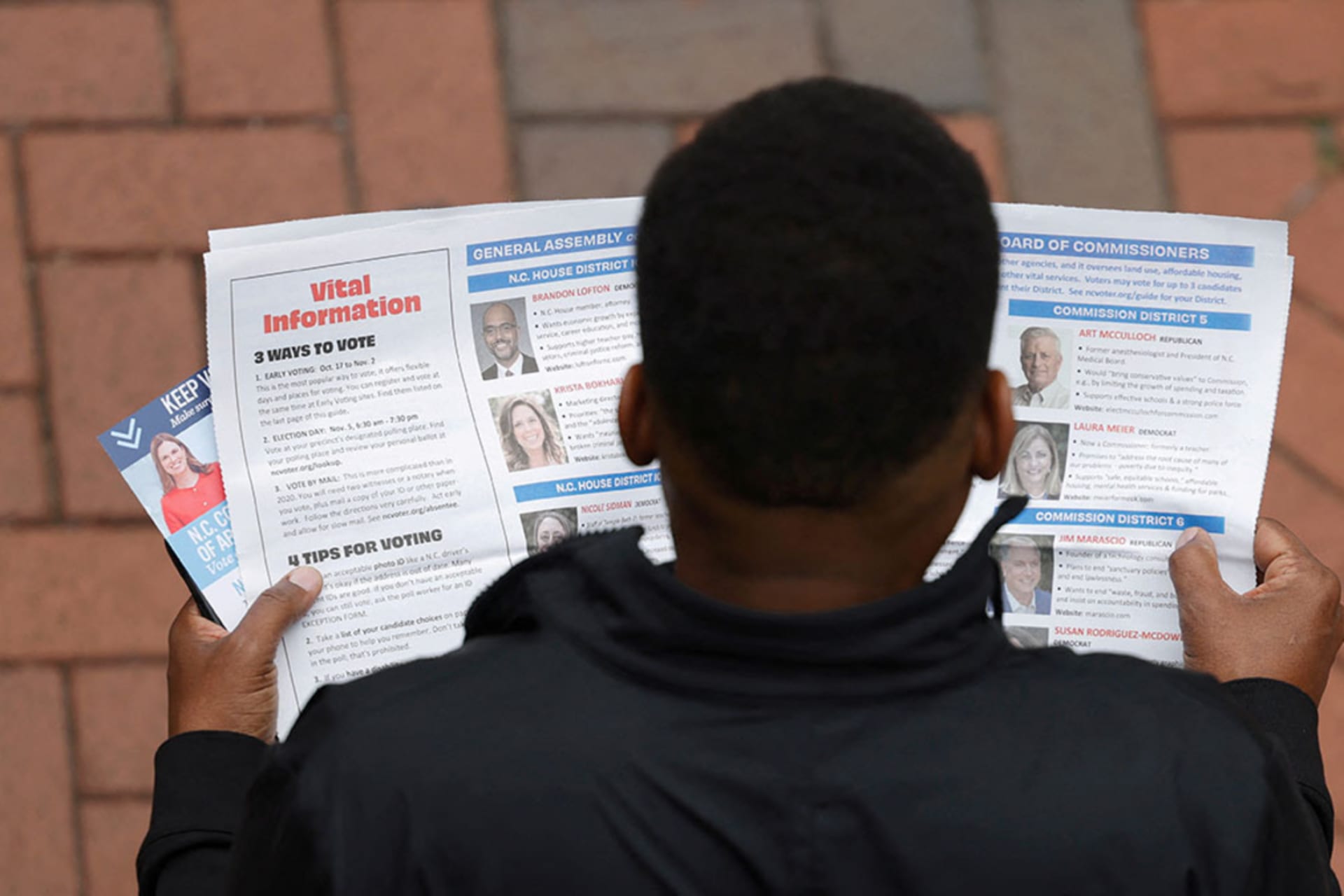
Election 2024

  • Election 2024
    TWNW Special: Surveying Foreign Media Coverage of U.S. Election 2024
    Podcast
    In this special episode of The World Next Week, hosts Robert McMahon and Carla Anne Robbins discuss how news outlets around the world are reporting on the November 5 U.S. elections and how it reflects on public and government interests. 
  • Election 2024
    What’s at Stake for Foreign Policy in the 2024 Elections
    On November 5, U.S. voters will choose new leadership, with ramifications for China, immigration, the Middle East, and many other national security issues. CFR experts weigh in.
  • Election 2024
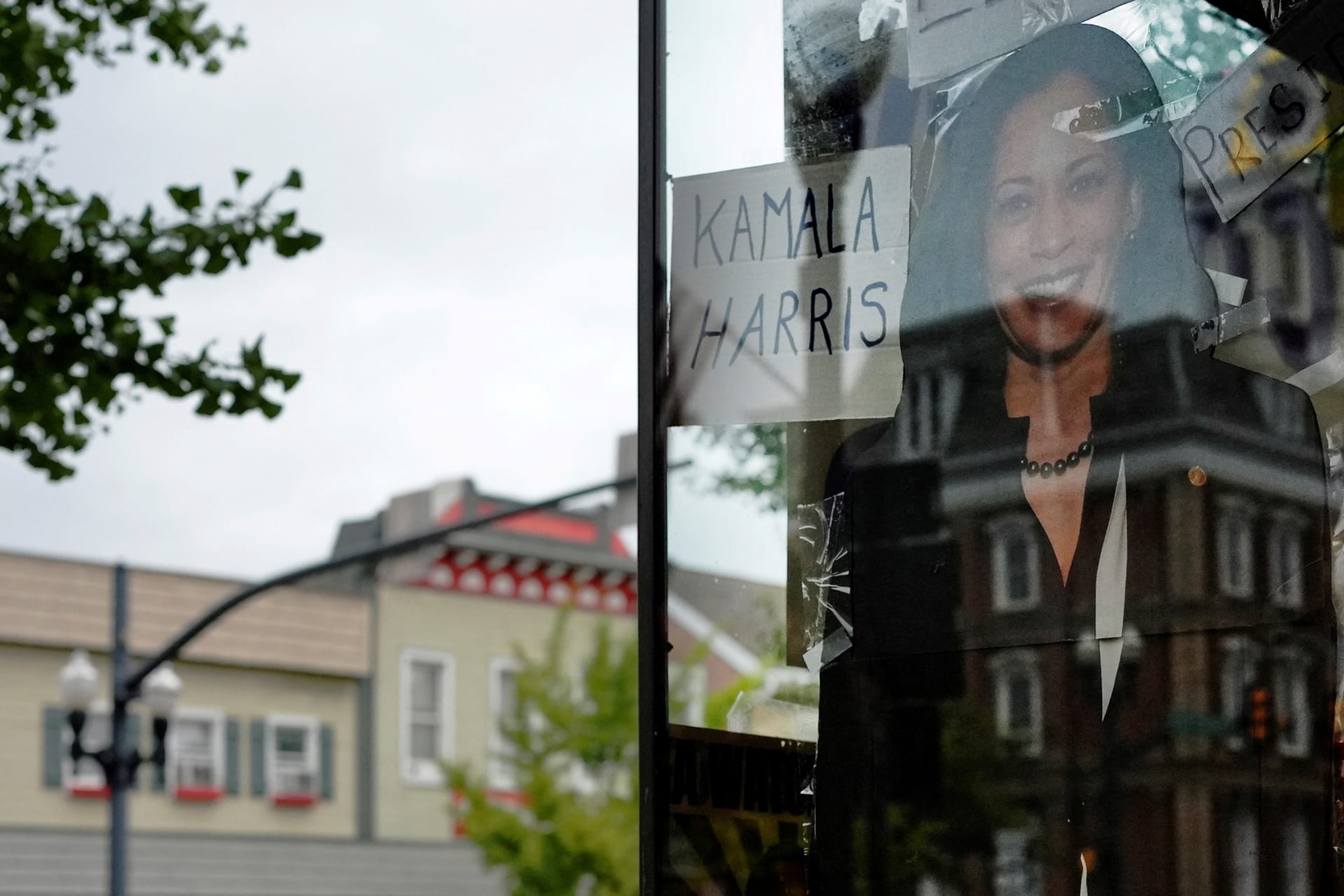
    Misogynoir in Today’s America: Exploring the History of the Racist, Sexist Attacks on Kamala Harris
    In what ways are sexist and racist tropes being used by the Trump campaign to characterize Harris in the presidential election?
  • Authoritarianism
    The Axis of Autocracies Challenge, With Jennifer Kavanagh and Andrea Kendall-Taylor (Election 2024, Episode 7)
    Podcast
    Jennifer Kavanagh, senior fellow and director of military analysis at Defense Priorities, and Andrea Kendall-Taylor, senior fellow and director of the Transatlantic Security Program at the Center for a New American Security, sit down with James M. Lindsay to discuss the nature and significance of growing cooperation between China, Russia, Iran, and North Korea. This episode is the seventh in a special TPI series on the U.S. 2024 presidential election and is supported by the Carnegie Corporation of New York.
  • United States
    Election 2024: How to Respond to the Axis of Autocracies
    Each Friday, I look at what the presidential contenders are saying about foreign policy. This week: Increased cooperation among China, Russia, Iran, and North Korea will present the next president with tough choices.
  • RealEcon
    Trade Is a Win for the U.S. Economy
    This op-ed was originally published by The Detroit News online on October 20, 2024 and in print on October 21, 2024.  As Americans get ready to head to the polls, no issue is more central to their choice for president than the economy. Both candidates have outlined distinct plans for how to boost U.S. economic strength, and former President Donald Trump has doubled down on his belief that reducing trade will help achieve this. He wants to put across-the-board tariffs on products coming into the United States, a policy that will not only increase inflation, but also make it harder for American companies to grow their business. The simple reality is that trade supports American economic prosperity. Calls for raising barriers to trade will only hurt American economic dynamism. One of the most significant challenges to defending trade is the reductive nature of campaign sound bites. Trade produces a range of benefits, some of which are obvious, but many others that are not. Politicians often complain that trade is just about expanding people’s ability to buy cheap goods like toys, clothing and furniture. However, trade also bolsters the ability of businesses to access affordable, high-quality parts and components that they use to make products to sell in the United States and around the world. Those parts that we bring in from other countries, such as axles, batteries and steel pipes, make up half of all imports. This means that much of what we trade is not consumer goods such as phones and furniture, but essential inputs to the U.S. economy. Take the iconic American truck — the Ford F-150. In addition to American labor and components, Ford relies on foreign parts for producing the F-150: about a third of all its parts are sourced from abroad. It is then sold in the United States and other countries around the world. Popular demand for the F-150, both in the United States and abroad, supports 3,800 jobs at the Dearborn plant where the trucks are assembled. But the economic benefits are not just limited to this single plant. In fact, Ford employs 59,000 hourly workers around the country to manufacture its line of cars and trucks. Along with auto workers that work on the assembly line, Ford employs a range of other workers, such as product designers and software engineers that research and develop the software that is embedded in all modern vehicles. Ford Credit also sells automotive financial products to finance the purchase of Ford vehicles. Americans understand the value of those jobs, and evidence shows that automotive jobs pay higher wages than those in other manufacturing industries. The importance of trade to those jobs is rarely talked about on the campaign trail, however. Many companies like Ford make a wide range of sophisticated products using both American and foreign inputs that are in high demand at home and abroad. By taking advantage of trading opportunities, these companies create a lot of American jobs across a diverse range of industries and are a source of strength for the U.S. economy. In fact, U.S. firms that trade in goods support half of all jobs in the economy, and almost three-quarters of those jobs are at firms that both export and import goods. These exporter-importer firms are major employers across key sectors of the economy, employing over half of all workers in manufacturing, retail, transportation, utilities, wholesale, and information. The things they trade also increasingly include higher-technology goods and services. Trade continues to be central to job growth in U.S. manufacturing, as well. In the past decade, total manufacturing employment increased by about 10%. During the same period, while non-traders continued to shrink, goods-trading manufacturers created more jobs on net. Because the share of goods traders in manufacturing employment averages about 85%, this recovery would not have occurred if all manufacturers grew at the same (negative) rate as non-traders. For all those reasons, calls to raise barriers to trade, such as through tariffs, could hurt the U.S. economy. Examining the realities of job growth in U.S. industry dispels the commonly held view that only exports support domestic job growth while imports harm it. Imported inputs are often essential ingredients to U.S. production that supports plants throughout the United States. To bolster the fundamentals of U.S. economic strength, Americans need a trade policy that is more open, not less.
  • United States
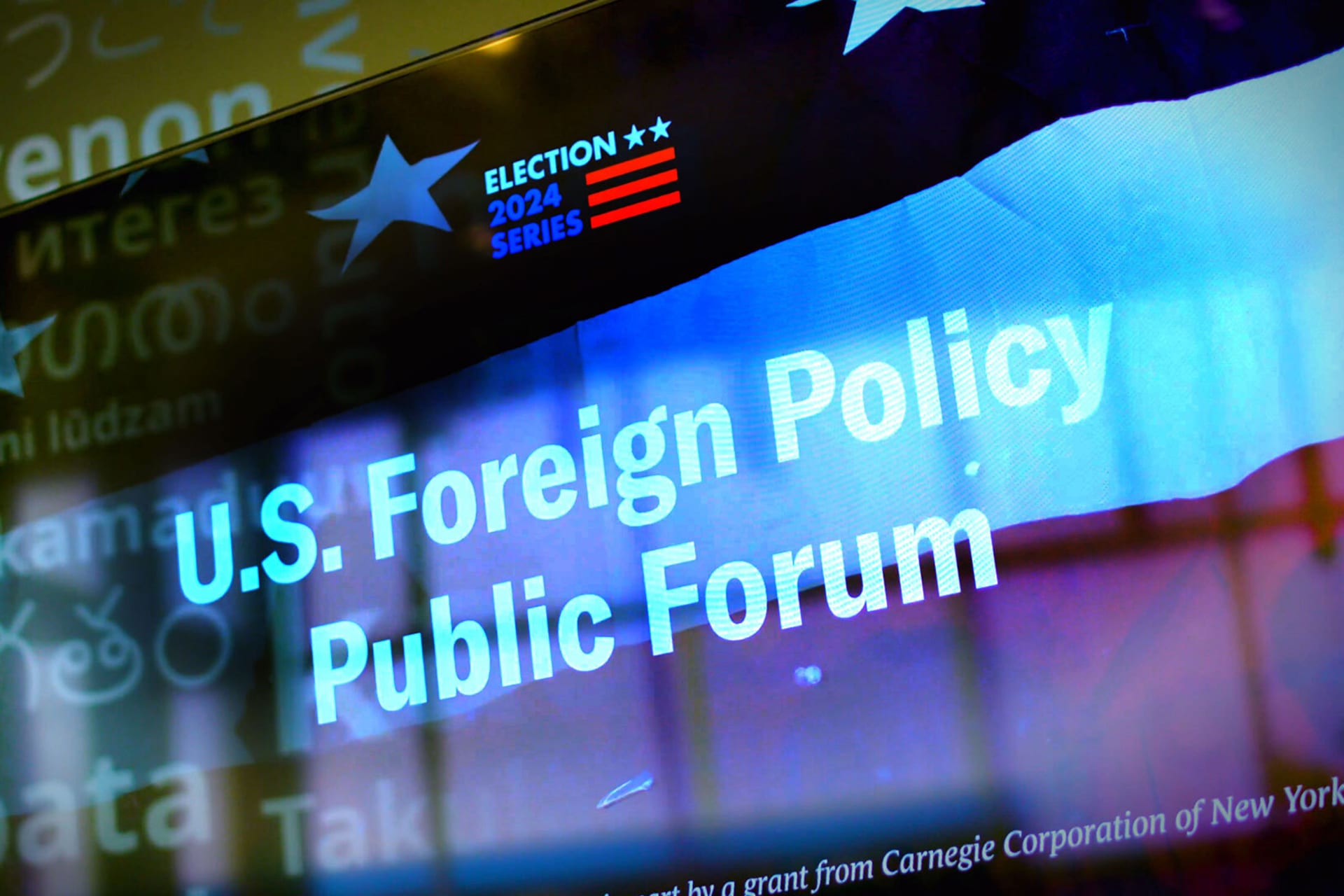
    CFR-Franklin & Marshall College Election 2024 U.S. Foreign Policy Public Forum
    Play
    Panelists with distinguished careers in government, business, and academia hold an in-depth, nonpartisan conversation on America's role in the word. They discuss the trade-offs presented by different policy options both locally and globally and provide context on the international issues, choices, and challenges facing the next president—including trade and immigration, Russia and Ukraine, U.S.-China relations, and the Middle East. To learn more about the foreign policy issues at play in the 2024 campaign, explore CFR’s Election 2024 hub for candidates’ stances and expert analysis on international challenges facing the United States. The CFR Election 2024 initiative is made possible in part by a grant from Carnegie Corporation of New York.   ALTMANN: Good evening, everyone. AUDIENCE MEMBERS: Good evening! ALTMANN: Thank you. My name is Barbara Altmann. I have the privilege of serving as the sixteenth president of Franklin and Marshall College. It’s my great pleasure to welcome you here to this evening’s event. We are grateful and we are proud that the Council on Foreign Relations team selected F&M as one of only four institutions nationally and the only institution in Pennsylvania to host this event. It promises to be a great evening with a panel of leading experts including—and let me brag here just for a minute—F&M’s very own Evelyn Farkas, class of 1989. (Applause.) She’s listening. (Laughs.) Evelyn will discuss America’s role in the world and the foreign policy issues at stake with her colleagues on the panel—everything at stake in the 2024 election, including trade and immigration, Russia and Ukraine, U.S.-China relations, and of course, the Middle East. This evening, as we all listen, I’ll be paying attention not only to the expertise of these respected leaders as they discuss such timely and complex topics, but also the manner in which they interact and engage. Here at F&M, where our unlikely mascot is the Diplomat, we are always listening and watching for true diplomacy in action. I know that our panelists will model how they embrace and find strength in their diversity of perspectives; how they speak boldly and at the same time listen actively; how they approach challenging topics with curiosity, the intent to learn from one another, and the desire to bring others into the conversation. By observing this kind of event and participating, our students and we all understand better that how they learn with and from one another is just as important as what they learn. That is how we all grow as individuals. It’s how we grow as a community. That’s how we shape the world for the better. And that is the best of the Diplomat way. It is now my honor to introduce our host, Elise Labott, who will moderate this diplomatic discussion. The 2024-25 Edward R. Murrow press fellow at the Council on Foreign Relations, Elise Labott is an award-winning journalist covering U.S. foreign policy, national security, and global affairs. She is currently an adjunct professor at American University’s School of International Service and writes a Substack publication, Cosmopolitics. Labott is also the founder and editor-in-chief of Zivvy News, a nonprofit platform that engages youth in political and global issues. Previously, she was a contributing editor at Politico and a columnist for Foreign Policy. As CNN’s global affairs correspondent until 2018, Labott reported from over eighty countries and covered major global events including the 9/11 attacks, the Arab Spring, the rise of the Islamic State group. Her career includes reporting on conflicts and international crises with notable contributions to CNN’s Freedom Project on human trafficking. Labott has also contributed her expertise to ABC News and Agence France-Presse, and she actively serves as a global ambassador for vital voices. She holds a bachelor’s degree in international relations from the University of Wisconsin-Madison and a master’s degree in media studies from The New School for Social Research. I now ask you to help me welcome Elise. (Applause.) LABOTT: Thank you, President Altmann, for those kind words and for introducing our forum tonight. I am Elise Labott, the CFR Edward R. Murrow press fellow, and I’m delighted to welcome you to the Election 2024 U.S. Foreign Policy Forum, cosponsored by the Council on Foreign Relations and Franklin and Marshall College. Tonight’s event is the last of four public nonpartisan forums that the Council on Foreign Relations is hosting with colleges and universities across the country in pivotal states in the leadup to Election Day. We’ll be discussing America’s role in the world and the foreign policy issues at stake in the upcoming election. Our panelists—we’re going to examine the trade-offs presented by different policy options both locally and globally; and provide context on those international issues, choices, and challenges facing the next president. Topics will include trade and immigration, Russia and Ukraine, U.S.-China relations, the Middle East, and more. Now, these issues, as you know, have deep implications both globally and locally right here in Pennsylvania, where trade supports over 1.5 million jobs and where voters hold diverse views on how the U.S. should engage in global leadership, particularly in the areas of Ukraine, NATO, and the Middle East. Tonight’s discussion will challenge us to think critically about the tradeoffs that different policy options present and how they impact not only our local communities, but also America’s standing on the global stage. Now, as an independent membership organization, think tank, and publisher, CFR serves as a nonpartisan source of information and analysis to advance understanding of global affairs and the foreign policy choices facing the U.S. and other countries. Now, the goal this evening is to raise awareness of those issues that affect our daily lives and help you make an informed decision before casting your ballot. Now, obviously, there are too many important issues to cover in ninety minutes, so we may not get to everyone. But I really hope you will bring up those most important to you during our question-and-answer program. Now, we encourage you to also take advantage of CFR’s Election 2024 resources available on CFR.org. It’s really a great array of resources on various issues, including a tracker of the candidates’ positions on issues, podcasts, videos, and explainers that delve into specific issues. And, obviously, you can also find articles by experts in Foreign Affairs, the preeminent journal of international affairs in U.S. foreign policy, published by CFR. So I’d like to thank Franklin and Marshall College for hosting this event and the Carnegie Corporation of New York for their generous support of our Election 2024 initiative. Now, I can’t think of a better panel to discuss these issues and how they affect Pennsylvania. My panelists are: Shannon O’Neil, senior vice president, director of studies, and the Maurice R. Greenberg chair at the Council on Foreign Relations. (Applause.) Ivan Kanapathy, senior vice president at Beacon Global Strategies. (Applause.) Evelyn Farkas, executive director of the McCain Institute, Arizona State University, and also a Franklin and Marshall alum who is also with us tonight. (Applause.) And Steven A. Cook, Eni Enrico Mattei senior fellow for Middle East and Africa studies and director of the International Affairs Fellowship for Tenured International Relations Scholars at the Council on Foreign Relations. (Applause.) Now, as a reminder, today’s discussion is on the record. It’s being livestreamed. I know we have hundreds of other people watching us tonight, so welcome to our viewers online. You can also watch it after the fact at CFR.org. Now, we have something interesting for you tonight. F&M Center for Opinion Research conducted a statewide survey in September to gauge Pennsylvania voter priorities for the upcoming election. So we’re now going to do a seven-question live poll to get a sense of how you all in the room feel about a variety of foreign policy related topics, pulling from issues that were highlighted in this Franklin and Marshall survey. So right now I want you to pull out your program and scan the QR code on the inside cover of your program. OK. Now, don’t rush through it all at once. I want you to please read each question as I go, and answer the poll questions on your phone, and we’re going to see the results up there. And then we’re going to recap the results for each question individually. So we’re going to go through it one question at a time; don’t rush though it. OK. I’m going to be voting, too, on my phone. How important is foreign policy when considering who you will vote for in the next presidential election? Don’t—this question is anonymous, folks, so don’t worry; you can say who you really mean. We’re not coming after you. No names are going to be tracked. OK. How important is foreign policy when you’re considering who you’ll vote for—very important, somewhat important, not important? OK. We’ll give a few more seconds to complete the poll. And now we’re going to close the poll and look at the results. Let’s see here. All right, I’m going to have to look up here. (Laughter.) OK. So very important, 69 percent. That’s really interesting because that’s a higher number than at most of our other colleges, and this is the fourth one tonight. So glad to see that we’re making an impact here. (Laughter.) OK. Number two: How active should the United States be in global affairs—more active than it is now, maintain current level of activity, less active than it is now, or not at all active in global affairs? OK. So 51 percent say maintain current level of activity, and then 29 percent—so a little less than half—less active than it is now, 16 percent more active than it is now. I’m glad that we’re not at a hundred percent on not active at all. (Laughter.) OK. Number three: Which of the following do you consider the greatest threat to U.S. national security—AI, China, climate change, domestic challenges, Russia, other? Domestic challenges, 50 percent. OK. Artificial intelligence, not as high as I might have thought. China, 16 percent. And climate change pretty close behind it, 15 percent. Russia, 9 percent. So domestic challenges. And we’re going to be talking about how international affairs really affects domestic challenges tonight, so that’s interesting to know. OK. Question number four: When it comes to trade with China, how should the United States approach tariffs on Chinese imports given the impact on Chinese businesses and American consumer prices? Should we increase tariffs, should we keep tariff levels about the same, decrease tariffs, don’t know? Don’t know, 35 percent. Keep tariff levels about the same, and increase, and decrease about the same. So, interesting. So a lot of people don’t know, so we’re going to be talking a little bit tonight about those tariffs and we’ll see at the end if—how we feel about it, because we’re going to be voting again on these issues. OK. Number five: How should the United States approach security along the U.S.-Mexico border—build a physical barrier around the full border, allocate greater resources to border surveillance and enforcement, address causes of migration from Latin America through aid programs and diplomacy, reform the U.S. immigration system to allow more pathways to enter legally, all of the above, none of the above, don’t know? Reform the U.S. information—immigration system to allow more pathways to enter legally and—52 percent—and address causes of migration through aid. So that’s kind of consistent, reforming the immigration system, consistent to some of the other colleges that we had. And I know that’s very important here in Pennsylvania and particularly Lancaster. I hope I said that right, Lancaster. (Laughter.) I practiced a lot today. (Laughter.) OK. Number six: Do you think the war in Gaza will lead to negotiations toward a two-state solution? COOK: Elise? LABOTT: Steven, listen up. COOK: You have the wrong slide. FARKAS: Ukraine. It’s Ukraine. O’NEIL: It’s Russia and Ukraine. COOK: It’s Russia. LABOTT: Oh, OK. (Laughter.) OK. Which of the following is closest to your view about the war between Russia and Ukraine? The United States should provide more military support to Ukraine, 63 percent. Maintain its current level of support, provide less support to Ukraine, withdraw all military support, don’t know. Provide more military support to Ukraine. And we’re going to talk about that tonight, and, obviously, that’s a very important issue here in Pennsylvania, where we have an ammunition production plant. We’re going to be talking a lot about that. OK. Last question, here we go: Do you think the war in Gaza will lead to negotiations toward a two-state solution? Steven, I know how you feel. No, 82 percent. (Laughs.) 10 (percent)—optimists at 9 percent—(laughter)—8 percent; it keeps—it keeps dropping. Don’t know, 11 percent. OK. We’re going to be talking about all these issues tonight. And the beauty of it is that after we have this discussion we’re going to do this poll again and see if you feel any differently. I was in Arizona a few weeks ago and some people did feel a little bit differently after that poll, and we voted again, and those answers changed. So we’ll see how we do. OK. So we’ve done our poll. We’ve introduced our panelists. Let’s dive right in. Let’s talk about supply chains and the resilience needed for a state like Pennsylvania. Shannon, let’s start with you. Supply chains are shifting away towards China. How can Pennsylvania’s businesses, particularly in manufacturing and agriculture, leverage this shift to supply chains—perhaps something like Mexico as a nearshoring partner—to improve that resilience? O’NEIL: Well, thanks, Elise, and it’s a real pleasure to be here with all of you. So thank you all for coming out tonight to talk about the elections and to talk about foreign policy. And so, you know, let’s talk about international economics because that’s an important part. And as we think about the issues in the campaign, you know, there’s lots of pocketbook issues that are out there. People are thinking about—you know, they’re thinking about inflation. They’re thinking about housing prices. They’re thinking about jobs. And lots of those, while they depend on local communities, they also depend on the international economy. And so we think about there’s big changes happening in the globe today, and one of the biggest, I would say, is the movement of supply chains. So these are sort of the pieces and parts and components and the processes that all come together to make a car, or to make a blender, or to make a lovely outfit, or all kinds of other things. And lots of these things cross borders one, two, five, ten times to come together, because what we’ve found over the last thirty or forty years is that by producing something in one place, in one country, in one city, in a number of factories, you get economies of scale and economies of scope that allow you to make it better, faster, and cheaper than anywhere else. Now, we have for many years depended on China as a big part of this, but also other countries around the world. And what we’ve seen over the last few years is geopolitics begin to affect these supply chains. COVID affected these supply chains, as we all know when we went to the store and tried to find things that we were used to finding every day that weren’t there. But we’ve also seen geopolitics affect them. And right now we’re seeing really a once-in-a-generation fluidity and movement of supply chains around the world, and so people looking to source from other places. So what does that mean for Pennsylvania? What does that mean for the United States in general? It means on the one side that there’s lots of opportunity to bring some of that manufacturing home, or to create a particular piece or part, or to assemble a product in other places than they’ve been before. So that’s an opportunity. But it also means that places like Pennsylvania need to get involved in a supply chain if they’re not already there. There are a lot of industries here that are already there, right? There’s lots of exports from Pennsylvania in agriculture in electronics, in other kinds of manufacturing. And that creates much better jobs than other kinds of work. In fact, the Commerce Department has done a study and they find that export-oriented jobs pay on average 18 percent more than jobs that are towards domestic economy, so just focused on the domestic economy. So how do you get more of those? And what I would argue as we see this movement of supply chains around the world, there’s a great opportunity for U.S. states, for U.S. cities, and others to join in in supply chains, but you’re going to need a partner because you’re still going to need economies of scale, economies of scope. So you’re going to need to have lots of customers out there, and many of those customers will be here in the United States but there’s 8 billion people that live in other countries and they buy things too. And so being able to serve those markets is a way to more jobs, to more orders, to more revenue, and to more local prosperity. So that is where, as we think about this, we need to look where we’re headed. LABOTT: So you write a lot about Mexico, and we have some political changes there. We have a new president. So with those political changes, how should Pennsylvania businesses and trade communities see this kind of potential economic opportunity or risk that might arise from these shifts, especially in agriculture and manufacturing? O’NEIL: So for U.S. exporters, our neighbors have actually been our biggest buyers. Canada and Mexico are the biggest export markets for the United States, and they buy all kinds of things from the United States, and often pretty high value added, pretty technical and sophisticated products—so, you know, the kinds of manufacturing that we do here. And so I think as we look to create more of those, we need to look at those markets more. And so what’s happening in those countries really affects what’s going on in towns here in Pennsylvania that are looking to export to those markets. So Mexico today has a new president. She started just over two weeks ago. She’s looking, as well as the United States is looking, in the—in the next year or so to come to revise or renegotiate the free trade agreement between the United States, Mexico, and Canada. It’s called the USMCA; so United States, Mexico, and Canada Free Trade Agreement. And there’s lots of things on the agenda there. There is, you know, how do we make sure all three of the economies grow and do better. There’s lots of questions about where does China fit into all of this and sort of Chinese imports into the three countries—what should be imported, what should not be imported, what sort of tariffs should be put in place not just in the United States but in the other countries that are our partners. And there are going to be real questions about how do we make sure that there is a—as they would say, a level playing field but there’s access for private sector businesses fairly equally across all three economies that are working together, so exporters from Pennsylvania or other states also have access to Mexican customers as well as Canadian customers. So all of those are on the agenda for the next administration. And we’ll see—we see very different platforms as we look at the campaigns of a Harris administration or a Trump administration in how they might approach our neighbors and these trading partners. LABOTT: Yeah. And so I think when you go to the polls, I mean, one of the things to consider, really, is how policymakers would ensure, if elected, that Pennsylvania maximizes the benefits of those trade agreements. Ivan, let’s talk a little bit about China. OK. This was a(n) interesting poll that I saw from the Global Coalition of International Leaders: 54 percent of Pennsylvanians believe U.S. lawmakers pay too little attention to competition with China, and 65 percent think that tensions between China and Taiwan are important to U.S. national security and economic interests. So, with—I mean, with Pennsylvania’s reliance on manufacturing exports, you know, how do states—this state’s industries prepare for further economic tensions between the U.S. and China, especially as we see this tech rivalry intensify? And as U.S.-China relations evolve, how can the manufacturing base position itself? KANAPATHY: It’s a great question, Elise. I think that, you know, the relations with China have over the last, I don’t know, twenty-plus—twenty, maybe thirty years have been very focused on our trading relationship, which has gone through, you know, tremendous ups and downs. And I think sort of how the American people see it and how they felt it is important. For example, like, I think median household income—so, like, your—you know, I guess your typical American family I think in the Clinton years rose, and they—and I think they felt it. But then across the Bush and Obama administrations, it kind of stagnated. And I think a lot of folks associate that with—at least partially with China entering the WTO, which is—happened, basically, at the end of the Clinton administration. And some of the things that Shannon was talking about, right, the manufacturing jobs, you know, a lot of those kind of moved overseas, again, at least partially because of some of the policies that were enacted during that time period. And I think now what you’ve seen, I guess, since both the Trump and the Biden administration is quite a different approach, I think, from what we saw before that time. And we’ve heard both candidates talk about how they want to move out and move forward on economic policies to include tariffs, right, and in particular with respect to China. So I think folks have a lot to consider and to think about in those terms. One thing I’ll say is that, you know, being painfully aware that we’re, you know, a panel of, quote/unquote, “experts” up here, that I think, you know, a few years ago, we got a lot of expert opinions that turned out to be wrong and, I mean, you know, in 2018 the United States raised tariffs, and all the experts said, don’t do it. In 2019, the U.S. raised tariffs on China, and all the experts said, don’t do it, it will hurt us. In 2020, the United States did it again, and those tariffs are still in place today, right? They’re still there. And there’s reasons for that, and some of them maybe you can say are political, but I don’t think the effects that were predicted happened because, for example, median household income actually went up quite a bit between 2016 and 2019. So, again, there’s other reasons that factor into that, but I think it’s important that, you know, folks are looking at all those factors. LABOTT: Yeah, and you know, particularly in steel and chemicals, you know, these industries are going to be able to position themselves to benefit from those shifts in global supply chains away from China. Evelyn, let’s talk about Ukraine, and we saw that President Zelensky was here a few weeks ago visiting this ammo production base that produces artillery, which is one of the primary weapons, ammunition. Some people have called Ukraine, you know, the artillery war. And we saw in the poll that a lot of people think we should supporting more to Ukraine, and President Zelensky signed that agreement with Zabornicha (ph), I think. So, given Pennsylvania’s significant defense and manufacturing industries, how might the state’s economy be affected by continued U.S. support for Ukraine in the war. FARKAS: Well, thank you for the question, Elise. I have to start, though, by thanking Mike Froman and CFR, thanking Barbara Altmann, Steve Medvic, and F&M. I am like practically jumping out of my skin I’m so excited to be here. (Laughter.) And most of you know it’s for several reasons: one, I am a graduate of F&M. (Applause.) And I had the pleasure of serving on the board—Barbara’s board—for five years. Two, my first job out of F&M—and I can talk to all you young people about how to get jobs out of F&M, but it doesn’t really work this way anymore—was with the Council on Foreign Relations through a temp agency in New York City. And at the ripe age of twenty, I said, some day I want to become a member—a CFR member—and I became a CFR member, so that’s another reason why I am very excited because I continue to have the affiliation with CFR. And then, finally, my in-laws live in Lancaster, and they are here in the audience with my husband. (Applause.) So that is—so that is why I’m excited to be here. LABOTT: OK, well, I thought nobody was as excited—as excited to be here as I am, but I guess maybe it’s you. (Laughter.) FARKAS: I think so. With regard to the impact of the war in Ukraine on Pennsylvania’s economy, clearly it has resulted in a boon for the economy because there is defense production. As you mentioned, there is an artillery—there’s an Army facility that produces 155 artillery ammunition. Here in Scranton, President Zelensky visited recently, and I believe there was also a Bradley Fighting Vehicle plant in York. I don’t know if it is still manufacturing Bradleys, but in any event, clearly the defense industry is benefitting, and frankly, there is a large swath of U.S. defense industry that is benefitting from—directly—from our support to Ukraine. But more importantly, I think, what we need to understand is what the war is about. It’s about standing up to Vladimir Putin. Why do we care about Vladimir Putin? I mean, we can sit at home and say, well, we don’t care about Vladimir Putin; let him have his way. But he is a neo-imperial autocrat, and he recognizes this truth: The United States remains the single strongest economic, military, and political power in the world. It’s the only power that can stand up to Russia and China, alone and certainly with our allies and partners. And by allies I mean the NATO alliance, which is the only operational alliance, the strongest operational alliance in the world, and our alliances in Asia. So the autocrats, whether we like it or not, they view us as the enemy. We can sit at home and eat bonbons on our couch, but they know we’re strong, and they know we can stop us (sic), and so they want to weaken us before we can stop them. Vladimir Putin decided that it was very important for him to recreate the Soviet Union, kind of a neo-imperial adventure. And I don’t want to go on too long because I can talk about this all night, but suffice it say that, for the United States, there’s a lot at stake. And I’ll kind of wrap it up like this: If Vladimir Putin gets his way in Ukraine, he will then turn—and you can Google Georgia and Moldova because they are right now in the middle of elections. Moldova just finished them, but they have a runoff; and Georgia, they are coming up. Those are two states that used to be part of the Soviet Union that Vladimir Putin would also like to take back. Vladimir Putin would also like to reassert control over Eastern Europe—frankly, the place where my parents came from; they fled communist Hungary. Vladimir Putin wants to take us back to a sphere of influence system before World War II. So after World War II, we set up the international system—we don’t have time to talk too much about the details of that, but suffice it to say it has kept us out—we can all agree—out of World War III because while there have been lots of wars—and Steven is about to talk about some of them—we have not had a world war since World War II because of the system that we set up. Vladimir Putin and, frankly, China, are trying to put this in jeopardy. I don’t have time to talk about how China is slightly different from Russia because what China wants to do—and I’m doing it anyway— LABOTT: We’ll get to that. We’ll get to that. But anyway, suffice it to say that supporting Ukraine is not only good for Pennsylvania, but it’s good for U.S. national security and it’s good for democracy. FARKAS: Yeah. Let me get to the last thing. He will challenge the NATO alliance. We’re part of the NATO alliance. If we don’t come to the aid of a NATO country, the alliance will crumble. Russia will then weaken us domestically, more than it already has. LABOTT: OK, Steven. COOK: Elise. (Laughter.) LABOTT: Let’s talk about the Middle East. I mean, even as Steven and I were getting ready to come on stage here tonight, we saw there were some new developments out of the Middle East today. So bring us up to date on what’s going on in the Middle East and whether—I mean, you kind of answered our question for us—whether the—you know, the recent developments, the death of Yahya Sinwar, the head of Hamas, killed by Israel—was it last week? I don’t even remember anymore. What are we looking at? Are we looking at a truce? Is there an opportunity here? Or is Israel just, you know, not listening to President Biden or anybody looking to end the war? COOK: Well, thanks very much. I just want to remind everybody that there was a time not long ago people started talking about deemphasizing the Middle East, yet here we are again. But before— LABOTT: I think the Middle East like just—we always say that, but it’s like the pivot to China. We can never leave the Middle East, and we can never pivot to China. COOK: Well, the Middle East is genuinely in the middle, but before I get into what’s going on in the Middle East—(laughter)—I do want to say how nice it is to be back in Pennsylvania. I’ve actually spent a fair amount of time in my life in Pennsylvania when I thought about it: ten summers, I did my graduate work at the University of Pennsylvania. And it’s just nice to be in the state that is home to the cheesesteak and the Hershey Kiss. (Laughter, applause.) And so, I just—you know, there’s not a lot of good news in my portfolio, so to be in the home of the Hershey Kiss is really—is really quite nice. Look, every day there is—there are developments in the Middle East, and this afternoon the Israelis killed the number two, the successor to Hassan Nasrallah in Lebanon. And I think this speaks to what’s happening in the region right now, which is the Israelis, after fighting basically back on their heels for the better part of the last years, now feel that they have a lot of momentum. And way back, after the October 7 attacks in 2023, Israeli officials were very, very clear in stating that they were going to, quote/unquote, “change the rules of the game.” And I think a lot of people here in the United States didn’t want to listen to that or wanted to interpret that in many different ways, but the Israelis are now going about changing the rules of the game. And so, since— LABOTT: What does that—what does that mean? COOK: It’s—well, I’m about to tell you what it means. (Laughter.) LABOTT: All right. COOK: Stanashway (ph). She knows what it means. It means one second. What it means is that the Israelis no longer are going to tolerate living next to non-state actors that can threaten their security. So since mid-September, they have been basically dismantling Hezbollah, the best armed, most sophisticated, non-state actor in the world, which has become an expeditionary force and second-strike capability for the Iranian regime. They have—as Elise mentioned, they killed the leadership of Hamas, and many, many other people, as well, including large numbers of civilians, in order to meet their military goal, which is to render Hamas unable to threaten Israeli security like it did on October 7 again. They seem to believe—and there is evidence that they are getting there—that they are close to achieving their goal, at least in the Gaza Strip. There is no ceasefire to be had; like, this often happens with the United States in the Middle East. The United States wants something more than the parties themselves. So Yahya Sinwar, who was the leader of Hamas in Gaza, never was interested in a ceasefire. There is ample evidence, there’s ample text messages and other kinds of messages from him to his colleagues in Qatar saying there’s really no need for a ceasefire; we’re winning. And for the Israelis, Prime Minister Netanyahu is dependent upon right-wing parties who have demanded the absolute destruction of Hamas. Why? Because they want to resettle the Gaza Strip and annex the West Bank. What we have in the war between Israel and Hamas are one-staters against one-staters, and when you have one-staters against one-staters, you have no room for a ceasefire. When it comes to the north—Israel’s north—what they are doing is they are essentially fighting Iran. And we are expecting a very significant Israeli response to Iran’s ballistic missile attack— LABOTT: Do you think that— COOK: —on Israel three weeks ago. LABOTT: Do you think the Israelis will bomb Iran? COOK: They will—undoubtedly the case. It’s not a question of if; it’s a question of when. And the question is really what the targets they will hit— LABOTT: Yeah, what do you think—what do you think that’s going to be? COOK: I think that the Biden administration has been counseling the Israelis against hitting Iran’s nuclear infrastructure and Iran’s energy infrastructure. And the Israelis have said—and once again, this is a problem that we have had in listening to everybody in this conflict, whether it’s the Israelis or Hamas. We’ve been wanting to hear things that we want to hear rather than what they are saying. And so what the Israelis have said is we take the advice of the United States very seriously, but we will decide what we will hit, when we will hit, and how we will hit it, based on our own national security. And that’s where we are. There is no end to this conflict right now. LABOTT: Well, I want to ask you about this. I’m going to go back to this survey of Pennsylvania voters. Fifty percent of Pennsylvania voters—so half of Pennsylvania voters believe U.S. involvement in the Middle East has worsened our national security. Yet 77 percent think that this Israel-Hamas war is important for U.S. national security. So is it one point that it’s important to the U.S., but it has also made us less safe? COOK: Yeah, you know, those polls are super interesting, and I did a big research project over the course of the last few years in which I delved into the kind of historical connection between Israel and the United States. I would say that first one—the first question—please read it again, Elise—sorry— LABOTT: Seventy-seven— COOK: No, no, the 50 percent one. LABOTT: Oh, 50 percent of Pennsylvania voters believe U.S. involvement in the Middle East has worsened our national security. COOK: I’ll bet if we went back to 1972, 1971, 1974, it would be just about the same. It would be just about the same in Pennsylvania and throughout the country. There has always been this concern about the United States getting pulled into the Middle East, yet at the same time, Americans have also seen it important for the United States to be in the Middle East, and more than about a half—a little bit more than half of Americans have always supported the close relationship between the United States and Israel, at least since the early 1970s. So the second piece of it, which suggests that Americans are—I think both—which suggest, one, Americans think that we should be involved in the Middle East but are concerned that the current conflict in the Middle East will come back and hurt the United States, whether either bringing us into the conflict directly in a regional conflict, the United States being—you know, the Iranians take retaliatory measures by closing the Strait of Hormuz, where most of the world’s oil comes through—or a good portion of it comes through. LABOTT: Yeah, that’s another— COOK: And then the U.S. Navy— LABOTT: That’s another question. COOK: And then the U.S. Navy has to open it up, and that means our brothers, and sisters, and cousins, and uncles, and aunts are involved in conflict once again in the Middle East, or another concern—and this is a concern that our allies in the regions—or I should say partners in the region, which worked in the Pentagon; I don’t like that word—that there will be—there has been a radicalization as a result of U.S. policy in the region, and all of those are valid concerns. No one is making that up. And I think the American people—and the people of Pennsylvania are in tune with the dangers of the Middle East by answering those questions in the way that they have. LABOTT: And also— COOK: And I’m not just saying that because I’m at beautiful F&M. (Laughter.) LABOTT: And also, then, Shannon, there’s the issue of, you know, energy security, and that, you know, Pennsylvania’s energy producers have to prepare for potential disruptions here. O’NEIL: Yeah, well, we’re seeing just changes all over the world and in sort of the energy matrix. It’s like we’re seeing it in—you know, interestingly, as we have, you know, conflict in the Middle East, we have conflict in Ukraine and Russia, and we have other places that we’re worried about, actually, the prices of oil have been falling recently, and I think that attests to the just incredible amount of production happening in the United States, right? We’re the number one producer of energy, now surpassing Saudi Arabia and other places. It also has to do with, you know, we’re beginning to see—in the United States but in countries of the world—we’re beginning to see a movement toward renewable energy, right? We are seeing kind of a full-scale movement in many nation after nation, moving into other kinds of alternative ways of producing energy, which I should say is a good thing. We’ve had a little bit of gloom and doom up here, so let’s—(laughs)—try to pull back a little bit and find, you know, some of the technological and other changes that are actually, I think, huge advantages for the United States. And as I look around at the world, you know, which country would you want to be in, there are many reasons to want to be in the United States. You know, you look around the world, and ours is the fastest \growing of the advanced, you know, manufacturing economies. You look around the world, and per capita income here, even with all the challenges we have, is much higher than most European nations and others, you know, that do well. But you look around the world, and we one of the biggest energy producers and look to be one of the biggest energy producers going forward, to the point where—you know, it’s a tricky word to say, but almost could be self-sufficient or, you know, we are exporting because we have such an abundance there. And that’s really important in today’s world and when you think about a lot of these geopolitical conflicts that we’re talking up here. It’s a strength that the United States has today. LABOTT: Yeah, go ahead. KANAPATHY: Yeah, I totally agree with Shannon on that, and I think, you know, the production is one side of it. We’re also at this—to mirror what Elise was talking about—we’re sort of at this leading edge of this AI revolution, right, and one of the things about AI is we’re realizing is that there is a huge energy draw, a huge need, and I think our energy producers and our energy policymakers need to think very deeply about that and what the—not just the future, but the very near future, holds and the stress it’s putting, you know, on our grid. And to touch on one other thing Elise mentioned about the supply chains and the China question, and this is really—I think she mentioned Taiwan, you know— LABOTT: Well, yeah, with this critical semiconductor industry affecting, you know, not only U.S.-China relations, but let’s say Pennsylvania’s tech sector—you know, what strategies should policymakers adapt to ensure a stable supply of semiconductors in this rising tension? KANAPATHY: Yeah, that’s the other—right, another huge, critical input to AI—semiconductors—and I think—you know, I think folks here might, you know, know and understand how critical Taiwan is at some level, but I’ll just throw out there, there’s been estimates that, you know, there are wars in Europe that are critically important to national security, as we’ve talked about. There are wars in the Middle East happening now, obviously, but if a war in the Taiwan Strait happened, the estimates on the first order are about two to three trillion dollars, and if you include second, third order, Bloomberg will tell you it’s about a ten trillion dollar hit to the global economy, which means, you know, for all Americans—including Pennsylvanians—basically a depression, like something we haven’t seen in nearly a century. LABOTT: Excellent. (Laughter.) Evelyn, we’re talking about AI and, you know, there is also this—you’ve talked about the idea of AI-driven disinformation in elections. We’ve also talked about just this axis of, you know, kind of—you could call it axis of resistance, axis of—you know, Steven is—we said Steven is going to be chaos, Evelyn is going to be axis of resistance— FARKAS: Evil. I think evil. LABOTT: Evil, autocrats, what have you. But, you know, Iran, Russia, China, North Korea all working together to possibly have these AI-driven threats for election integrity. FARKAS: Yeah, I mean, I think the AI—so I want to maybe channel a little bit of Shannon and not be all doom and gloom because obviously AI—if you’re from the F&M science department, it holds so much promise, you know, in terms of combatting disease and things of that nature. So there’s a lot of positive that comes with AI, also all the productivity, which will mean maybe a four-day work week, which will mean that we— LABOTT: I love it. FARKAS: —use less energy, and then our climate will be better, so— LABOTT: Shannon, Mike Froman, four-day work week. (Laughter.) FARKAS: So to offset some of the badness is that, but I do worry about AI and what the, quote/unquote, “bad guys,” what the rogue states, what the autocrats can do with AI. And I worry about because of course I worked a long time in the defense sector as a foreign policy person, and we know that, actually, the Ukraine war is not so much the artillery war—you mentioned that before—it’s the drone war. It’s the autonomous, you know, unmanned weaponry war. (Laughs.) And I think— LABOTT: That’s going to be—but that even, like, people are using AI for these positions, right? FARKAS: It’s going to be—yes. And so then I think back to things we don’t talk about enough anymore, although they’re coming back to the fore. The biggest threat, I think, to mankind today still is the nuclear weapon and AI can also allow—you know, AI can also unleash nuclear catastrophe on humans. So I think it’s important to understand that AI is a catalyst, a force multiplier—a force multiplier for good and evil. But maybe I want to also draw attention to the fact that we still have a nuclear issue. We clearly now have a nuclear arms race. North Korea is, for all intents and purposes, a nuclear state. I went there in 2008. We were—last time we tried to have them dismantle their nuclear weapons industry, if you will. They are a nuclear weapons state. Iran is on the cusp, as you know. So I think—I also want us to think about the actual weapons themselves. LABOTT: Steven? COOK: Yeah, I want to get in on this AI thing for a second and then go back to something about energy security. There is—and I think this is a totally under reported story but it is going to affect us, and it will—it does presage a potential power shift in the global order. There is an AI arms race going on in the Middle East right now. Israel is a leading AI power. Saudi Arabia, the UAE, and other countries are competing with each other to invest in and attract AI to their countries and— LABOTT: Yes, some of the diplomats we’ve spoken to. You try to talk about Israel and they’re, like, we’re only talking about AI now. COOK: Right. So I think the point is, is that the ability of them to attract AI investment because it requires so much energy and energy is so cheap in this part of the world— LABOTT: Such a good point. COOK: —that people are going to move and invest in these places and that’s going to give places like Saudi Arabia, the United Arab Emirates, Qatar, others, more power than just being oil producers. And Shannon—and just to loop that to what we were talking about before, Shannon’s absolutely right. We are the major oil producer in the world and Pennsylvania is like the Kuwait of natural gas—the Kuwait of the United States in gas. But it still is a global market and it still requires the United States to be in the Middle East helping to ensure security and stability particularly in the Persian Gulf. You know, the conflict between Israelis and Palestinians soak up a lot of time and diplomatic effort and emotion but really the prime directive for the United States is stability and security in the Gulf because of the flow of oil and freedom of navigation issues in and around the region. That’s why President Biden in his 2020 campaign referred to the Saudi leadership as, you know, beyond the pale. He sought to freeze out the Saudi Crown Prince over a variety of transgressions, most notoriously the murder of Jamal Khashoggi, who was a columnist for the Washington Post. But less than a year after freezing out the prime minister he showed up in Saudi Arabia and fist bumped Mohammed bin Salman because the Saudis remain a swing state in terms of the production of oil, which is critical not only to— LABOTT: Well, and also back to Pennsylvania. COOK: One second, Elise. It’s critical not only to, you know, SUV drivers in Pennsylvania but also to the global economy. Our trading partners—Korea, Japan, China—are all dependent upon energy from this part of the world and we are, for better or worse, the providers of security and stability in that part of the region—part of the world, sorry. LABOTT: Well, I was just going to say and if you remember that, you know, oil—gas prices were very high at that time and it was really all about kind of driving down the gas prices. COOK: I don’t know. I drive an EV, so what were the gas prices? (Laughter.) LABOTT: Oh. Well, that’s a precautionary tale to get a— COOK: I powered up at a Sheetz here. It was awesome. LABOTT: —to get a(n) EV but it was right before the midterms, if I remember. Shannon, before we open it up for our audience here I want to talk to you about immigration. You know, there’s a large immigrant workforce contributing to Pennsylvania’s agriculture and service industries. I know here in Lancaster it’s particularly an important issue. Talk to us about that and how we see potential immigration policies in the next—whether it’s a President Harris or a return of President Trump, impacting labor availability in key sectors of Pennsylvania’s economy. O’NEIL: Well, let me start that actually. Let me make a case. We’ve had the sort of the gloom and doom here. We’ve had, like, the troubles with China and Taiwan. We’ve had the Russia-Ukraine. We’ve got the turmoil in the Middle East. Let me make a case for the under discussed but as important to the United States day to day other country out there, and that is Mexico. And it’s tied to immigration, but one second. So Mexico is a country that affects us, affects all of you every day, right? It affects us, especially in the winter the produce that is on your tables when you go to the grocery store. It is the country that affects lots of the commerce and makes our factories here competitive or not. It buys lots of our products and lots of the components that go into assembly down there. It is a country that affects our security. You know, we look around and there’s lots of challenges for Americans all over the world but we have last year almost a hundred thousand Americans who died of fentanyl and other synthetic drugs. Most of the chemicals came from China and other places but they were mixed together into those drugs in Mexico as well. Some in the United States, but primarily Mexico so it’s a security challenge there. It is a country that affects us in terms of our environment because we have a 2000-mile border and there’s lots that goes back and forth, and it is a country that affects us because of communities. We have millions of Mexicans who live here and tens of millions of Mexican Americans so there’s a long cultural connection there. And, you know, it was many years ago that salsa started outselling ketchup so, you know, that’s a cultural connection that we have to Mexico. But Mexico—this is just to give you—you know, I want to put it on the table as we think about countries that are really important to day to day in the United States and to Pennsylvania. But it’s also important because of migration, right, and that is a huge topic today in the campaigns but also in people’s day to day lives in the United States. We have—you know, we’ve seen growing migration to the United States. We’ve seen growing migration all over the world. There’s over a hundred million people who’ve been displaced forcibly from their homes and from their countries and are moving around the world, and some of them have come here to the United States for all sorts of reasons. And Mexico is really important to this whole process because many of these individuals—not all of them but many of them come up to the U.S. southern border and present themselves. So that is the border that we share with Mexico. So Mexico’s migration policies and what it does affects how many people come up to the U.S. southern border and Mexico has actually been working very closely with the United States for many years, first in the Trump administration, now in the Biden administration, to reduce the number of people who come to the border, to keep some of those people within Mexico. And, interestingly, we talk about, here in the United States we have, you know, some 2 million asylum cases that are pending, people waiting to, you know, get their day in court and decide if they can stay. Mexico has 500,000 asylum cases, people waiting to see if they can stay in Mexico. So they, too, are becoming a receiving country, right—migrants who are integrating into Mexico—just as we are here. So it’s sort of a challenge for that country. Now, what’s going to happen under the next administration, right? We will see, but I think we have sort of different policy sets up between the two different candidates. Harris, if I were to characterize her, she kind of comes at migration issues with a law enforcement on one side and sort of more legal channels for people to come in legally on the other side. So a little bit of a—you know, she was a prosecutor in a past life and a little bit of a law approach to it. So, you know, she’s back. There was a bill that was in front of the Senate last February that would have provided billions of dollars for the border to building up the number of judges there, sort of the—you know, the centers to hold people and the like. So really building up kind of law enforcement at the border as well as creating 250,000 new legal pathways into the United States, sort of work visas and the like. So I think she’ll approach it in that way, sort of continue down that path. As we look at a Trump administration, at least what he’s said out there and some of his advisors have said out there, is, you know, we’ll see some reduction probably in the number of legal visas or slowing down the process that happened during the first term. But the real pillar, which will be different than a Harris, is deportation. So the, you know, roughly, 10 (million), 11 million undocumented migrants that are here in the United States the idea is to send many of those back to the countries from which they came. So this will be an issue, I would say, for local communities where many of those individuals live. It will be an issue for the 5.5 million Americans who are under the age of eighteen who have a parent who is undocumented. So there are 5.5 kids—U.S. citizen kids—that have a parent that is undocumented. There are real challenges and, you know, experts will tell you that it’s impossible to deport that many people and no administration has ever gotten near that number. But there are—it will be real changes for the local economies, the local communities in which they exist. And the last thing I’ll just say migrants are—have been a net benefit to the U.S. economy, especially when they can come through legal pathways. When they come into areas they tend to not only, you know, work in places that are there but they tend to open up other kinds of businesses. They spend money in the local community, right? They go to the grocery store and they go to the restaurant and the theater and the laundromat and all those places. They increase tax revenues in local places and they bring sort of a general population, and especially as—you know, we see one of the challenges in the United States is our demographics change as native-born Americans have fewer kids, as we age as a society, as Baby Boomers retire and we have fewer people in our workforce. And the reason our workforce has been growing while China’s workforce has been shrinking, while many European workforces have been shrinking, a big reason has been immigration and the kids of immigrants. And so that has been historically a real economic strength for the United States and I think the real question for us is how do we make sure that when people are coming to the United States they’re doing it through legal pathways and there are legal pathways for them to come through for our labor markets but also for the families that often have mixed status—some who are U.S. citizens and some who are not. LABOTT: And as we said, obviously, very important here in Pennsylvania and Lancaster. OK. We’re going to open it up now to audience questions. If you can stand. I’m going to maybe stand up and see if I can see you. Stand, speak into the mic, state your name and affiliation, and let’s keep the questions short so we can take as many questions as we can. We have some mic runners on either side of the room. If you have a question just hold your hand up high because it’s a little dark over in there. OK. In the back, right there in the in the red shirt. Yes. Q: One thing that hasn’t been mentioned— LABOTT: Can you tell us your name and where you’re from? Q: Oh, sorry. Dolly Shuster, Lancaster. Something that hasn’t been mentioned in any of this is BRICS and the impact that that has on any of the topics that have been discussed, the influence that it has with Russia and Russia being not as isolated as we tend to think of with the support that it has and the growing influence with BRICS. And take it whichever way you want for the topics that you’ve had. LABOTT: Great, great question, ma’am. Evelyn, do you want to take that one? FARKAS: I’ll start politically but then over to the other side for economic wisdom. I think Vladimir Putin has worked very effectively to use the BRICS organization, if you will, to demonstrate to his people that he’s not isolated, that he has partners, and I would say that the—yeah, I don’t really know. That’s probably the shortest answer I can give. LABOTT: OK. Ivan, you want to—or Shannon? KANAPATHY: Yeah. I think that, you know, what I think Evelyn mentioned before, we have a greater concern as sort of the four— LABOTT: Axis. KANAPATHY: Some people say crank or the axis which, because in BRICS you have folks like India, you have South Africa, who are not—who are— LABOTT: Saudi Arabia may be joining then. KANAPATHY: Yeah, the other folks might be joining and it hasn’t—I don’t know that BRICS has actually accomplished much other than sort of the diplomatic. But we do worry, of course, about the four primary that are very clearly now working together in particular right now to support Russia’s, you know, efforts in Ukraine, materially supporting them from China, from North Korea, from Iran, and we see Russia, obviously, helping Iran and things like that. So there’s a lot of cooperation going on amongst those four and that is something that I think the U.S. is focused on. LABOTT: Shannon, just very quickly on the economic side, is there any concern that the BRICS could really be a formidable economic alliance to the West? O’NEIL: So the BRICS and, you know, they originally—Brazil, Russia, India, China, and South Africa, and then they’ve added a host of new members, and then there’s some others like Turkey and others who are applying to join. And, you know, what they have together is more diplomatic and it is more sort of anti-U.S. dominance or control, you know, sort of wanting to reshape some of the rules. But they don’t have a positive agenda. They don’t have something they want to replace the current world order with. They just don’t like sort of their place in it. LABOTT: The spoilers. O’NEIL: What I would say is that, you know, with these new additions what’s interesting is most of the countries don’t have particular economic relations with each other but they do have relations with China. And so, you know, some of the frustrations of the original members—particularly Brazil and India, who are, you know, also more democratic than some of the other members—is that some of this may end up being, especially on the economic side, more of a hub and spoke where China really has relations with all of them. And we see that even more with the Russian war and sort of Russia becoming more dependent on China. And I think there’s a really uneasy territory for some of the democracies that are within there as it becomes—moves towards more autocratic approaches on the politics. COOK: Just very quickly, Saudi Arabia, the UAE, Egypt, and Turkey all want to be part of BRICS. Three of those are strategic partners of the United States in the Middle East and the other one is actually a NATO ally, and I think this interest in being part of the BRICS is a hedge that these countries are undertaking— LABOTT: That’s a great point. COOK: —because the United States has talked very seriously about leaving the region in kind of irresponsible ways, and they don’t believe that the United States has staying power and they’re looking for alternatives and they’re getting involved in the BRICS. LABOTT: OK. Hands. This right here in the white shirt, black tie. Q: Hi. I’m Carl (sp). I go to F&M. This kind of—my question kind of bounces off something Steven was saying earlier about “allies,” quote/unquote, in the Middle East. We only have, as you mentioned, partners in the Middle East. To what extent—we talked about a broad range of sort of threats facing America, issues facing the international order. How will allies play a role in us facing these threats, this diverse array of threats that maybe we can’t manage all ourselves? How can we encourage allies to sort of act in the American national interest while fulfilling their own national interests—that sort of thing? I think it’s a perennial problem in national security of how can we balance allied interests while still articulating our own interests and managing those relationships? LABOTT: Great question. Steven? COOK: Well, I just—and you look, there’s never a perfect partner and there’s never a perfect ally. There’s always going to be those problems. Even among our closest allies there are problems. We have tariffs on Canadian steel. The Canadians are the nicest people in the world. Why would we want to do that to them? (Laughter.) Mike Froman is here. Maybe he can explain why that should or should not be the case. But, nevertheless, you know, the search for the perfect ally who’s completely aligned with American national interest just doesn’t exist and I think that that’s a tick that we often have in our commentary about it. But I’ll give you an example of how we can work with a partner—a problematic partner but never a partner—in order to advance our national security interests and that is our ongoing negotiations with Saudi Arabia over a security pact. Saudi Arabia is a problematic ally in a variety—a problematic partner in a variety of ways but it’s also a very, very important country, and to the extent that we want to outmaneuver the Chinese in the Gulf and they want to outmaneuver the Iranians in the Gulf we have a confluence of interest in getting together and signing a security pact. Which isn’t just a security pact. It’s a pact about AI. It’s a pact about nuclear technology. It’s a pact about a variety of things that will knit the two countries together, that will satisfy both of our national security interests. For the Saudis they say, look, we have a relationship with the Chinese that—it’s not going away. But we understand your concerns. You need to understand our concerns about the Iranians, which we haven’t done over the course of the fifteen years. Now we’re starting to get religion on that, no pun intended, and we’re hammering out a security pact as a result. LABOTT: Yeah. Evelyn, pick up on that point briefly about U.S. foreign policy leadership, about the hedging but also in this multi-polar world. I want to, again, quote from this poll. Fifty-three percent of Pennsylvania voters favor the U.S. playing a shared leadership role. And as the world becomes more multi-polar but with the rise of China and this alliance with Russia and, you know, what we’re talking about how does the U.S. position itself on the global stage? FARKAS: I mean, I think what we’ve done is really convince our allies, and allies are the countries with which we have a military alliance where we will defend one another and those are the NATO allies. We have our allies in the Asia Pacific and the only one in the Middle East we have is Israel. So but we have many partners. And we also try to convince our partners to work with us to make the world a safer place for our values and our interests, so for democracy, and for freedom of navigation, for commerce. LABOTT: Well, and also so that the U.S. doesn’t have to be the world’s policeman, if you will. Like, share the burden. Share the burden. FARKAS: We share the burden. Right. So what we’ve done, and I think Ivan can talk to this too, is specifically in the context of NATO if you—for those of you NATO geeks you might have noticed that the last several summits have also had heads of state from Asia Pacific present at the summits. LABOTT: And the Middle East. FARKAS: So from Japan—treaty-bound ally—South Korea, Australia, New Zealand, and correct me if I’m—the Philippines, I think, showed up at one of the more recent ones, possibly. I’m not sure. So— LABOTT: I think there were forty NATO partners, something like— FARKAS: Yeah. No. Well, NATO is thirty-one I think it is. COOK: OK. You guys are geeking out on the NATO stuff. (Laughter.) FARKAS: But the point is—the point is— LABOTT: We’re going deep on NATO right now. FARKAS: What we did, and I’ll just get to the point—what we did is that we schooled—we made our NATO allies aware of the threat posed by China and how we have to work together to counter China smartly because they had blinders on, much as they did with regard to Russia, which is another story. LABOTT: Yeah, and I think the U.S. has been good about that. In the beginning, Ivan, they didn’t really—you know, I think the Europeans were maybe a little, like, it’s really Russia, but I think NATO has really come to see China as a threat. KANAPATHY: Yeah. I mean, I think it’s still a work in progress from the U.S. point of view. But for sure over the last few years and, look, to be honest, China hasn’t helped itself very much, right? I mean, that the exact—we’ve just recently—I think, last week the United States sanctioned two companies in China for making killer drones for Russia. So they are manufacturing and selling weapons to Russia who is using them against Ukraine. So, yeah, I think the Europeans are definitely coming around. LABOTT: OK. A question. FARKAS: And export control is one area where they need to do better. LABOTT: OK. Right here, right here on the front row. Yes, you, sir. No, right—(laughter)—right here, the gentleman standing right—we can take both of you. Let’s— Q: Hi. Jerry Strickmanner (ph) from Lancaster. The big question is we talk about all these things but we’ve had the failure of the U.N., and when you talk about all this cooperation and we have people coming in and defending these terrorist states and walking out on our ally Israel. Talk about that, and how does all the thing you’ve talked about for the last hour fit in with a U.N. that’s been a failure for seventy years. LABOTT: It’s a great question, sir. Thank you. Steven, I mean, look, there’s a lot of talk about whether the U.N. is in effect an anti-Semitic organization. COOK: Look, the U.N. has been ineffective over a long, long, long period of time— LABOTT: On a multitude of issues. COOK: —on a multitude of issues. You’re not—I’m not going to defend the U.N. here. I think the U.N. Security Council based on the way it’s structured creates paralysis within the U.N. But the way in which the U.N. has been leveraged for political reasons—and you point out one of the political reasons that has sort of inverted some of the logic in which we can—in which we look at the world—is problematic. Like, how is it that the Human Rights Council has countries like Iran and North Korea and Libya and countries with notorious human rights violations—Saudi Arabia. So it is an organization that, from my perspective, is because of the way it’s structured is not really redeemable. Now, that’s not to suggest that everything the U.N. does is terrible. Right before COVID I spent time in Iraq and I spent time not just in Baghdad but among displaced people throughout Iraq. If it was not for the U.N. High Commission for Refugees, or UNDP, these people would be unable to survive. Unable to survive. Mosul, which was absolutely leveled—absolutely leveled by both the United States and Iraqi forces and the liberation from the Islamic State—is being rebuilt through the U.N. So there are some good things, but on those kind of big issues that you’re talking about the U.N. has become a caricature of itself. LABOTT: OK. So let’s take this gentleman right here. FARKAS: Can I just add one thing, though? LABOTT: Quickly, yeah. FARKAS: So U.N. ineffective. You know, genocides, atrocities, all these things happening. But the World Food Programme is in Sudan, the World Food Programme is in Gaza, and their people are getting killed. But also let’s not forget even though the U.N. itself isn’t solving all the world’s problems it’s still—the U.N. charter is still preventing World War III so long as the states abide by it, which is to say it’s a bargain between sovereignty, respect for borders, and conversely telling states, OK, if you respect one another’s borders then in exchange for the world accepting these borders you must provide basic human rights for the people in your states. It doesn’t work perfectly but it’s kept us out of World War III. LABOTT: OK. The gentleman with the glasses right here. Q: You’re not going to mention the Arizona State hoodie? (Laughter.) So my name’s Tony Dastra. Very much a local political guy, not so much the foreign policy issue. But the lack of solution on this issue comes to local concerns. As I understand it, the last time United States tried a nuclear deposition site was the Yucca Mountain project back a couple decades ago. We mentioned getting rid of nuclear arms, but the reality we’re talking about maybe restarting Three Mile Island in Pennsylvania because of our energy demands despite being the Kuwait of gas. What’s the global conversation on nuclear waste deposition? Like, what can we as a global society do to ensure that these pieces of infrastructure and also artilleries that we’re making can be properly disposed of so they don’t become a global concern? LABOTT: Yeah. That’s a good question. Evelyn? FARKAS: Well, I’m not sure that I’m the expert on disposing of the materials. Of course, there’s a lot of, you know, politics involved. Most localities don’t want those materials in their backyard, if you will. But the quest for—we mentioned earlier the need for more energy and so we see companies like Google and others investing—or maybe it was Microsoft. I don’t remember which one. Yes, investing in nuclear power and small—more—smaller nuclear energy production facilities. I think that in and of itself is fine and we should be able to control it against proliferation. But the bigger thing that I worry about is the proliferation of nuclear arms. LABOTT: OK. I’m going to take a quick lightning round. We’re going to take three questions. We’re going to ask the panelists to wrap them—answer and with a closing remark. I’m going to take something from the balcony. We have a gentleman, I think, right here. Q: Hi. My name is Ian. I’m a student here at F&M. My question is on the Middle East. Just today looking at the news there were reports of Israel potentially bombing Lebanon and some of the panelists mentioned the probability of bombing Iran, and I’m sure that many people are alarmed like I am by how casually we mention the possibility of one nuclear power bombing another nuclear power. And with that in mind I wonder whether there should be limits to the kind of foreign intervention that the U.S. government is willing to support from its allies and how—and if there are limits how can the U.S. government enforce those limits. LABOTT: Good question. This woman right here. Q: Hi. Thank you so much. My name is India (ph). I’m a sophomore here. I wanted to ask a question revolving around China and the tariffs which were mentioned today, specifically talking about President—former President Trump and how he was saying if he were to come into office again that he would impose a 60 percent tariff increase on China’s exports. And considering how it will deeply impact the economy and how economists have already spoken about how it will do so I wanted to ask and hope for the panelists to share how this will deeply impact local economies and why Gen Z, who are going to be the prominent group of people who will be the decision makers for this upcoming election, why it’s important for us to consider that policy that former President Trump is trying to impose. LABOTT: OK. Thanks. We’re going to take one more in the back right here and then I’m going to ask the panelists to kind of choose which one they want and we’ll wrap it up. Q: Hi. I’m Ben. I’m a sophomore at F&M. The elephant in the room for many of us is the impending election. My question was about do you have any expert insights about how party coalitions or how candidates who are on the ballot for the national and state elections how will their policies on all these foreign issues that we’ve been talking about—do you have any insights about that? Anything that is—especially on the more obscure things, like, that aren’t talked about as much, say, how will the Trump versus Harris campaigns handle, say, nuclear powers being in the situation where they’re opposed to each other like that? LABOTT: Great. OK. Shannon, I’m going to—we’re going to wrap this up and we’re going to redo our poll but I’m going to ask the panelists to answer these questions in the frame of if you had a piece of advice for the next administration maybe you can offer that. And, Shannon, maybe you can kind of just encapsulate what are the differences here between, you know, the two parties in terms of foreign policy, maybe. O’NEIL: That’s a small question. LABOTT: Yeah. (Laughter.) O’NEIL: You know, if I had to encapsulate, which is a—it’s a dangerous thing to try to do, but you know—but I think we have—historically in the United States, we have sort of different strands of thinking about the rest of the world. And you know, there are many parts of the U.S. public and the different parties who think about reaching out to the rest of the world, embracing the rest of the world, finding opportunity in the rest of the world, and playing this role of being—you know, as the major superpower still, as, you know, the guarantor of security, playing that role, sort of the international policeman or the like. And then we also have historically strands from the beginning of the founding of our country which are that, you know, we should stay within our borders, we should really deal with the problems we have here at home, we shouldn’t be engaged in things far out in the rest of the world. And there’s different nuances to the way different people think about this and sort of lay it out, but I think we are seeing that play out in this election. You know, there are, you know, strands of different parties who are that, you know what, the United States needs to be out there in the world; the way to make ourselves safer, and richer, and more equal, and provide opportunities at home is to find partners and allies, to deepen the commercial ties, the security ties, the other ties with nations all over the world. That’s one approach. And you know, another approach is that, no, you know, we should put up walls, whether those are commercial walls with tariffs, you know; whether those are, you know, limits on what we’ll do for other countries that are being attacked. And I think we see a bit of that divide. It doesn’t—it doesn’t divide very neatly between one party and the other, but I do think we see differences between what the Harris campaign has been talking about and what the Trump campaign has been talking about. So as I look at that, you know, where you see the United States in the world—whether it is on security issues, on diplomacy issues, on commercial issues, on communities and people issues—there are big choices to be made come November. LABOTT: Yeah. Why don’t you pick up on the tariff question? KANAPATHY: Yeah, yeah. No, I’m happy to. As this is sort of the closing, certainly thank you to President Froman of the Council for pulling this all together, President Altmann of Franklin and Marshall, and the whole teams here for doing that. So it’s been great for me to get out of Washington, for one, and to see you all, folks. It’s just—it’s wonderful to kind of see the rest of America whenever I can—whenever any of us can, I think. On the tariff question, I would—I guess, you know, we went to—you mentioned 50, 60 percent is what I think former President Trump is proposing. He went to 25 (percent), not on everything across the board, but let’s say for argument’s sake he went to 25 (percent). And again, this is what I was talking about earlier about the experts, right? It actually wasn’t inflationary. It just wasn’t. Like, that’s a fact, right? That’s sort of undeniable, at least for a couple years. And so I think there are different opinions and there are different experts. And quite frankly, you know, Mike Froman’s successor, Bob Lighthizer, is an expert. He is. And this is what he recommends. And you know, part of it, as more of a geopolitics guy and a(n) Asia policy guy, the tariffs, whether we want to admit it or not, I think they have been the principal driver pushing supply chains out of China, which is something that both parties in the U.S. think is a very good thing for us and a good thing for, you know, the globe overall, so. LABOTT: Evelyn. FARKAS: Well, I want to come to the question about how do we make our allies less willing or less likely to start another war or escalate a war. And I think it comes back to having—keeping America strong, having a strong defense so that we can deter the bad guys, but also use our defense if we have to to threaten bad guys on behalf of our allies and partners so they don’t have to take military action. We also need our economy to provide incentives—so not just sticks, but carrots—to allies, partners, and bad guys. (Laughs.) So our diplomacy, actually, very much depends on us having a strong defense and a strong economy. LABOTT: And that leads to strong—includes strong manufacturing here in Pennsylvania and other—and other states. Steven. COOK: Yeah. I was thinking while everybody was being brilliant here about how to answer the question about allies and redlines. And in fact, our allies don’t have any redlines. We talk about redlines. We say this is a redline; don’t do this. LABOTT: Well, a lot of times we don’t either. COOK: Hold on. Well, right. So, you know, we’ve said—we said to the Israelis: Don’t go into Rafah. They went into Rafah. We told the Saudis: Don’t invade Yemen. They invaded Yemen. We told the Egyptians: Please don’t, you know, engage in the worst human rights atrocities, you know, in recent memory. And they go ahead and do that. And there’s no—there’s no penalty for them. And I think that’s because American policymakers look at the world and they say these are countries, however problematic—they are—help support the United States, help make the United States when—pursue its interests in ways that make it relatively easier and relatively less expensive. There’s a famous article written well, well, well before you were born called “Dictatorships and Double Standards,” written by Jeane Kirkpatrick, who ended up being the U.S. permanent representative to the U.N. The argument was, basically, they may be bastards, but they’re our bastards; and that they help support—countries that are our partners help support a global order that accrues to our benefit. And it’s morally really, really difficult to accept that some of our partners are violating people’s human rights, or invading other countries, and engaging otherwise atrocities. But foreign policy is not—is often a choice between worse and even worse. And to the extent that Egypt, Saudi Arabia, Israel, Jordan, and others are part of a regional order that helps the United States do the kinds of things, project its power, achieve its interests in the region in ways that make it easier for us to do it with less money, believe it or not, we’re going to give them a pass on those things. And I don’t think there’s a difference—to wrap it around the current issue—I don’t think there’s a huge difference between either candidate on this issue. Both Republicans and Democrats—and I’m not going to even talk about Trump or Harris—have supported and nurtured this regional order made up of these countries and turned their—turned their eye to some of the less-pleasant aspect(s) of our regional partners. LABOTT: Thanks, Steven. OK. Now that you heard all of that, hopefully you had some, you know, food for thought, and we’re going to ask you to answer the same seven questions from the beginning of the session to see if your views have or haven’t changed. Once again, please scan the QR code inside the cover of your program to take the poll once again. Refresh your screen if you don’t see the correct question on your phone. I’m going to stand up here. OK. How important is foreign policy when considering who you will vote for in the presidential election—very important, somewhat important, not important? OK. Before, it was 69 percent very important; now 78 percent. So it sounds like we changed some minds tonight. Somewhat—OK. How active should the U.S. be in global affairs—more active than it is now, maintain current level of activity, less active, not at all active, don’t know? OK. Maintain current level of activity, 59 percent. That’s a little bit higher than it was, at 53 percent before our discussion. So it sounds like we again changed some minds. OK. Number three: Which of the following do you consider the greatest threat to U.S. national security—artificial intelligence, China, climate change, domestic challenges, Russia, other? OK. Before, it was 50 percent; now it’s—domestic challenges is still, you know, pretty consistent, 46 percent. And China, still very important. When it comes to trade with China, how should the U.S. approach tariffs on Chinese imports—increase, keep about the same, decrease tariffs, don’t know? Let’s see here. OK. Keep tariffs about the same, 51 (percent), higher than it was. It was 32 (percent) before the discussion. And don’t know was 35 (percent). Now keep tariff levels about the same, Ivan—(laughter)—thank you. COOK: Uniquely influential with this group. LABOTT: It does. It sounds like we’re uniquely influential. How should the United States approach security along the U.S.-Mexico border—build a physical barrier, allocate greater resources, address causes of migration, reform the immigration system, all of the above, none of the above, don’t know? Reform the system, 56 (percent), a little bit higher than it was at 51 (percent). So again minds are changing tonight. All right, two more. Which of the following is closest to your view about the war between Russia and Ukraine—the U.S. should provide more aid, maintain current levels, provide less military support to Ukraine, withdraw all military support, don’t know? Provide more aid, it’s higher than it was. Before, it was 59 (percent); now we’re at 66 (percent). And maintain current levels, consistent, about 25 (percent). OK. Last question: Do you think the war in Gaza will lead to negotiations towards a two-state solution? (Laughter.) Steven? Steven, if it was possible, it’s even higher than it was. It was at no at 80 (percent), and now we’re at a solid 95 (percent). (Laughter.) So, obviously, we did change some minds tonight. I want to thank my panelists. (Applause.) And now I’m going to introduce our president, Mike Froman, for some closing remarks. (Applause.) FROMAN: Well, thank you very much. First of all, I just really want to thank everybody here—Steve, Evelyn, Elise, Ivan, Shannon. Let’s give them a round of applause for a great job. (Applause.) I want to thank Barbara Altmann and Steve Medvic, and also the whole Franklin and Marshall College family for having us. You’ve been great partners. (Applause.) As Elise mentioned, this is the last of four of these forums that we’re doing. We did one in Arizona, in Phoenix, at Arizona State University; in Atlanta at Georgia Tech; in Grand Rapids with Grand Valley State University; and this is the fourth. And it’s been a really important trip for us, in part because to get us out of the bubble of Washington and New York and, as Ivan said, to see parts of the rest of the country, we learn a lot. For example, last night in Grand Rapids we were hosted by the Hauenstein Center for Presidential Studies. It turns out that Hauenstein was the founder of the Goldfish cracker—(laughter)—and it was the Goldfish cracker fortune which supported our event last night. (Laughter.) So I learned that. I wasn’t aware where the Goldfish came from. Nor was I aware that your mascot is the Diplomat. (Cheers.) COOK: All right! (Applause.) FROMAN: When you go to sports matches, do you, like, cheer for the fighting Diplomat? I mean, it, like, seems a little like a contraction in terms? Or—there you go. All right. Like, peace. (Laughter.) Harmony. Anyway— COOK: Written proposal. (Laughs.) FROMAN: I want to thank the Carnegie Corporation of New York for supporting this and so many of our—of our other programs. You know, for—this has been called the year of the election. Over half of the world’s population went to the polls this year. And we’re coming to near the end of the year, and of course ours is two weeks away from today. And I don’t have to tell Pennsylvanians how important it is to vote. I’m sure you get calls about every three minutes at home—(laughter)—telling you that from one campaign or the other. But I think what is important is that voters are equipped with the best information possible to make an informed decision, and that’s our goal at the Council on Foreign Relations. So I urge you to look up CFR.org, where there’s a raft of resources, including our Election 2024 hub which talks about the positions of the—of the candidates. I urge you to not only read, but subscribe to our leading magazine, Foreign Affairs magazine, which is the best magazine in the field and really has been shaping the debate on a number of these issues that we’ve talked about here. And lastly but not—certainly not least, I do urge you all who are registered to vote. And thank you for your attention. Thank you for spending your evening with us. And good luck. (Applause.)
  • Election 2024
    CFR-GVSU Election 2024 U.S. Foreign Policy Public Forum
    Play
    We will livestream this conversation here. You can register to attend in person at the GVSU Hauenstein Center website. Join us for an in-depth, nonpartisan conversation on America’s role in the world and the foreign policy issues at stake in the 2024 election, including international trade and national security, the U.S.-China relationship, and U.S. engagement in global conflicts. Panelists with distinguished careers in government, business, and academia will discuss the trade-offs presented by different policy options both locally and globally and provide context on the international issues, choices, and challenges facing the next president. The forum will also be livestreamed and posted to CFR.org after the fact.
  • United States
    C. Peter McColough Series on International Economics With Martin Wolf
    Play
    Martin Wolf discusses how the outcome of the U.S. presidential election might change the world’s political economy and the path ahead.  The C. Peter McColough Series on International Economics brings the world’s foremost economic policymakers and scholars to address members on current topics in international economics and U.S. monetary policy. This meeting series is presented by RealEcon: Reimagining American Economic Leadership, a CFR initiative of the Maurice R. Greenberg Center for Geoeconomic Studies.
  • Cybersecurity
    Cyber Week in Review: October 18, 2024
    Freedom House publishes report; EU passes Cyber Resilience Act; Meta takes down influence operation in Moldova; OpenAI releases report on use of AI for election misinformation; domestic, pro-Trump AI influence campaign identified.
  • United States
    Election 2024: Is the United States Ready to Confront the Axis of Autocracies?
    Each Friday, I look at what the presidential contenders are saying about foreign policy. This week: Rising cooperation among China, Russia, Iran, and North Korea will likely test whoever takes office on Inauguration Day.
  • Elections and Voting
    The 2024 Elections and Foreign Influence
    Play
    Cait Conley, senior advisor to the director at the Cybersecurity and Information Security Agency (CISA), discusses protecting democratic processes from foreign cyber and disinformation attacks. A question-and-answer session follows her opening remarks. TRANSCRIPT FASKIANOS: Welcome to the Council on Foreign Relations State and Local Officials Webinar. I’m Irina Faskianos, vice president for the National Program and Outreach here at CFR. CFR is an independent and nonpartisan membership organization, think tank, and publisher focused on U.S. foreign policy. CFR is also the publisher of Foreign Affairs magazine. As always, CFR takes no institutional positions on matters of policy. Through our State and Local Officials Initiative, CFR serves as a resource on international issues affecting the priorities and agendas of state and local governments by providing analysis on a wide range of policy topics. Again, today’s discussion is on the record, and the video and transcript will be posted on our website after the fact at CFR.org. We’re delighted to have over 400 participants from forty-eight states and U.S. territories with us today. So thank you for being with us. We are pleased to have Cait Conley here to discuss foreign influence and the 2024 elections. I will give you just a few highlights from her distinguished bio. Cait Conley is the senior advisor to the director of the Cyber Security and Infrastructure Security Agency within the U.S. Department of Homeland Security. Prior to this role, she served as a director for counterterrorism on the National Security Council. She's also the former executive director for the bipartisan defending Digital Democracy Project initiative at Harvard's Belfer Center for Science and International Affairs. So, Cait, thank you very much for being with us today. I thought we could start by you talking a little bit about your efforts at the Cybersecurity and Infrastructure Security Agency, and the resources available to election officials at the subnational level, especially as we're in the countdown now to Election Day on November 5—I think seventeen days—and what you see taking place in the days after the election. So over to you. CONLEY: Irina, thanks so much for you and the team putting today together, and for this awesome program. And thank you all, who have dialed in, for your time today. This is an incredibly—not just timely, but incredibly important topic for all of us, right? As Americans. What we’re talking about and what we often say here is, you know, we are proud of our role as CISA—so the Cybersecurity and Infrastructure Security Agency. Very long name. So CISA plays a unique role in this space in that, following Russian efforts in 2016 to attempt to interfere with the 2016 presidential election, it was a bit of a wake-up call for all Americans, right, in the cybersecurity vulnerabilities and the influence operation vulnerabilities of our process. And just the fact that American democracy was once again a target by our foreign adversaries in their efforts to further their own foreign policy objectives in undermining American standing in the world. And so with that, after the 2016 election infrastructure—the systems that actually underpin the democratic process—were designated as critical infrastructure. And my agency was designated as the federal lead for partnering with state and local officials, like you all, to help ensure the security and resilience of that system. And it is with full acknowledgment, recognition, and tremendous respect that elections are administered in the states, right? Like the Constitution makes this very clear, who has that ball in terms of, you know, the principal actor in this space? But what's not fair is for us at the federal level to sit back and ask you all to not only administer elections but to on your own defend it against the range of cyber criminals we see out there, terrorist groups, to include state actors, right? And so I think that's where, looking at what we see in the 2024 election cycle, we can say that we are absolutely facing the most complex threat landscape yet for an election. And what I mean by that is the range of physical, cyber, and operational risks that we have to defend this process against is greater than what we’ve seen in prior cycles. But there is a hugely good news story here. And this is where, as I go through the arc of this journey together at the end what I hope everyone feels is not just tremendous pride in this process, but confidence in this process, that the outcome, regardless of who wins, will reflect the will of the American people. And so with that, I will say since the designation of critical infrastructure in 2017, we have seen waves of investment, thanks to many of you on this call, right? Waves of investment in the cybersecurity and physical security of our election offices and our election infrastructure. And it’s for those reasons, and additional federal government support and investment, that, again, we just have tremendous confidence in the integrity and security of this system, and ensuring that, at the end of the day, every vote is going to be counted as cast. Now, we don't take that for granted. What we've seen this cycle in terms of the threat landscape? On the cyber side, we've seen ransomware target state and local government offices, as well as other critical infrastructure sectors, to include election infrastructure being impacted by some of this too. Not necessarily because they're targeting elections or trying to interfere in elections, but because election offices are offices too—(laughs)—and these are just targets of opportunity for these malicious actors who are just looking to find a victim to extort. We've also seen things like distributed denial of service attacks against websites. Those are things we've seen in foreign elections against election offices. And what's important to note here is while that can be disruptive, it can make it harder for a voter to know where their polling location is or it may delay the ability of the unofficial election night results to come out, a DDoS attack still has no actual bearing on the security or integrity of the actual vote cast and your counting process. So we still see things like ransomware and DDoS that are valid cyber threats, but not the security or integrity of the process. More about the disruptive effect they could have. Then we get to the physical side. And I think this has probably been one of the most challenging parts, especially for this year. And this is where we've seen, largely based on unfounded claims that the 2020 election did not reflect the will of the people, election officials have become targets of threats and harassment. And so we've seen a surge in requirements to help increase the overall physical security of these locations. And so it's no longer just about securing the systems, right, and ensuring proper chain of custody there, but now we're talking about how do you keep people safe? And so with that, you know, we’ve seen things like swatting of election officials, so where people are calling in false claims of a violent incident in order to deliberately have these emergency response teams deployed, trying to prompt some type of interaction with law enforcement and the victim, putting both at risk. We’ve also seen things like fentanyl-laced letters being sent to election offices, or even just suspicious white powders deliberately contained in letters to election offices to intimidate workers and to disrupt the process. And so we see these types of continued things, again, looking to intimidate, to threaten, in some cases to harm people and also disrupt the democratic process itself. And then we get into the operational risks. And so we just saw over the past couple weeks mother nature and natural disasters are still very real considerations. And I have to tell you, it is inspiring to see the resilience that states impacted by both hurricanes Helene and Milton have demonstrated, and being able to unify, unite, implement backup plans, and contingency operations to conduct elections, to still hold democracy, right, despite the devastation they may be faced. There was an incredibly powerful press conference yesterday by the Buncombe County, North Carolina elections director, the North Carolina executive director of their state board of elections, talking about, despite hurricane Helene and the devastation it brought to that county, weeks later they’re up and running, administering early voting so that North Carolina citizens can still have their voices heard. And if that doesn’t inspire you in terms of, like, the resilience of American society and the importance of democracy, right, like, it just really is an incredible tale. So on top of all of that, we then get to the threat posed by our foreign adversaries and the foreign influence operations that they are conducting, which share a very common objective. They want to undermine the American public's confidence in our democracy and sow partisan discord. Whether it's Russia, Iran, or China, they share the same objective, regardless of the tactics they use in these influence operations. And so we have seen in this cycle a greater degree, significantly so, of these foreign influence operations than in prior cycles. And in some ways, the most sophisticated yet because of the tools that are being leveraged. And so I know I was just talking for a lot and laying that macro, so I’ll pause. And happy to deep dive any of that. But I will say that we are—we are seeing a spectrum of tactics used, especially by Russia and Iran, to, again, target different elements of the population, as well as all American voters with these narratives that are deliberately intended to stoke partisan discord and to undermine people’s confidence in our democratic process. FASKIANOS: Thank you, Cait, very much for that. So we’re going to go to all of you now for questions and to share, you know, what’s working in your communities. As a reminder, we are on the record. (Gives queuing instructions.) So let’s begin. We have the first question from John Jasinski. Q: Can you hear me now? FASKIANOS: We can. Q: OK, great. My question is really simple: Who offers the greatest threat, the foreign actors or domestic actors? CONLEY: John, that is a phenomenal question, right? And in some ways, one begets the other. So I think we see our foreign adversaries who are throwing what they’ve got into this fight, right, I think with respect to Russia, the scope and scale of the things they’re bringing to bear are greater than other adversaries. But I think what we are seeing happen is they are latching on to narratives that are even originating domestically, right? When folks are saying inaccurate information about things like our voting process, that’s fueling these foreign adversary narratives. They’re adding gasoline to the fire. And I think it’s really important to remember, as Americans, that we have to recognize while elections may be political, election security is not. Election security is national security. And we don’t want to do the work of our adversaries for them. And it's these types of narratives that are undermining confidence in our democratic process that disregard and completely undermine the actual facts about the extensive layers of safeguards that are in place to ensure the security, and integrity of our system because their objectives are to make sure that Americans lose confidence in our democracy and undermine democracy itself. So in many ways, John, it's kind of this mutually fueling cycle of when folks provide that type of information we see foreign adversaries looking to amplify those things. And in many cases, what we’ve seen more this cycle too is our foreign adversaries trying to obfuscate their role in it, to hide their hand by doing things like hiring public relations firms and other commercial firms to push out narratives. They’ll even hire witting and unwitting Americans to further these narratives too. So, again, I just think it’s really important, as Americans, that we don’t want to do the bidding of Russia or Iran. And to be aware that these are the things they’re pushing. Irina, I think you might be muted still. FASKIANOS: I am. Thank you. I'm going to take the next question from Justin Bielinski, who is a supervisor in Milwaukee County, Wisconsin: Can you provide any examples of these foreign influence campaigns breaking through into mainstream elections reporting this cycle? CONLEY: Thanks, Justin. Yeah, so I think there are a few examples. Actually, this afternoon I am hoping you will see a press release and accompanying few-page document from CISA and the FBI where we provide some actual examples of these types of things we've seen manifest this cycle. Some of the things we've seen them do involve creating these websites that mimic authentic media outlets, and then replicate them. So, for example, we’ve seen this done with the Washington Post, with Fox News, with Reuters, where they’ll create a fake website that manipulates the real website address slightly, and then they’ll actually put in fake articles with real authors that are filled with their information narratives, their information operation narratives. Again, whether it’s things like, on the Russia side, trying to dissuade Americans from wanting to support Ukraine, or stoking, like, policy issues that that, again, fuel partisan discord. We see them trying to get these messages out by then taking those fake website links and actually sending them to people as shortened URLs, where you couldn’t tell the difference. You just get this message in some type of social media account or via email. You click it, you go to a web page that you think is the real whatever, right? The real Washington Post, the real Fox News. And it turns out, it’s not. And so we’ve seen tactics like that, where they’ve taken on a range of issues. And I think what’s also really important to remember is nothing is off the table for these folks. Once they see a narrative that they think can get traction here domestically, they are incredibly flexible to latch onto that narrative and to use that to their advantage. I’ll give an example of something we saw earlier this year which shows the power of the information domain potentially leading to effects in the physical domain. In July, the Office of the Director of National Intelligence put out a statement that highlighted how the intelligence community had observed Iran actually using influence operations to foment and stoke protests here in the United States around the Israel-Gaza conflict. And so that’s where some of the tactics and angles we’ve seen haven’t just been about, like, election security itself. It’s also been about policy issues relevant to the election cycle. But the PSA we put out today is going to have actual examples of some of the websites that they’ve done, as well as lists of websites that they’ve created as one of these example tactics. FASKIANOS: That’s great. And we can circulate it as well to this group. Is it going to be—and how—is it going to the general public as well? Or who are you disseminating it to, Cait? CONLEY: Yeah, so we’ll be pushing now to the media outlets as well. And then we’ve got a separate media call scheduled for Monday with some of our federal partners and colleagues to talk more about this and other things. But we’ve actually done a four-part public service announcement series this cycle between CISA and the FBI. This is the fourth and final one. The first three were about examples of narratives that we have seen Iran or someone else use in prior cycles that they may use again this year. So, for example, you know, I spoke earlier about distributed denial of service. Our first PSA was about DDoS attacks, where we were saying, look, they’re probably going to happen on Election Day. It’s probably going to happen. But that’s OK. It’ll be disruptive and inconvenient, but in no way will it actually impact vote casting or counting. But your election—or, your foreign adversaries are probably going to try to make you believe otherwise. And so to be aware that that’s a narrative they could spin. It’s the same thing with ransomware. That was our second public service announcement. A ransomware attack may hit a county on Election Day. And it's going to be real inconvenient, because they might not have email and it might be harder to actually get on the phone—or, get on your computer to get your phone tree to call all your poll workers, or—there's going to be a lot of inconveniences that come from that. But the actual integrity of the voter registration database, the actual integrity of the voting systems, and the vote tabulation systems are not going to be impacted to that, because those are isolated out. And so it's just important to understand that when these things happen, we might see adversaries trying to spin it and to not fall for it. But it could be coming. We've already seen them do this quite a bit with voter registration data. Cyber criminals do this too. As many of you know, voter registration data is—most of it's publicly available, or commercially available, right? And so what they'll often do too is they'll take publicly available voter registration information and use it as evidence that they hacked something. And it's false. It's just stuff that they were able to access. They're trying to make it look like something it is not. And so those are things that we just need to be aware of. So those are the first three PSAs. And then this will be the fourth, where we kind of stitch it all together. But would definitely recommend checking out our Protect 2024 website, I'll drop the link in because this is where we have all this stuff live. I think it’s just really good general information not just for frontline defenders like you all, like the state and local officials who are actually out there on the front lines trying to defend systems and be the first responders, but it does have some really good security information there. But it’s also just general awareness of the threats we’re facing. FASKIANOS: Fantastic. All right. Let’s go next to Brian Peale (sic; Peete), director of the Riley County Police Department in Kansas: What causes and concerns are you seeing with AI in this landscape from negative and false information dissemination to actual election security in county votes and protecting cyber infrastructure? CONLEY: Thanks, Brian. Super important question. So I think my biggest concern is kind of what I talked about a little bit, which is cyber incidents can happen that will have no bearing on the actual security or integrity of the process. But there’s going to be those who try to tell the American public otherwise, and I think where that leads to some concern, right, just like what I gave you as an example of what the Iranians tried to do this summer with the Israel-Gaza conflict protest here in the U.S. You could easily see an adversary trying to—especially in the days after the election to use anything possible as a narrative to spread, to try to undermine confidence in the electoral outcome or the process itself regardless of who wins, and I think that's really important, right? This isn’t actually about who wins. Their objective is to undermine confidence regardless and I think that’s where—as many of you know, like, elections are run by state and locals. This is absolutely a process where there’s tremendous rigor in terms of validating and certifying the results. And so you’re not going to get the official results on Election Day. It’s going to take time for that to occur and that window of time is where I think we’re really going to see our adversaries double down on fomenting these narratives to fuel distrust and, unfortunately, what we’ve seen is how those feelings can manifest into physical threats, right. Again, going back to what we saw after 2020 and honestly, sadly, even something we just saw yesterday in Oregon where there were, you know, allegations of the former president not being put on the ballot, which were inaccurate, that led to threats of violence against election officials in Oregon. And so, again, it just—it shows the power of the information domain, like, cutting over into real threats. And that’s what I fear because people aren’t going to know if the persona that’s telling them that lie is actually in their same state, or the neighboring state, or in Saint Petersburg, Russia, right? They're just not going to know. FASKIANOS: So you’ve talked about—you just touched upon it. Can you go into a little bit more detail about what state and local officials should be doing in the day after November 5 in light of the security threats and the misinformation that will continue to be disseminated? CONLEY: Yeah. So, I mean, at the end of the day, defending democracy is a team sport and I think—kind of going back to something I said earlier, I think what a lot of us have learned is, you know, election security is not political. It’s national security. It’s not a partisan issue. It’s an American issue because it’s not about the outcome; it’s about protecting the process itself. And so I think, you know, as we look at just even what we expect our foreign adversaries to be doing the days after Election Day very well could be the highest threat period we see as it takes time for the final and official counts to occur, as it takes time for the state's chief election official to certify the results. And so I think working with your state and local election officials now to think about security not just for Election Day but now thinking about beyond Election Day could be a really helpful conversation, and just asking them what help they may need and recognizing that we’ve asked a lot of these folks, right. Like, we have put a lot on election administrators. We’ve asked them to not just know how to administer the democratic process but to now become physical security experts and cybersecurity experts and foreign influence operations experts, right? Like, there’s a lot that they’re dealing with and I think they would appreciate help, and I think we all need to try to figure out how can we help them take this on, this no-fail mission that is really all of ours. And so I would ask, just thinking through how could you help your election official and maybe think through with them some of the security concerns for potentially post-Election Day, I will tell you on the national level, you know, there are some specific dates in the electoral process that are written to the Constitution in terms of when they must occur. And so one, for example, that has come to mind in a lot of discussions we’ve had with election officials is December 17 because that’s the day where in every state across the country the electors—so that state’s electoral college representatives—must come together, whether it’s in their state capital or whatever location, to cast their official votes and that is what is transmitted to Congress. And so that day and potentially trying to disrupt that process, maybe not even through violent means but through nonviolent means, could be something that folks may just want to talk through and maybe plan for. FASKIANOS: Thank you. There’s a written question. Please—again, if you want to ask a question please raise your hand or you can put it in the Zoom chat. From Karen Lotts who’s with the Chippewa County Board of Supervisors in Wisconsin: What action in the U.S. would prompt not being able to have an election? CONLEY: I mean, I would say that what we’ve seen for 250-plus years or nearly 250 years, I should say, is we’ve had a lot of disruptions to the elections process, right? We’ve had, again, just two hurricanes came through and impacted states and caused some significant devastation. But we’ve seen a storm hit and a tree fall on a power line and knock out power to polling locations. We just went through the pandemic in 2020. We’ve seen a lot of things disrupt actual election administration but here is where the testament of American resilience is the inspiring story and the good guy wins in the end. Like, American democracy has overcome all so far and we are absolutely confident it will continue to this year. But it’s because everyone who plays a part in that. So I would take this back to—I don’t think anything’s going to stop American democracy. We’ve already seen tremendous efforts by state and local officials in North Carolina and Florida and Georgia overcome some pretty extreme devastation over the past several years—all of these threats I just talked about. The other thing is none of them are new. All the cyber threats I’ve been talking about—ransomware, distributed denial of service, like trying to hack into accounts—that’s not new. Some of the physical threats over the past few years are newer but now we know that this is part of this and we’ve been planning for it, and that’s why when I say our election infrastructure because of state and local officials like you on the front lines and all of the work that’s been put in, because of the federal government making this a top national security priority, because of the work by election vendors to move the needle and do even better to ensure the security of their systems, our election infrastructure is legitimately more secure this cycle than any prior cycle and I think that’s an important thing in general for security, right? We will continue to move the needle and to do better because we’re also facing the evolving threat environment. But we’ve also seen election officials invest so much into resiliency and that’s why I think we also see an election community that is more prepared than ever and that’s why I say I don’t think anything’s going to stop democracy. I think American democracy will continue to thrive. But it takes all of us. FASKIANOS: Thank you. I’m going to ask a written question from Ann Bollin, who is a Michigan representative: Isn’t the elimination of some of the checks and balances in election law—for example, no ID, no postmark, extending deadlines—a threat? I’m not sure if this is in your lane but I’m asking the question. CONLEY: Yeah. No. So not really CISA’s lane but just because state and local election officials are responsible for the Constitution, for determining how to administer in their states. But what I will say is in this job I’ve met with, you know, the election director or the chief election official from every state and I have to tell you the level of commitment of these public servant professionals to ensuring that every eligible voter has the ability to cast a ballot and to ensure that that ballot is counted as cast is unwavering, right, and like those are what these folks are—the public servants are committed to. They’re not doing it for glory. They’re not doing it for financial incentives. They’re doing it because it’s the right thing to do. And so with that, there are states who have different approaches but across all states ensuring every eligible voter has the ability to vote is a priority and that is the standard. And so I will say also because I think there was a few questions about the voter list maintenance, voter list maintenance is a responsibility of all election officials and so there’s different ways that can get conducted. But we have seen persistent prioritization of that and, again, there’s lots of ways to get that done but I think, again, that is a universal responsibility and obligation that we’ve seen election officials committed to. FASKIANOS: Great. I’m going to go to a raised hand from Stan Hilkey who I believe is the executive director of Colorado’s public safety, but you can correct me. Q: No, that’s correct. Colorado’s public safety. Thank you so much, and appreciate this information. Like other states we are wrapping layer upon layer of security around the threat environment, et cetera, and one of the things, though, that I worry that we in the public safety realm don’t do well is combat the narrative. We attack the problem. We make sure things are working. We make sure people that are making threats we can address them. But sometimes I feel like we don’t do as good a job as we should in combating the narrative and trying to get ahead of bad information. What do you recommend as best practices for that? CONLEY: Stan, you hit the nail on the head, right? Like, you—when people ask me a lot when I talk about foreign influence operations and disinformation, like, what are the most effective tactics for mitigating it, and a lot of times they’re, like, well, what about this synthetic media analysis tool or that? I'm, like, stop. The most effective thing to combat this is just straight-up communication, like, speaking like a real human to the American people about what the facts are. Because here’s the thing. The facts are on our side. We have this incredible story to tell. State and locals have an incredible story to tell, and you’re not strangers to these folks, right? Like, they’re members of their community. They’re people that you see in the grocery stores and you go to PTA meetings or, like, soccer games with or football games. And so your voice carries tremendous, tremendous power. And so one of the things we’ve really spent this year trying to reemphasize with all of our state and local stakeholders is communication. There’s no fancy solution that’s going to win the day. Like, the thing that’s going to win the day is you. It’s you getting out there and you telling your voters or your citizens what the facts are the best you know it and what that means and putting those threats in context for them. So what we try to do, Stan, to help tackle that, especially recognizing that there’s a lot of government offices out there that may not have a dedicated communications team, right? You’re talking about a few folks doing it all. You are the Swiss army knife of public officials. So we tried to develop two things this year to be helpful in that way. One was a guide to develop an overall communications plan. So how do you build a communications plan around election security—or, in this case, we said infrastructure security—that will be able to help you build trust early, right? Like, don’t just wait for the incident to happen to communicate with the people for the first time. Trust takes time to build. So communicate early with folks. And then the second document we provided was a playbook for how to develop an incident response communications plan for or around election infrastructure security. So I’ll drop both in the chat in case they’re helpful, and while they’re for election officials, like, their value really goes beyond that. These are just communications best practices that we do believe enhance public safety and security by getting critical information out. FASKIANOS: Great. Thank you. I’m going to go to the next raised hand from Councilmember Jeff Preptit of the Nashville Davidson Metropolitan Government in Tennessee. Q: Yes. Hey, good morning and good afternoon, everybody. Thank you for allowing me to ask a question. So there have been a number of questions within the chat around voter registration and the perceived threat of ineligible voters registering to vote, and one of the things that we have seen here in Tennessee are consistent acts by local election administrators that are essentially violative of the National Voter Registration Act. And so my question is and sort of what we’re seeing is but for local law firms and other nonprofit agencies that are within the election protection space—but for their actions we wouldn’t have had remedial measures to ensure that every individual who was eligible to register to vote was registered to vote. So my question is are there any programs or is there anything that is being done in conjunction with the DOJ to ensure that local election administrators are adhering to the requirements under the NVRA? CONLEY: Thanks, Jeff. And so I do have to preface this with, like, that—this is not really the CISA wheelhouse in terms of election infrastructure security and resilience, things like that but acknowledging the topic you bring up and concerns you bring up. I don’t want to speak for DOJ and so I would recommend, like, they’re the best place to reach out. But I do know they are committed to enforcing all federal laws to include the provisions of the NVRA and I think that they’ve taken actions in recent weeks to demonstrate that they’re going to hold folks accountable and pursue those means if it does look like they’re violating that. And so, again, I think that there is certainly a federal government commitment to upholding federal law and making sure that that matters. And I will just say that—you know, I think you were talking about at the beginning the noncitizen voting claims and I do want to just make a very clear point for this group—again, not CISA’s wheelhouse but just an important point of clarification. Noncitizen voting in federal elections is a federal crime and we do not see evidence that this is a real issue at scale and had a material impact on the outcome of any election. So but, again, I would defer you to state and locals who are responsible for the voter roll maintenance. But I think it’s just an important reminder because some folks don’t even realize that noncitizen voting in a federal election is a federal crime in every state and so— FASKIANOS: Thank you. So I’m going to take the next question from Massachusetts Representative Tram Nguyen. Q: Thank you so much for this webinar. I’m Tram Nguyen, state representative from Massachusetts. I want to go back to your earlier discussion of communication. I think it’s very important for us to talk about these issues, right? That’s why we’re here. We’re interested in this. But I don’t think the average person out there understands the threat. So how do you—do you have any advice on how to strike that balance of talking about the importance of understanding these threats without sounding like an alarmist to the average folks out there who may or may not be paying attention to these issues on a day to day and most of us don’t have staff to deal with it? CONLEY: No, I think that’s a great question. I think that that’s kind of the balance that we’ve been trying to strike, too, as a federal government. What I will say is for this election cycle what you’ve seen coming out of the federal government has been an unprecedented commitment to be as transparent as possible about the threat environment and that started, really, in early July where we published the first election threat environment update. And exactly to your point, the intentions of these updates it wasn’t just for state and local officials or election officials. This was for the American people and to really just continuously give the American people this snapshot of this is what our adversaries are doing. Like, we need you to know this. And so I do think that the updates that we’ve put out, both the first one in July, then there was a hundred-day update, then there was a sixty-day update, then there was a thirty-day update, and then on Monday we will be releasing the fifteen-day update, and so I don’t know if the team could—I can drop the links in, too, for those but they’re ODNI press releases that have these and they’re one-pagers that are just meant to be something that folks can read and you don’t have to be steeped in foreign policy or national security or domestic security to be able to understand what they’re trying to do. And I will say that that was also the intention of the public service campaigns that CISA and the FBI have done this year. It’s still not perfect. I can’t help it. Like, at the end of the day, it’s still a little bit of Fed speak, right, despite our best efforts to not. But I think this last one we’re doing is the first time we’re using actual examples of some of these influence operations and I have to tell you what I think is one of the most powerful ones is we have an image of the fake Washington Post website right next to the fake Fox News website and the point of this is they’re not going after some Americans. They’re going after all Americans in unique ways. FASKIANOS: Great. And yes, we will be circulating after this all the links that you’ve—and the things you’ve mentioned, Cait. So we will circulate it to everybody on the call, and even those who got—didn’t make it onto the call. So we want you to have that information. I’m going to go back to John Jaszewski from Mason City, Iowa. Q: Thank you, Irina. I have just a simple question: Is there something that the average voter can do—some easy way to figure out what is a fake news website, and what is a real news website? Is there some sort of test that they can do that's easy to do and simple to figure out that this is actually a bogus news story I'm reading or is not? CONLEY: John, another great question. So I would say the first thing is don’t click on things that seem suspicious to you, right? Like, if you get a link in a text message that just doesn’t seem like it’s really who they purport to be or it’s, like, the fake kind of short URL, often those things are intended to take you to a fake site and you won’t really realize it unless you check the site once you get there. But that is one of the things. So what you’ll see when we publish all the websites, too, is none of them are the actual real website. You know, instead of, like, foxnews.com it’s, like, foxnews.tm. So there are little things that you can look for to just kind of make sure it’s the actual authentic thing. But I will tell you, it is getting harder and harder to do that with just kind of like the naked eye because they’re using more sophisticated tools, right, like generative AI to make images more compelling and writing articles that sound like real articles that a real American wrote, you know, not like a 23-year-old Russian army specialist. And so I think what we’ve been telling folks is when it comes to elections this year you’re going to be getting information from everywhere. There’s going to be a ton of noise. What you need to do is realize that your state and local election official is that signal through the noise. If you have a question about election administration in your jurisdiction or your state go to your state or local election official. Go to their webpage, many of which are on the .gov. So as CISA we manage that top-level domain. So if it's, like, OrangeCountyNewYork.gov—I made that up. That's where I'm from. But, like, that .gov CISA manages, and so that’s, again, one way to make sure that your state or local government is actually—like, visitors on that webpage know you’re real and you’re actually a government entity and not someone, you know, pretending to be. So there’s steps like that that we can take and that’s the same thing with getting state and local governments on .gov emails too, right? So just people have more confidence that they know you are the authentic sender and not someone impersonating you. FASKIANOS: OK. And you wrote an article in Foreign Affairs in January about the disruptive potential generative AI in elections. We can share that as well. I don’t know if there’s anything more from that piece that you’ve co-authored, I think, with Jen Easterly and Scott Schwab about how it will play out in this election. CONLEY: I do appreciate that. I feel like my generative AI and election journey this year has started and is coming to an end with CFR in terms of kind of the cycle. So that was our first publication on this issue and I think we got it right in terms of where we said we don’t think generative AI is going to fundamentally introduce new risks. But it’s going to make some of these tactics they’d already been using even worse, right—like, even more compelling, and that’s really what we’re seeing. We’re seeing things like them, again, creating fake websites—where before they could do that and they did do that but now they can do it faster and it’s more compelling. I think the other part of this that we’re seeing manifest and at the state and local level something where, again, I think you’re going to be the tip of the spear on are things like robocalls using voices that are impersonating someone or robotexts which don’t use gen AI but, again, just things that—to be prepared for that you may see this cycle. So I think we’re going to see generative AI in future years be used more and more but I think this year it’s really just not introducing anything fundamentally new but it’s just making the existing tactics even more effective. But there is a good news story here, too. We’ve also been using generative AI to make our cybersecurity defenses even stronger. So it’s a technology where we will take as much as we can to be even stronger with it, too. FASKIANOS: Thank you. Next question from Brian Peele (sic; Peete): Are you seeing foreign attacks on state and local levels as well? I mean, how much are you monitoring the subnational, and what are your efforts on that front? CONLEY: Yeah. So what we have seen is we have seen some down-ballot targeting at the congressional level by, like, Russia, by China, around policy issues. So not one political party or the other but certain representatives who may be very pro-Taiwan or maybe very pro-Ukraine. And so where, again, the foreign objectives of the adversary may conflict with some of the policy preferences of a representative we have seen some of that. I can’t get into specifics beyond that but I will say that is something we’ve also seen this cycle. But what I’d say we’ve also seen is on the foreign influence operations side also the development of fake media outlets that purport to be local media, and you’ll see a couple examples in what we put out this afternoon but purporting to be something like the Savannah Times or the Westland Sun, trying to make themselves look more authentic to those local target audiences by looking like they’re from those areas is another thing we’ve seen with, again, just more advanced targeting at the state and local level. FASKIANOS: Great. Thank you. OK. So I’m just looking for—the last—another question I wanted to ask you is: Looking back at 2020, what are some of the lessons you learned from 2020 and 2016 that you are carrying out—you know, that you’re looking at from 2024? CONLEY: Yeah. So I think, you know, we’ve made, as I said at the beginning, a lot of progress working with state and local officials across the country, you know, from coast to coast to continue to move the needle on election security, on critical infrastructure security, building on all of these years of progress. And so I think entering the ’24 cycle we’re seeing a lot of the same threat vectors we saw in 2020, plus. And so we have to keep moving that needle, right? Like, security is the race without a finish line because you are always facing an evolving threat environment. But I think a lot of it is what we kind of talked about already where we continue to see those routine cyber threats that were a thing in 2022—DDoS, ransomware, hacks, and leaks. On the physical side, that’s probably the newest bin and something that’s unique to just the past few years—again, largely fueled by unfounded claims around 2020. And so when you get into 2024 and the influence operations domain and what we’re seeing especially from the foreign adversaries, I think it is more than what we’ve seen in prior cycles. It’s the tactics we’ve seen in prior cycles plus, and I think there’s still more that we’re expecting to see, if we’re being honest. You know, I think in 2020 Iran didn't really start their attacks against election infrastructure and election security until really the post-election period or in the lead-up. So I think we're kind of on that cusp when we're expecting some additional incoming and campaigns. So, if you remember, in 2020 Iran took voter registration information to get contact info and then sent emails claiming to be from the Proud Boys to try to intimidate certain voters to not turn out. They were behind that. Like, those kinds of tactics we haven’t seen yet but are highly possible and I think that that’s just something to be careful of. The other thing we saw them do in 2020 was the Enemies of the People website where, again, after Election Day capitalizing on claims of election fraud and things like that they created a website called Enemies of the People where they put on blast election officials around the country—put their names, their faces, their home addresses. So it’s those kinds of very deliberate attacks against public servants that I think we’re also very cautious of, too. FASKIANOS: And to Carolyn Broullon, yes, we are going to make this available as a link or links so you can share it with your counsel and clerk. So I’m going to ask—there’s a written question from West Virginia Secretary of State Mac Warner, and I’m going to just make it a little shorter: Concerns or concerns regarding the handling of the Hunter Biden laptop situation by CIA, FBI, and social media platforms, and feelings that this represents a case of cyber disinformation. How are you or how is CISA addressing these concerns and trying to prevent them in the future? CONLEY: Yeah. So, Secretary Warner, good to see you and, you know, you are a partner that we’ve worked with for many years so glad to see you on this call. So what I would say, though, is my understanding of the Hunter Biden laptop was an issue during the Trump administration on how that administration chose to handle an issue. I’m not an expert in it, but what I would say is focusing on the 2024 cycle and my agency’s commitment to that which, again, like CISA wasn’t involved in however that administration handled that issue. This cycle I will tell you we are laser-focused on helping ensure the security integrity of the American democratic process from our foreign adversaries and so that's where we've really focused on working hand in hand with our intelligence community federal partners on things like you see from the Office of the Director of National Intelligence where we are making so much public. We're not holding things back. We’re making so much public, and I think it is really a testament to the professionalism of our intelligence community how much work has gone in to take this very sensitive stuff that we’ve collected through these clandestine and exquisite means, in many cases, and make them available to the American people so we know what’s going on so you all know what’s going on. FASKIANOS: Great. Thank you. So we are almost at the end of our time. John has his hand back up but I’m not sure if you just didn’t lower your hand or if you have one last follow-on comment or question. Q: I do have one more question— FASKIANOS: Great. Q: —and it’s pretty simple. Is there—you know, the local folks, poll workers and such that are being threatened either physically or psychologically, is there anything they can do to protect themselves? CONLEY: John, great question again. So what I would say is it’s typically the election officials that we’ve seen being targeted and so CISA did develop a personal security considerations guide—I will drop this in this chat, too—that basically it’s for all critical infrastructure owners and operators and not just election officials but all. But it talks through some just personal security considerations that folks can think through and take on to help ensure their own safety and security. We also made a training video for that that we’re in the final stages of producing that we’ll be posting on our website so folks can just access, and that is, hopefully, going to be another tool that whether an election official or poll worker or anyone you can just see and if there’s ways you can enhance your own personal security and safety that’ll be available. But the other things I would recommend are we published this summer a checklist for polling places—a physical security checklist for polling places and a physical security checklist for election offices and they’re intended to be self-guides for how do you think through security at your location in just some basic ways, and have some no- to low-cost solutions baked in to consider. FASKIANOS: Fantastic. I think we—oh, there’s also a comment from Patrick Finlon. I don’t have your affiliation. But a suggestion for physical security concerns is to contact your local law enforcement and district’s states attorney’s office. I think that also is good advice. So, Cait Conley, thank you so much for this discussion. You’ve given us so many resources. We will circulate them. I think we’ve learned from this call that you should go to CISA and there seem to be a lot of resources there that will help prepare you or guide you and protect election workers and whatnot and resources there. So we will circulate all of the great things that Cait referred to to all of you. So we really do appreciate it. We will also share out this webinar recording and the transcript. We also have a website, CFR.org/Election2024, that has a lot of nonpartisan information and analysis to help Americans better understand the critical foreign policy issues at stake in the upcoming U.S. election, and next week CFR will host the last two of its four U.S. foreign policy public forums with Grand Valley State University on Monday and Franklin & Marshall College in Lancaster on Tuesday. And if you are interested in coming it’s free and open to all. You can email [email protected] or visit the link posted in chat to register. As always, we encourage you to visit CFR.org, ForeignAffairs.com, and ThinkGlobalHealth.org for the latest developments and analysis on international trends, and you can share suggestions for future webinars by emailing [email protected]. Again, Cait Conley, thank you very much for all the work you’re doing, for taking time out of your busy day to be with us, and to all of you for what you’re doing in your communities to protect the elections and safeguard democracy. So thank you, all. Have a great day. CONLEY: Thank you.