World Leaders at CFR: Highlights From UNGA
Amid mounting global challenges, government and organizational leaders speaking at CFR during the UN General Assembly emphasized that the world is undergoing a profound transformation in areas like energy, trade, and security.
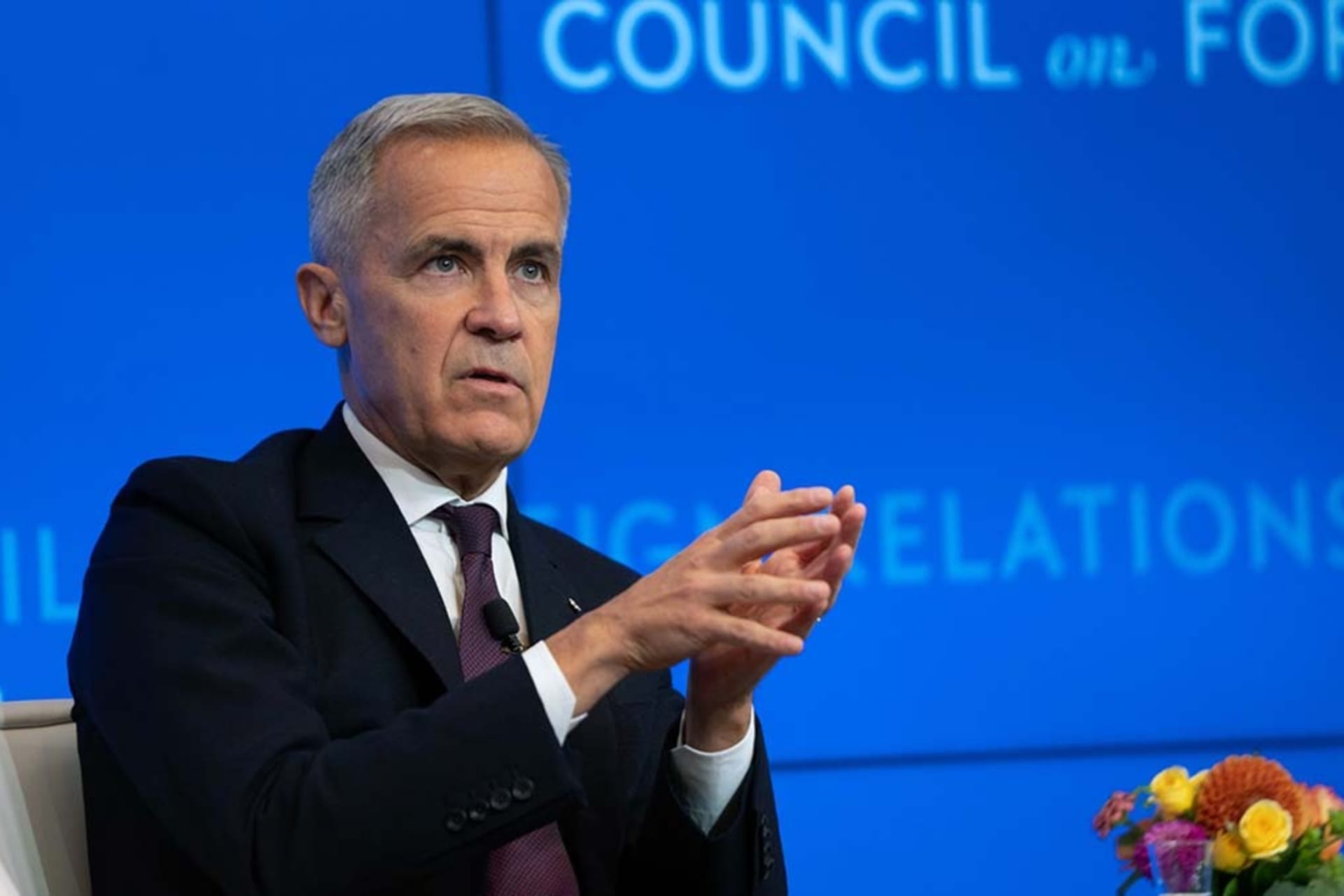
During the high-level week of the UN General Assembly, the Council on Foreign Relations welcomed world leaders and experts who called for bold reforms and fresh strategies to confront today’s economic, security, and geopolitical challenges—from overhauling international financial systems to combating domestic insurgent groups.
Below are highlights from these conversations, featuring heads of state, foreign ministers, and leading global policy experts.
Canada’s role in a fractured world
Reflecting on shifts in the international order at CFR on Monday, Canadian Prime Minister Mark Carney called the current moment “a rupture,” not a transition. He discussed how Canada, as a middle power, might be able to leverage its resources—critical minerals, artificial intelligence, and energy—as well as its values and trade and security partnerships to thrive in the new, evolving international order. “We’re no longer reliant on just the strength of our values, but the value of our strength,” Carney said, citing Canada’s involvement in Europe, Ukraine, and the Middle East, its defense commitments, and its expanded partnerships with major economies.
Watch the full conversation with Prime Minister Mark Carney.
South Africa seeks expanded trade relations
Trade with the United States “is mutually beneficial,” but U.S. President Donald Trump’s tariffs were “a wake-up call” that South Africa needs to diversify its trade with the rest of the world, said President Cyril Ramaphosa. It’s dangerous to retain trade relations with only a few countries, he added. In addition to lower U.S. tariffs, he called for extending the African Growth and Opportunity Act, which allows sub-Saharan African countries to export products to the United States duty-free. He also emphasized South Africa’s importance to international trade, noting that “a number of countries… see South Africa as an entry gate into the rest of the continent.”
Watch the full conversation with President Cyril Ramaphosa.
Human rights under siege
The international human rights system is under increasing strain, warned UN High Commissioner for Human Rights Volker Türk. Multiple conflicts and “blatant violations” of international humanitarian law are receiving little public attention. In recent years, growing polarization both within countries and across the global community has contributed to “a reductionist approach” to human rights. Despite declining funding and political will, Türk emphasized the UN human rights system’s preventative power and the need for innovation. “We cannot afford double standards or selectivity,” he said.
Watch the full conversation with High Commissioner Volker Türk.
Rebuilding Syria post-civil war
After nearly fourteen years of civil war, the government is working to “reinstate trust and confidence” in Syrian society, said Foreign Minister Asaad Hassan al-Shaibani. The most important priorities moving forward are “establishing peace and stability”—including stabilizing relations with Israel—and advancing economic development and rehabilitation efforts, he said. When it comes to the broader Middle East, Syria wants to become “an active member of the region,” Shaibani noted, adding that “a strong and unified Syria will be good for regional security.” The new government in Damascus is working to build positive relations with other countries in the region, as well as the European Union and the United States.
Watch the full conversation with Foreign Minister Asaad Hassan al-Shaibani.
Yemen’s expanding Houthi threat
Today, Yemen is facing a threat from the Iran-backed Houthis that also endangers the broader region and the world, warned President Rashad al-Alimi. The group currently controls part of the country, though Alimi is internationally recognized as Yemen’s leader. While the Trump administration’s redesignation of the Houthis as a terrorist group was “historic,” he said, it will be difficult to reach a peaceful solution “unless there are international and regional circumstances that can bring some pressure to bear.” Alimi called on the United States to provide Yemen with more economic support and added that Washington could lead an international alliance that aims to “eliminate the Houthi terrorist group.”
Watch the full conversation with President Rashad al-Alimi.
Somalia’s ongoing recovery efforts
After more than three decades of conflict—including against the Islamist insurgent group al-Shabaab—Somalia is advancing national efforts to restore stability and rebuild institutions, said President Hassan Sheikh Mohamud. Somalia’s “economy is recovering, our GDP is growing, [and] our revenue is expanding,” he asserted. Mohamud also emphasized the government’s determination to move forward, adding, “we are not allowing, by any means, Somalia to relapse into a violent process.”
Watch the full conversation with President Hassan Sheikh Mohamud.
Global energy security at a crossroads
Global energy security is facing mounting risks, warned Fatih Birol, executive director of the International Energy Agency. Europe, he noted, is in a “very difficult situation” due to a series of “historical” strategic mistakes, including overreliance on Russian gas. While a “huge amount of liquified natural gas” is expected to enter markets between 2026 and 2030, he stressed that markets alone are not enough to solve the energy crisis, urging international cooperation and diversification. Birol also predicted that “nuclear will have a much stronger share in the generation mix.”
Watch the full conversation with Executive Director Fatih Birol.
Ecuador’s call for global investment
Ecuador is “open for business,” declared Foreign Minister Gabriela Sommerfeld, describing the country as “a market where investments can thrive,” particularly in the energy sector. Given the increasingly complex global economic landscape—marked by geopolitical tensions and rapid technological changes—she stressed the importance of Ecuador’s integration into international and regional supply chains. She also highlighted Ecuador’s role as “a strong U.S. ally,” while stressing the need to “keep that market open” with China.
Watch the full conversation with Foreign Minister Gabriela Sommerfeld.
Namibia’s push for reform to elevate the Global South
Namibian President Netumbo Nandi-Ndaitwah urged reforms of the global financial system to “reflect the reality of today’s multipolar and interconnected world” and to support African value creation. “For too long, African natural resources have been leaving the continent,” she said, adding that “we are structuring the economy so that we become the producer and the processor”—a shift aimed at creating jobs to combat high youth unemployment. Nandi-Ndaitwah also called for global governance reforms to amplify voices from the Global South, noting that “small states have a big responsibility” to help shape the international order.
Watch the full conversation with President Netumbo Nandi-Ndaitwah.